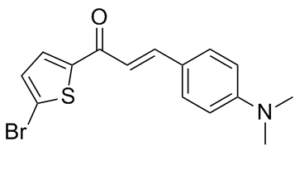
TB5 is a novel, potent, selective, reversible and competitive inhibitor of hMAO-B (human monoamine oxidase-B) with Ki value of 0.11±0.01 μM. TB5 is can be potentially used for the treatment of neurodegenerative disorders like PD and AD (Parkinson's and Alzheimer's diseases). In addition, TB5 was found to be nontoxic at 5 and 25 μm, with 95.75% and 84.59 % viability among cells, respectively.
Physicochemical Properties
| Molecular Formula | C15H14BRNOS | |
| Molecular Weight | 336.25 | |
| Exact Mass | 334.998 | |
| CAS # | 948841-07-4 | |
| Related CAS # |
|
|
| PubChem CID | 101571768 | |
| Appearance | White to yellow solid powder | |
| LogP | 4.9 | |
| Hydrogen Bond Donor Count | 0 | |
| Hydrogen Bond Acceptor Count | 3 | |
| Rotatable Bond Count | 4 | |
| Heavy Atom Count | 19 | |
| Complexity | 337 | |
| Defined Atom Stereocenter Count | 0 | |
| SMILES | CN(C)C1=CC=C(C=C1)/C=C/C(=O)C2=CC=C(S2)Br |
|
| InChi Key | PTLDLBSWTKNYCY-VMPITWQZSA-N | |
| InChi Code | InChI=1S/C15H14BrNOS/c1-17(2)12-6-3-11(4-7-12)5-8-13(18)14-9-10-15(16)19-14/h3-10H,1-2H3/b8-5+ | |
| Chemical Name |
|
|
| Synonyms |
|
|
| HS Tariff Code | 2934.99.9001 | |
| Storage |
Powder-20°C 3 years 4°C 2 years In solvent -80°C 6 months -20°C 1 month |
|
| Shipping Condition | Room temperature (This product is stable at ambient temperature for a few days during ordinary shipping and time spent in Customs) |
Biological Activity
| Targets |
Monoamine oxidase B (MAO-B): The half-maximal inhibitory concentration (IC₅₀) for human recombinant MAO-B was 0.012 μM, and the dissociation constant (Ki) was 0.008 μM (determined via Lineweaver-Burk plot analysis, indicating competitive inhibition). - Monoamine oxidase A (MAO-A): TB5 showed weak inhibitory activity against human recombinant MAO-A, with an IC₅₀ > 10 μM, demonstrating high selectivity for MAO-B over MAO-A (selectivity index > 833) [1] |
| ln Vitro |
hMAO-B and hMAO-A's catalytic sites interact with TB5 and TB8 through a competitive method of inhibition. With Ki and SI values of 0.11±0.01μM and 13.18, compound TB5 exhibits the highest selectivity and best inhibitory action toward hMAO-B. After 24 hours of dialysis, the inhibition of hMAO-A by compound TB8 and hMAO-B by compound TB5 is totally reversed. According to cytotoxicity experiments, TB5 has no hazardous effects at 5 and 25 μM, meaning that 95.75% and 84.59% of cells can survive, respectively. [1]. MAO-B inhibitory activity and selectivity: TB5 potently inhibited human recombinant MAO-B in a dose-dependent manner, with an IC₅₀ of 0.012 μM. In contrast, it had minimal effect on human recombinant MAO-A (IC₅₀ > 10 μM), resulting in a selectivity index (MAO-A IC₅₀/MAO-B IC₅₀) of over 833, indicating strong MAO-B-specific inhibition [1] - Reversibility of MAO-B inhibition: After incubating TB5 (0.1 μM, 10-fold higher than its Ki for MAO-B) with MAO-B for 30 minutes, the enzyme activity was recovered by ~90% following dialysis (3 times, 1 hour each, against buffer at 4°C). This confirmed that TB5 is a reversible MAO-B inhibitor, distinguishing it from irreversible MAO-B inhibitors (e.g., selegiline) [1] - Competitive inhibition mechanism: Lineweaver-Burk plot analysis revealed that TB5 inhibited MAO-B via a competitive mechanism. Increasing concentrations of TB5 (0.005, 0.01, 0.02 μM) increased the Michaelis constant (Km) for the MAO-B substrate (p-tyramine) without altering the maximum reaction velocity (Vmax), consistent with competitive binding to the enzyme's active site [1] |
| ln Vivo | The compounds are diluted with PBS/EtOH (70:30) after being dissolved in DMSO (5 mg/mL). We do kinetic analyses on TB5 and TB8. A series of Lineweaver–Burk plots was created with and without different amounts of the chemicals TC8 and TB5. Each of the five graphs in the collection was created by calculating the catalytic rates of MAO-B and MAO-A at various substrate concentrations (0.1–1 μM). While the remaining four graphs are created with varying amounts of TB5 and TB8, the first Lineweaver–Burk plot is created without an inhibitor[1]. |
| Enzyme Assay |
Human recombinant MAO-B/MAO-A inhibitory activity assay: The assay was performed in 96-well microplates using a fluorogenic substrate. The reaction mixture contained 50 mM phosphate buffer (pH 7.4), human recombinant MAO-B (or MAO-A), and different concentrations of TB5 (0.001-10 μM for MAO-B; 1-100 μM for MAO-A). The mixture was preincubated at 37°C for 15 minutes to allow enzyme-inhibitor binding. Then, the fluorogenic substrate (e.g., 100 μM p-tyramine for MAO-B, 100 μM 5-hydroxytryptamine for MAO-A) was added to initiate the reaction. After incubation at 37°C for 60 minutes, the reaction was terminated by adding 1 M HCl. The fluorescence intensity of the reaction product (4-hydroxybenzaldehyde for MAO-B) was measured using a microplate reader (excitation wavelength: 320 nm; emission wavelength: 400 nm). Enzyme activity was calculated as the percentage of activity relative to the vehicle control (without TB5), and IC₅₀ values were derived from dose-response curves [1] - Reversibility assay for MAO-B inhibition: MAO-B was incubated with TB5 (0.1 μM) in 50 mM phosphate buffer (pH 7.4) at 37°C for 30 minutes. A control group was incubated with vehicle alone. After incubation, the mixture was dialyzed against 50 mM phosphate buffer (pH 7.4) at 4°C for 1 hour, with buffer replacement three times. Following dialysis, MAO-B activity was measured using the fluorogenic substrate assay described above. The recovery of enzyme activity was calculated by comparing the activity of dialyzed TB5-treated MAO-B to the vehicle control [1] - Kinetic analysis of MAO-B inhibition (Lineweaver-Burk plot): MAO-B activity was measured in the presence of different concentrations of TB5 (0.005, 0.01, 0.02 μM) and various concentrations of the substrate p-tyramine (25, 50, 100, 200 μM). The reaction was conducted as per the fluorogenic assay, and the initial reaction rates were recorded. A Lineweaver-Burk plot was constructed by plotting 1/velocity (1/V) against 1/substrate concentration (1/[S]). The type of inhibition was determined based on changes in Km and Vmax: competitive inhibition was confirmed if Km increased and Vmax remained unchanged [1] |
| Animal Protocol |
5 mg/mL |
| References |
[1]. Synthesis, Biochemistry, and Computational Studies of Brominated Thienyl Chalcones: A New Class of Reversible MAO-B Inhibitors. ChemMedChem. 2016 Jun 6;11(11):1161-71. |
| Additional Infomation |
TB5 belongs to a new class of brominated thienyl chalcones, a group of compounds designed and synthesized for MAO-B inhibitory activity. Its high selectivity for MAO-B (selectivity index > 833) and reversible inhibition profile are clinically relevant, as reversible MAO-B inhibitors may have a lower risk of adverse effects (e.g., cheese reaction, a complication associated with irreversible MAO inhibitors) compared to irreversible counterparts [1] - MAO-B is an enzyme that catalyzes the breakdown of monoamine neurotransmitters (e.g., dopamine) in the brain. Inhibition of MAO-B increases brain dopamine levels, making MAO-B inhibitors potential therapeutic agents for neurodegenerative diseases such as Parkinson's disease. TB5, as a potent and selective reversible MAO-B inhibitor, represents a promising lead compound for further development in the treatment of such diseases [1] |
Solubility Data
| Solubility (In Vitro) |
|
|||
| Solubility (In Vivo) |
Note: Listed below are some common formulations that may be used to formulate products with low water solubility (e.g. < 1 mg/mL), you may test these formulations using a minute amount of products to avoid loss of samples. Injection Formulations (e.g. IP/IV/IM/SC) Injection Formulation 1: DMSO : Tween 80: Saline = 10 : 5 : 85 (i.e. 100 μL DMSO stock solution → 50 μL Tween 80 → 850 μL Saline) *Preparation of saline: Dissolve 0.9 g of sodium chloride in 100 mL ddH ₂ O to obtain a clear solution. Injection Formulation 2: DMSO : PEG300 :Tween 80 : Saline = 10 : 40 : 5 : 45 (i.e. 100 μL DMSO → 400 μLPEG300 → 50 μL Tween 80 → 450 μL Saline) Injection Formulation 3: DMSO : Corn oil = 10 : 90 (i.e. 100 μL DMSO → 900 μL Corn oil) Example: Take the Injection Formulation 3 (DMSO : Corn oil = 10 : 90) as an example, if 1 mL of 2.5 mg/mL working solution is to be prepared, you can take 100 μL 25 mg/mL DMSO stock solution and add to 900 μL corn oil, mix well to obtain a clear or suspension solution (2.5 mg/mL, ready for use in animals). Injection Formulation 4: DMSO : 20% SBE-β-CD in saline = 10 : 90 [i.e. 100 μL DMSO → 900 μL (20% SBE-β-CD in saline)] *Preparation of 20% SBE-β-CD in Saline (4°C,1 week): Dissolve 2 g SBE-β-CD in 10 mL saline to obtain a clear solution. Injection Formulation 5: 2-Hydroxypropyl-β-cyclodextrin : Saline = 50 : 50 (i.e. 500 μL 2-Hydroxypropyl-β-cyclodextrin → 500 μL Saline) Injection Formulation 6: DMSO : PEG300 : castor oil : Saline = 5 : 10 : 20 : 65 (i.e. 50 μL DMSO → 100 μLPEG300 → 200 μL castor oil → 650 μL Saline) Injection Formulation 7: Ethanol : Cremophor : Saline = 10: 10 : 80 (i.e. 100 μL Ethanol → 100 μL Cremophor → 800 μL Saline) Injection Formulation 8: Dissolve in Cremophor/Ethanol (50 : 50), then diluted by Saline Injection Formulation 9: EtOH : Corn oil = 10 : 90 (i.e. 100 μL EtOH → 900 μL Corn oil) Injection Formulation 10: EtOH : PEG300:Tween 80 : Saline = 10 : 40 : 5 : 45 (i.e. 100 μL EtOH → 400 μLPEG300 → 50 μL Tween 80 → 450 μL Saline) Oral Formulations Oral Formulation 1: Suspend in 0.5% CMC Na (carboxymethylcellulose sodium) Oral Formulation 2: Suspend in 0.5% Carboxymethyl cellulose Example: Take the Oral Formulation 1 (Suspend in 0.5% CMC Na) as an example, if 100 mL of 2.5 mg/mL working solution is to be prepared, you can first prepare 0.5% CMC Na solution by measuring 0.5 g CMC Na and dissolve it in 100 mL ddH2O to obtain a clear solution; then add 250 mg of the product to 100 mL 0.5% CMC Na solution, to make the suspension solution (2.5 mg/mL, ready for use in animals). Oral Formulation 3: Dissolved in PEG400 Oral Formulation 4: Suspend in 0.2% Carboxymethyl cellulose Oral Formulation 5: Dissolve in 0.25% Tween 80 and 0.5% Carboxymethyl cellulose Oral Formulation 6: Mixing with food powders Note: Please be aware that the above formulations are for reference only. InvivoChem strongly recommends customers to read literature methods/protocols carefully before determining which formulation you should use for in vivo studies, as different compounds have different solubility properties and have to be formulated differently. (Please use freshly prepared in vivo formulations for optimal results.) |
| Preparing Stock Solutions | 1 mg | 5 mg | 10 mg | |
| 1 mM | 2.9740 mL | 14.8699 mL | 29.7398 mL | |
| 5 mM | 0.5948 mL | 2.9740 mL | 5.9480 mL | |
| 10 mM | 0.2974 mL | 1.4870 mL | 2.9740 mL |