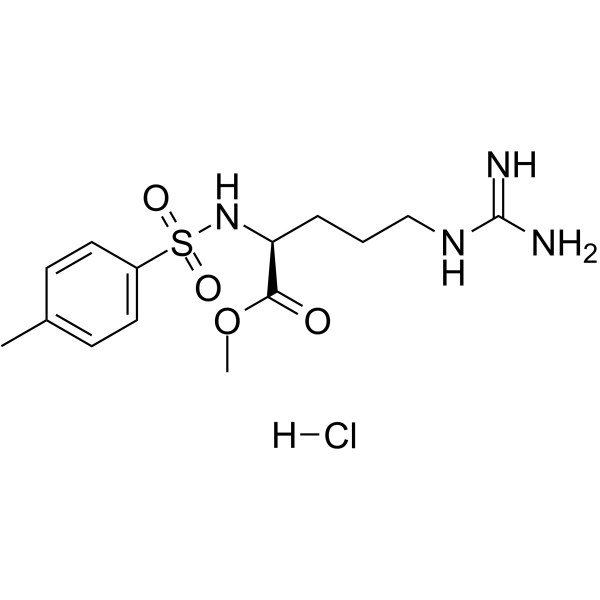
Physicochemical Properties
| Molecular Formula | C14H23CLN4O4S |
| Molecular Weight | 378.87 |
| Exact Mass | 378.112 |
| CAS # | 1784-03-8 |
| Related CAS # | TAME;901-47-3 |
| PubChem CID | 2723792 |
| Appearance | White to off-white solid powder |
| Boiling Point | 544.1ºC at 760mmHg |
| Melting Point | 145-147(lit.) |
| Flash Point | 282.9ºC |
| Vapour Pressure | 6.73E-12mmHg at 25°C |
| Index of Refraction | -14 ° (C=4, H2O) |
| LogP | 3.542 |
| Hydrogen Bond Donor Count | 4 |
| Hydrogen Bond Acceptor Count | 6 |
| Rotatable Bond Count | 9 |
| Heavy Atom Count | 24 |
| Complexity | 503 |
| Defined Atom Stereocenter Count | 1 |
| SMILES | CC1=CC=C(C=C1)S(=O)(=O)N[C@@H](CCCN=C(N)N)C(=O)OC.Cl |
| InChi Key | JIQFFACVQXXHMY-YDALLXLXSA-N |
| InChi Code | InChI=1S/C14H22N4O4S.ClH/c1-10-5-7-11(8-6-10)23(20,21)18-12(13(19)22-2)4-3-9-17-14(15)16;/h5-8,12,18H,3-4,9H2,1-2H3,(H4,15,16,17);1H/t12-;/m0./s1 |
| Chemical Name | methyl (2S)-5-(diaminomethylideneamino)-2-[(4-methylphenyl)sulfonylamino]pentanoate;hydrochloride |
| Synonyms | Ts-Arg-Me Hydrochloride; TAME Hydrochloride; TAME HCl |
| HS Tariff Code | 2934.99.9001 |
| Storage |
Powder-20°C 3 years 4°C 2 years In solvent -80°C 6 months -20°C 1 month Note: Please store this product in a sealed and protected environment, avoid exposure to moisture. |
| Shipping Condition | Room temperature (This product is stable at ambient temperature for a few days during ordinary shipping and time spent in Customs) |
Biological Activity
| ln Vitro | By encouraging Cdc20's autoubiquitination at its N-terminal region, TAME hydrochloride removes Cdc20 from APC in the absence of an APC substrate. Through encouraging the binding of free Cdc20 to APC and preventing Cdc20 autoubiquitination, cyclin B1 counteracts the effects of TAME hydrochloride [2]. Two strategies are employed by TAME hydrochloride to stabilize cyclin B1 in Xenopus extracts. First, it slows down the initial ubiquitination of unmodified cyclin B1 by reducing kcat of the APCCdc20/cyclin B1 complex without changing Km. Secondly, in the presence of TAME hydrochloride, cyclin B1 can no longer stimulate Cdc20 binding to APC due to its ubiquitination. As a result, cyclin B1 ubiquitination stops before it reaches the necessary threshold for proteolysis [2]. |
| References |
[1]. Pharmacologic inhibition of the anaphase-promoting complex induces a spindle checkpoint-dependent mitotic arrest in the absence of spindle damage. Cancer Cell. 2010 Oct 19;18(4):382-95. [2]. An APC/C inhibitor stabilizes cyclin B1 by prematurely terminating ubiquitination. Nat Chem Biol. 2012 Feb 26;8(4):383-92. |
Solubility Data
| Solubility (In Vitro) |
DMSO : ~155 mg/mL (~409.11 mM) H2O : ≥ 100 mg/mL (~263.94 mM) |
| Solubility (In Vivo) |
Solubility in Formulation 1: ≥ 2.58 mg/mL (6.81 mM) (saturation unknown) in 10% DMSO + 40% PEG300 + 5% Tween80 + 45% Saline (add these co-solvents sequentially from left to right, and one by one), clear solution. For example, if 1 mL of working solution is to be prepared, you can add 100 μL of 25.8 mg/mL clear DMSO stock solution to 400 μL PEG300 and mix evenly; then add 50 μL Tween-80 to the above solution and mix evenly; then add 450 μL normal saline to adjust the volume to 1 mL. Preparation of saline: Dissolve 0.9 g of sodium chloride in 100 mL ddH₂ O to obtain a clear solution. Solubility in Formulation 2: ≥ 2.58 mg/mL (6.81 mM) (saturation unknown) in 10% DMSO + 90% (20% SBE-β-CD in Saline) (add these co-solvents sequentially from left to right, and one by one), clear solution. For example, if 1 mL of working solution is to be prepared, you can add 100 μL of 25.8 mg/mL clear DMSO stock solution to 900 μL of 20% SBE-β-CD physiological saline solution and mix evenly. Preparation of 20% SBE-β-CD in Saline (4°C,1 week): Dissolve 2 g SBE-β-CD in 10 mL saline to obtain a clear solution. Solubility in Formulation 3: ≥ 2.58 mg/mL (6.81 mM) (saturation unknown) in 10% DMSO + 90% Corn Oil (add these co-solvents sequentially from left to right, and one by one), clear solution. For example, if 1 mL of working solution is to be prepared, you can add 100 μL of 25.8 mg/mL clear DMSO stock solution to 900 μL of corn oil and mix evenly. Solubility in Formulation 4: 100 mg/mL (263.94 mM) in PBS (add these co-solvents sequentially from left to right, and one by one), clear solution; with ultrasonication. (Please use freshly prepared in vivo formulations for optimal results.) |
| Preparing Stock Solutions | 1 mg | 5 mg | 10 mg | |
| 1 mM | 2.6394 mL | 13.1971 mL | 26.3943 mL | |
| 5 mM | 0.5279 mL | 2.6394 mL | 5.2789 mL | |
| 10 mM | 0.2639 mL | 1.3197 mL | 2.6394 mL |