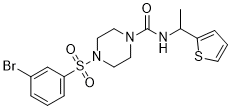
T6167923 (T-6167923) is a novel and potent inhibitor of MyD88-dependent signaling pathways with anti-inflammatory activity. It acts by binding to Toll/IL1 receptor (TIR) domain of MyD88 and disrupting the formation of MyD88 homodimer. T6167923 inhibits pro-inflammatory cytocines with IC50s of 2.7 μM, 2.9 μM, 2.66 μM and 2.66 μM for IFN-γ, IL-1β, IL-6 and TNF-α, respectively.
Physicochemical Properties
| Molecular Formula | C17N3O3S2BRH20 |
| Molecular Weight | 458.393 |
| Exact Mass | 457.012 |
| CAS # | 2437475-16-4 |
| Related CAS # | 2437475-16-4; 1090528-71-4 |
| PubChem CID | 25648555 |
| Appearance | White to off-white solid powder |
| Density | 1.530±0.06 g/cm3(Predicted) |
| LogP | 2.5 |
| Hydrogen Bond Donor Count | 1 |
| Hydrogen Bond Acceptor Count | 5 |
| Rotatable Bond Count | 4 |
| Heavy Atom Count | 26 |
| Complexity | 591 |
| Defined Atom Stereocenter Count | 1 |
| SMILES | C[C@@H](C1=CC=CS1)NC(=O)N2CCN(CC2)S(=O)(=O)C3=CC(=CC=C3)Br |
| InChi Key | PNTQVMBKHCOLQD-ZDUSSCGKSA-N |
| InChi Code | InChI=1S/C17H20BrN3O3S2/c1-13(16-6-3-11-25-16)19-17(22)20-7-9-21(10-8-20)26(23,24)15-5-2-4-14(18)12-15/h2-6,11-13H,7-10H2,1H3,(H,19,22)/t13-/m0/s1 |
| Chemical Name | 4-(3-bromophenyl)sulfonyl-N-[(1S)-1-thiophen-2-ylethyl]piperazine-1-carboxamide |
| HS Tariff Code | 2934.99.9001 |
| Storage |
Powder-20°C 3 years 4°C 2 years In solvent -80°C 6 months -20°C 1 month |
| Shipping Condition | Room temperature (This product is stable at ambient temperature for a few days during ordinary shipping and time spent in Customs) |
Biological Activity
| ln Vitro | In peripheral blood mononuclear cells, T6167923 (0-500 μM; 20 h) suppresses the pro-inflammatory cytokine response to staphylococcal enterotoxin B (SEB) [2]. In HEK 293T cells, T6167923 (10-500 μM; 2 hours) suppresses the production of secreted alkaline phosphatase (SEAP) [2]. T6167923 (100 μM; 16 hours) decreases the inhibitory effect on MyD88 signaling by binding to TIR proteins [2]. T6167923 (1-500 μM; 13 hours) prevents the production of full-length MyD88 homodimers [2]. |
| ln Vivo | When mice are treated with SEB and LPS, T6167923 (0.17 and 1 mg; once intraperitoneally) shields them from toxicity [2]. |
| Cell Assay |
Cell viability assay[2] Cell Types: Peripheral blood mononuclear cells Tested Concentrations: 0-500 μM Incubation Duration: 20 hrs (hours) Experimental Results: SEB response to TNF-α, INF-γ, IL-6 and IL was dose-dependently attenuated - The IC50 of 1β in peripheral blood mononuclear cells were 2.66, 2.7, 2.66 and 2.9 μM, respectively. Cell viability assay [2] Cell Types: HEK 293T cell line Tested Concentrations: 10-500 μM Incubation Duration: 2 hrs (hours) Experimental Results: Dose-dependent inhibition of lipopolysaccharide (LPS)-induced MyD88-mediated NF-kB-driven SEAP in HEK 293T cells Expression IC50 range is 40–50 μM. Cell viability assay [2] Cell Types: HEK 293T cell line Tested Concentrations: 100 μM Incubation Duration: 16 hrs (hours) Experimental Results: TIR protein specifically targets MyD88 and reduces the inhibitory effect of MyD88 signaling in a dose-dependent manner. Western Blot Analysis[2] Cell Types: MyD88 knockout HEK 293-I3A Cell Tested Concentrations: 1-500 μM Incubation Duration: 13 hrs (hours) Experimental Results: Dose-dependent inhibition of TIR domain-mediated inhibition of full-length |
| Animal Protocol |
Animal/Disease Models: 16-20 weeks old BALB/c mouse LPS enhanced model [2] Doses: 0.17 and 1 mg Route of Administration: intraperitoneal (ip) injection; 0.17 and 1 mg once Experimental Results: The therapeutic effect on SEB poisoning is dose-dependent. |
| References |
[1]. Identifying the inhibition of TIR proteins involved in TLR signalling as an anti-inflammatory strategy. SAR QSAR Environ Res. 2018 Apr;29(4):295-318. [2]. Discovery of small molecule inhibitors of MyD88-dependent signaling pathways using a computational screen. Sci Rep. 2015 Sep 18;5:14246. |
Solubility Data
| Solubility (In Vitro) |
DMSO : ~250 mg/mL (~545.39 mM) H2O : < 0.1 mg/mL |
| Solubility (In Vivo) |
Solubility in Formulation 1: ≥ 2.08 mg/mL (4.54 mM) (saturation unknown) in 10% DMSO + 40% PEG300 + 5% Tween80 + 45% Saline (add these co-solvents sequentially from left to right, and one by one), clear solution. For example, if 1 mL of working solution is to be prepared, you can add 100 μL of 20.8 mg/mL clear DMSO stock solution to 400 μL PEG300 and mix evenly; then add 50 μL Tween-80 to the above solution and mix evenly; then add 450 μL normal saline to adjust the volume to 1 mL. Preparation of saline: Dissolve 0.9 g of sodium chloride in 100 mL ddH₂ O to obtain a clear solution. Solubility in Formulation 2: ≥ 2.08 mg/mL (4.54 mM) (saturation unknown) in 10% DMSO + 90% (20% SBE-β-CD in Saline) (add these co-solvents sequentially from left to right, and one by one), clear solution. For example, if 1 mL of working solution is to be prepared, you can add 100 μL of 20.8 mg/mL clear DMSO stock solution to 900 μL of 20% SBE-β-CD physiological saline solution and mix evenly. Preparation of 20% SBE-β-CD in Saline (4°C,1 week): Dissolve 2 g SBE-β-CD in 10 mL saline to obtain a clear solution. Solubility in Formulation 3: ≥ 2.08 mg/mL (4.54 mM) (saturation unknown) in 10% DMSO + 90% Corn Oil (add these co-solvents sequentially from left to right, and one by one), clear solution. For example, if 1 mL of working solution is to be prepared, you can add 100 μL of 20.8 mg/mL clear DMSO stock solution to 900 μL of corn oil and mix evenly. (Please use freshly prepared in vivo formulations for optimal results.) |
| Preparing Stock Solutions | 1 mg | 5 mg | 10 mg | |
| 1 mM | 2.1815 mL | 10.9077 mL | 21.8155 mL | |
| 5 mM | 0.4363 mL | 2.1815 mL | 4.3631 mL | |
| 10 mM | 0.2182 mL | 1.0908 mL | 2.1815 mL |