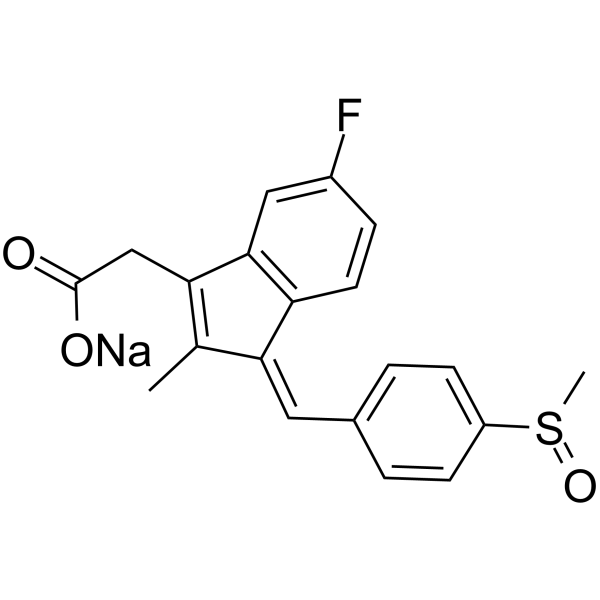
Physicochemical Properties
| Molecular Formula | C20H17O3FS.NA |
| Molecular Weight | 379.40038 |
| Exact Mass | 378.07 |
| CAS # | 63804-15-9 |
| Related CAS # | Sulindac;38194-50-2 |
| PubChem CID | 23665561 |
| Appearance | Typically exists as solid at room temperature |
| LogP | 3.896 |
| Hydrogen Bond Donor Count | 0 |
| Hydrogen Bond Acceptor Count | 5 |
| Rotatable Bond Count | 4 |
| Heavy Atom Count | 26 |
| Complexity | 623 |
| Defined Atom Stereocenter Count | 0 |
| SMILES | [NaH].OC(CC1=C(C)/C(=C\C2C=CC(S(=O)C)=CC=2)/C2C=CC(=CC1=2)F)=O |
| InChi Key | YMXUJDLCLXHYBO-WPTDRQDKSA-M |
| InChi Code | InChI=1S/C20H17FO3S.Na/c1-12-17(9-13-3-6-15(7-4-13)25(2)24)16-8-5-14(21)10-19(16)18(12)11-20(22)23;/h3-10H,11H2,1-2H3,(H,22,23);/q;+1/p-1/b17-9-; |
| Chemical Name | sodium;2-[(3Z)-6-fluoro-2-methyl-3-[(4-methylsulfinylphenyl)methylidene]inden-1-yl]acetate |
| HS Tariff Code | 2934.99.9001 |
| Storage |
Powder-20°C 3 years 4°C 2 years In solvent -80°C 6 months -20°C 1 month |
| Shipping Condition | Room temperature (This product is stable at ambient temperature for a few days during ordinary shipping and time spent in Customs) |
Biological Activity
| ln Vitro | The efficient prevention of TGF-β1-induced EMT is demonstrated by the downregulation of mesenchymal markers and transcription factors and the overexpression of the epithelial marker E-cadherin when sulindac (MK-231) (500 μM, 48 h) sodium is administered [1]. A549 cells' increased migration and invasion caused by TGF-β1 can be inhibited by sulindac sodium (500 μM, 48 h) [1]. TGF-β1-induced EMT can be reversed more effectively by sulindac (sodium) at 500 μM for 48 hours, and SIRT1 overexpression encourages TGF-β1-induced EMT[1]. |
| ln Vivo | Sulindac (MK-231) Sodium (15 mg/kg PO twice daily; 7.5 mg/kg PO twice daily; sulindac in combination with PD-L1)) demonstrated a significant decrease in tumor volume and an increase in CD8+ T lymphocyte infiltration in tumor tissue when used in conjunction with other treatments [2]. Sulindac sodium has the ability to downregulate PD-L1, which lowers exosome P (15 mg/kg, po, bid for sulindac alone; 7.5 mg/kg po, bid for sulindac plus PD-L1) [2]. Sulindac sodium downregulates PD-L1 in combination therapy, increasing Parkinson's disease (PD) by 7.5 mg/kg po, bid (sulindac in combination with PD-L1) and 15 mg/kg po, bid (sulindac alone) [2]. Prostaglandin E2 (PGE2) is not systemically inhibited by low-dose sulindac sodium [2]. |
| Cell Assay |
Western Blot analysis [1] Cell Types: A549 cells Tested Concentrations: 500 μM Incubation Duration: 48 h Experimental Results: Inhibition of epithelial-mesenchymal transition of A549 cells induced by transforming growth factor (TGF)-β1. Immunofluorescence[1] Cell Types: A549 Cell Tested Concentrations: 500 μM Incubation Duration: 48 h Experimental Results: TGF-β1 reverses SIRT-1 expression and inhibits TGF-β1-induced cadherin switch. Cell migration assay [1] Cell Types: A549 Cell Tested Concentrations: 500 μM Incubation Duration: 48 h Experimental Results: Inhibition of migration, co-treatment with TGF-β1 reduces drug resistance. Cell invasion experiment [1] Cell Types: A549 Cell Tested Concentrations: 500 μM Incubation Duration: 40 h; 48 hrs (hours) Experimental Results: It can effectively inhibit the increase in lung cancer cell invasion induced by TGF-β1. |
| Animal Protocol |
Animal/Disease Models: CT26 syngeneic mouse tumor model [2] Doses: 15 mg/kg; 7.5 mg/kg Route of Administration: 15 mg/kg, po, bid (sulindac alone); 7.5 mg/kg po, bid ( Sulindac in combination with PD-L1) Experimental Results: Downregulates PD-L1 by blocking NF-κB signaling and modulates the response of pMMR CRC to anti-PD-L1 immunotherapy. Animal/Disease Models: CT26 syngeneic mouse tumor model [2] Doses: 15 mg/kg; 7.5 mg/kg Route of Administration: 15 mg/kg, po, bid (sulindac alone); 7.5 mg/kg po, bid ( Sulindac in combination with PD-L1) Experimental Results: Downregulates PD-L1 by blocking NF-κB signaling and modulates the response of pMMR CRC to anti-PD-L1 immunotherapy. Cound can effectively inhibit PD-L1 without obvious systemic toxicity. |
| References |
[1]. Celecoxib and sulindac inhibit TGF-β1-induced epithelial-mesenchymal transition and suppress lung cancer migration and invasion via downregulation of sirtuin 1. Oncotarget. 2016 Aug 30;7(35):57213-57227. [2]. Sulindac Modulates the Response of Proficient MMR Colorectal Cancer to Anti-PD-L1 Immunotherapy. Mol Cancer Ther. 2021 Jul;20(7):1295-1304. |
Solubility Data
| Solubility (In Vitro) | May dissolve in DMSO (in most cases), if not, try other solvents such as H2O, Ethanol, or DMF with a minute amount of products to avoid loss of samples |
| Solubility (In Vivo) |
Note: Listed below are some common formulations that may be used to formulate products with low water solubility (e.g. < 1 mg/mL), you may test these formulations using a minute amount of products to avoid loss of samples. Injection Formulations (e.g. IP/IV/IM/SC) Injection Formulation 1: DMSO : Tween 80: Saline = 10 : 5 : 85 (i.e. 100 μL DMSO stock solution → 50 μL Tween 80 → 850 μL Saline) *Preparation of saline: Dissolve 0.9 g of sodium chloride in 100 mL ddH ₂ O to obtain a clear solution. Injection Formulation 2: DMSO : PEG300 :Tween 80 : Saline = 10 : 40 : 5 : 45 (i.e. 100 μL DMSO → 400 μLPEG300 → 50 μL Tween 80 → 450 μL Saline) Injection Formulation 3: DMSO : Corn oil = 10 : 90 (i.e. 100 μL DMSO → 900 μL Corn oil) Example: Take the Injection Formulation 3 (DMSO : Corn oil = 10 : 90) as an example, if 1 mL of 2.5 mg/mL working solution is to be prepared, you can take 100 μL 25 mg/mL DMSO stock solution and add to 900 μL corn oil, mix well to obtain a clear or suspension solution (2.5 mg/mL, ready for use in animals). Injection Formulation 4: DMSO : 20% SBE-β-CD in saline = 10 : 90 [i.e. 100 μL DMSO → 900 μL (20% SBE-β-CD in saline)] *Preparation of 20% SBE-β-CD in Saline (4°C,1 week): Dissolve 2 g SBE-β-CD in 10 mL saline to obtain a clear solution. Injection Formulation 5: 2-Hydroxypropyl-β-cyclodextrin : Saline = 50 : 50 (i.e. 500 μL 2-Hydroxypropyl-β-cyclodextrin → 500 μL Saline) Injection Formulation 6: DMSO : PEG300 : castor oil : Saline = 5 : 10 : 20 : 65 (i.e. 50 μL DMSO → 100 μLPEG300 → 200 μL castor oil → 650 μL Saline) Injection Formulation 7: Ethanol : Cremophor : Saline = 10: 10 : 80 (i.e. 100 μL Ethanol → 100 μL Cremophor → 800 μL Saline) Injection Formulation 8: Dissolve in Cremophor/Ethanol (50 : 50), then diluted by Saline Injection Formulation 9: EtOH : Corn oil = 10 : 90 (i.e. 100 μL EtOH → 900 μL Corn oil) Injection Formulation 10: EtOH : PEG300:Tween 80 : Saline = 10 : 40 : 5 : 45 (i.e. 100 μL EtOH → 400 μLPEG300 → 50 μL Tween 80 → 450 μL Saline) Oral Formulations Oral Formulation 1: Suspend in 0.5% CMC Na (carboxymethylcellulose sodium) Oral Formulation 2: Suspend in 0.5% Carboxymethyl cellulose Example: Take the Oral Formulation 1 (Suspend in 0.5% CMC Na) as an example, if 100 mL of 2.5 mg/mL working solution is to be prepared, you can first prepare 0.5% CMC Na solution by measuring 0.5 g CMC Na and dissolve it in 100 mL ddH2O to obtain a clear solution; then add 250 mg of the product to 100 mL 0.5% CMC Na solution, to make the suspension solution (2.5 mg/mL, ready for use in animals). Oral Formulation 3: Dissolved in PEG400 Oral Formulation 4: Suspend in 0.2% Carboxymethyl cellulose Oral Formulation 5: Dissolve in 0.25% Tween 80 and 0.5% Carboxymethyl cellulose Oral Formulation 6: Mixing with food powders Note: Please be aware that the above formulations are for reference only. InvivoChem strongly recommends customers to read literature methods/protocols carefully before determining which formulation you should use for in vivo studies, as different compounds have different solubility properties and have to be formulated differently. (Please use freshly prepared in vivo formulations for optimal results.) |
| Preparing Stock Solutions | 1 mg | 5 mg | 10 mg | |
| 1 mM | 2.6357 mL | 13.1787 mL | 26.3574 mL | |
| 5 mM | 0.5271 mL | 2.6357 mL | 5.2715 mL | |
| 10 mM | 0.2636 mL | 1.3179 mL | 2.6357 mL |