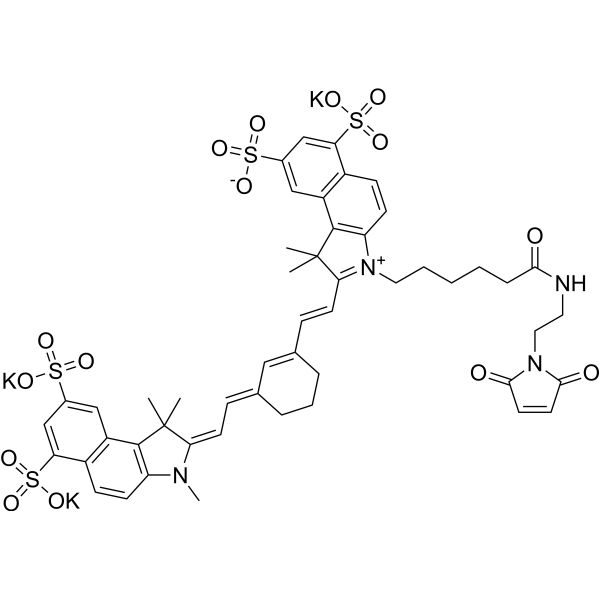
Physicochemical Properties
| Molecular Formula | C51H51K3N4O15S4 |
| Molecular Weight | 1205.52 |
| Appearance | Blue to dark blue solid powder |
| HS Tariff Code | 2934.99.9001 |
| Storage |
Powder-20°C 3 years 4°C 2 years In solvent -80°C 6 months -20°C 1 month Note: Please store this product in a sealed and protected environment (e.g. under nitrogen), avoid exposure to moisture and light. |
| Shipping Condition | Room temperature (This product is stable at ambient temperature for a few days during ordinary shipping and time spent in Customs) |
Biological Activity
| ln Vitro | Preparation of stock solutions 1. Preparing proteins Please get ready the protein (antibody) concentration to 2 mg/mL for the optimal labeling effect. 1) The protein solution's pH should be 8.5±0.5. Using 1 M sodium bicarbonate, correct the pH if it is less than 8.0. 2) The labeling efficiency will be significantly decreased if the protein content is less than 2 mg/mL. It is advised that the final protein concentration range be between 2 and 10 mg/mL in order to achieve optimal labeling efficiency. 3) To ensure optimal labeling efficacy, the protein needs to be in a buffer free of ammonium ions and primary amines, like Tris or glycine. 2. Making Dye Use anhydrous DMSO to dilute the CY dye and create a 10 mM stock solution. Using a glass tube or a vortex, thoroughly mix. Note: It is advised to aliquot the CY storage solution and keep it in the dark at -20 or -80 degrees Celsius. 3. Determine how much dye working solution is needed. The amount of protein to be labeled determines how much CY dye is needed for the labeling procedure. About 10 is the ideal molar ratio of CY dye to protein. Example: If the needed labeled protein is 500 μL 2 mg/mL IgG (MW=150,000), then the required CY volume is 3.95 μL. To dissolve a tube of 1 mg CY dye, use 100 μL DMSO. The following is the comprehensive calculating procedure (using CY3-NHS ester as an example): 1) mmol (IgG) = mg/mL (IgG) ×mL (IgG) / MW (IgG) = 2 mg/mL×0.5 mL / 150,000 mg/mmol = 6.7×10⁻⁶ mmol 2) mmol (CY3-NHS ester) = mmol (IgG) ×10 =6.7×10⁻⁶ mmol×10 = 6.7×10⁻⁵ mmol 3) μL (methyl-formaldehyde) = mmol (formaldehyde) × MW (formaldehyde) / mg/μL (formaldehyde) = 6.7×10⁻⁵ mmol× 590.15 mg/mmol / 0.01 mg/μL = 3.95 μL (formaldehyde) Method of usage 1. Labeling response 1 ) Gently shake 0.5 mL of the protein sample solution to combine, then slowly add a determined volume of freshly made 10 mg/mL CY dye. Centrifuge for a brief period of time to gather the sample at the bottom of the reaction tube. To keep protein samples from becoming denaturated and inactivated, do not mix them vigorously. 2) After giving the reaction vial a gentle shake and placing it in a dark area, let it sit at room temperature for 60 minutes. To improve labeling efficiency, gently invert the reaction vial several times every 10-15 minutes to completely mix the two reactants. 2. Desalting and purifying proteins An example of a SepHadex G-25 column purification process for dye-protein conjugates is provided below. 1) As directed by the manufacturer, set up the SepHadex G-25 column. 2) Fill the SepHadex G-25 column to the brim with the reaction mixture. 3) Add PBS (pH 7.2–7.4) as soon as the sample dips below the upper resin surface. Remix the necessary sample with extra PBS (pH 7.2–7.4) to finish column purification. Put the parts together that contain the chosen dye-protein combination. |
| References |
[1]. Near infrared fluorescent sensors for selective glucose recognition. 2021. [2]. Ptaszek M. Rational design of fluorophores for in vivo applications. Prog Mol Biol Transl Sci. 2013;113:59-108. [3]. Shindy, H. A. (2017). Fundamentals in the chemistry of cyanine dyes: A review. Dyes and Pigments, 145, 505–513. doi:10.1016/j.dyepig.2017.06.029. |
Solubility Data
| Solubility (In Vitro) | May dissolve in DMSO (in most cases), if not, try other solvents such as H2O, Ethanol, or DMF with a minute amount of products to avoid loss of samples |
| Solubility (In Vivo) |
Note: Listed below are some common formulations that may be used to formulate products with low water solubility (e.g. < 1 mg/mL), you may test these formulations using a minute amount of products to avoid loss of samples. Injection Formulations (e.g. IP/IV/IM/SC) Injection Formulation 1: DMSO : Tween 80: Saline = 10 : 5 : 85 (i.e. 100 μL DMSO stock solution → 50 μL Tween 80 → 850 μL Saline) *Preparation of saline: Dissolve 0.9 g of sodium chloride in 100 mL ddH ₂ O to obtain a clear solution. Injection Formulation 2: DMSO : PEG300 :Tween 80 : Saline = 10 : 40 : 5 : 45 (i.e. 100 μL DMSO → 400 μLPEG300 → 50 μL Tween 80 → 450 μL Saline) Injection Formulation 3: DMSO : Corn oil = 10 : 90 (i.e. 100 μL DMSO → 900 μL Corn oil) Example: Take the Injection Formulation 3 (DMSO : Corn oil = 10 : 90) as an example, if 1 mL of 2.5 mg/mL working solution is to be prepared, you can take 100 μL 25 mg/mL DMSO stock solution and add to 900 μL corn oil, mix well to obtain a clear or suspension solution (2.5 mg/mL, ready for use in animals). Injection Formulation 4: DMSO : 20% SBE-β-CD in saline = 10 : 90 [i.e. 100 μL DMSO → 900 μL (20% SBE-β-CD in saline)] *Preparation of 20% SBE-β-CD in Saline (4°C,1 week): Dissolve 2 g SBE-β-CD in 10 mL saline to obtain a clear solution. Injection Formulation 5: 2-Hydroxypropyl-β-cyclodextrin : Saline = 50 : 50 (i.e. 500 μL 2-Hydroxypropyl-β-cyclodextrin → 500 μL Saline) Injection Formulation 6: DMSO : PEG300 : castor oil : Saline = 5 : 10 : 20 : 65 (i.e. 50 μL DMSO → 100 μLPEG300 → 200 μL castor oil → 650 μL Saline) Injection Formulation 7: Ethanol : Cremophor : Saline = 10: 10 : 80 (i.e. 100 μL Ethanol → 100 μL Cremophor → 800 μL Saline) Injection Formulation 8: Dissolve in Cremophor/Ethanol (50 : 50), then diluted by Saline Injection Formulation 9: EtOH : Corn oil = 10 : 90 (i.e. 100 μL EtOH → 900 μL Corn oil) Injection Formulation 10: EtOH : PEG300:Tween 80 : Saline = 10 : 40 : 5 : 45 (i.e. 100 μL EtOH → 400 μLPEG300 → 50 μL Tween 80 → 450 μL Saline) Oral Formulations Oral Formulation 1: Suspend in 0.5% CMC Na (carboxymethylcellulose sodium) Oral Formulation 2: Suspend in 0.5% Carboxymethyl cellulose Example: Take the Oral Formulation 1 (Suspend in 0.5% CMC Na) as an example, if 100 mL of 2.5 mg/mL working solution is to be prepared, you can first prepare 0.5% CMC Na solution by measuring 0.5 g CMC Na and dissolve it in 100 mL ddH2O to obtain a clear solution; then add 250 mg of the product to 100 mL 0.5% CMC Na solution, to make the suspension solution (2.5 mg/mL, ready for use in animals). Oral Formulation 3: Dissolved in PEG400 Oral Formulation 4: Suspend in 0.2% Carboxymethyl cellulose Oral Formulation 5: Dissolve in 0.25% Tween 80 and 0.5% Carboxymethyl cellulose Oral Formulation 6: Mixing with food powders Note: Please be aware that the above formulations are for reference only. InvivoChem strongly recommends customers to read literature methods/protocols carefully before determining which formulation you should use for in vivo studies, as different compounds have different solubility properties and have to be formulated differently. (Please use freshly prepared in vivo formulations for optimal results.) |
| Preparing Stock Solutions | 1 mg | 5 mg | 10 mg | |
| 1 mM | 0.8295 mL | 4.1476 mL | 8.2952 mL | |
| 5 mM | 0.1659 mL | 0.8295 mL | 1.6590 mL | |
| 10 mM | 0.0830 mL | 0.4148 mL | 0.8295 mL |