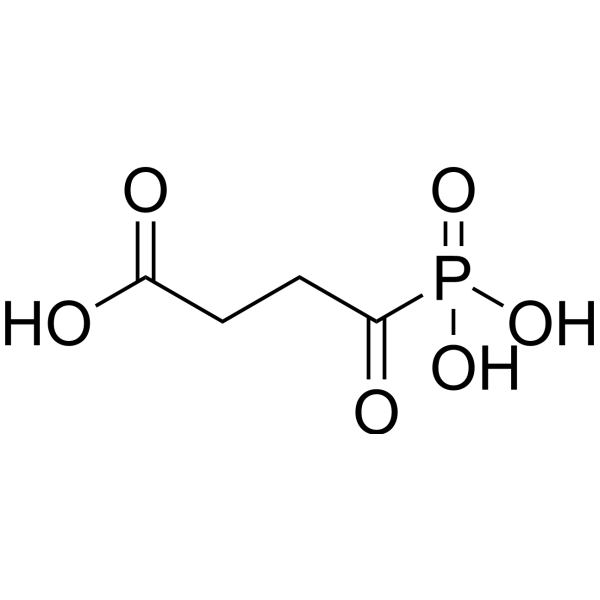
Physicochemical Properties
| Molecular Formula | C4H7O6P |
| Molecular Weight | 182.0685 |
| Exact Mass | 181.998 |
| CAS # | 26647-82-5 |
| Related CAS # | Succinyl phosphonate trisodium salt;864167-45-3 |
| PubChem CID | 46209593 |
| Appearance | Colorless to light yellow ointment |
| LogP | -2.4 |
| Hydrogen Bond Donor Count | 3 |
| Hydrogen Bond Acceptor Count | 6 |
| Rotatable Bond Count | 4 |
| Heavy Atom Count | 11 |
| Complexity | 215 |
| Defined Atom Stereocenter Count | 0 |
| SMILES | P(C(C([H])([H])C([H])([H])C(=O)O[H])=O)(=O)(O[H])O[H] |
| InChi Key | XUHDEWZJMFKPOD-UHFFFAOYSA-N |
| InChi Code | InChI=1S/C4H7O6P/c5-3(6)1-2-4(7)11(8,9)10/h1-2H2,(H,5,6)(H2,8,9,10) |
| Chemical Name | 4-oxo-4-phosphonobutanoic acid |
| HS Tariff Code | 2934.99.9001 |
| Storage |
Powder-20°C 3 years 4°C 2 years In solvent -80°C 6 months -20°C 1 month |
| Shipping Condition | Room temperature (This product is stable at ambient temperature for a few days during ordinary shipping and time spent in Customs) |
Biological Activity
| Targets |
- α-Ketoglutarate dehydrogenase complex (α-KGDHC) (E. coli: Ki = 1.2 ± 0.1 μM; pigeon breast muscle: Ki = 0.8 ± 0.08 μM; rat brain: Ki = 0.9 ± 0.09 μM) [1][2][4] |
| ln Vitro |
- Succinyl phosphonate is a potent and specific inhibitor of α-KGDHC, acting as a phosphonate analogue of α-ketoglutarate. It competitively inhibited α-KGDHC from E. coli with a Ki of 1.2 ± 0.1 μM, suppressing the oxidative decarboxylation of α-ketoglutarate by 85±4% at 10 μM [1] - It inhibited α-KGDHC from pigeon breast muscle with a Ki of 0.8 ± 0.08 μM, reducing enzyme activity by 78±3% at 5 μM [1] - It effectively inhibited α-KGDHC isolated from rat brain and cultured cells (e.g., cortical neurons) with a Ki of 0.9 ± 0.09 μM, decreasing enzyme activity in a dose-dependent manner (IC50 = 1.5 ± 0.12 μM for cultured cortical neurons) [2][4] |
| Enzyme Assay |
- E. coli α-KGDHC inhibition assay: α-KGDHC was purified from E. coli cultures. The reaction mixture contained the enzyme, α-ketoglutarate (substrate), coenzymes (NAD⁺, CoA), and Succinyl phosphonate (0.1–20 μM) in buffer. The reaction was initiated by adding substrate, and the rate of NADH formation (reflecting enzyme activity) was monitored by measuring absorbance at 340 nm for 10 minutes [1] - Pigeon breast muscle α-KGDHC inhibition assay: Pigeon breast muscle tissue was homogenized and centrifuged to obtain crude enzyme extract. The assay system included the enzyme extract, substrate, coenzymes, and Succinyl phosphonate (0.05–10 μM). Enzyme activity was determined by detecting the decrease in NAD⁺ absorbance at 340 nm [1] - Rat brain α-KGDHC inhibition assay: Rat brain tissue was homogenized and fractionated to isolate α-KGDHC. The enzyme was incubated with Succinyl phosphonate (0.05–15 μM) in the presence of substrate and coenzymes. NADH production was measured spectrophotometrically to calculate inhibition efficiency and Ki value [2][4] |
| Cell Assay |
- Cultured cortical neuron α-KGDHC inhibition assay: Primary cortical neurons were cultured in medium for 7–10 days. Succinyl phosphonate (0.5–20 μM) was added to the culture medium, and cells were incubated for 4 hours. Cells were lysed, and the supernatant was used for α-KGDHC activity assay by detecting NADH formation at 340 nm. The IC50 value was calculated based on dose-response curves [2][4] |
| References |
[1]. Succinyl phosphonate inhibits alpha-ketoglutarate oxidative decarboxylation, catalyzed by alpha-ketoglutarate dehydrogenase complexes from E. coli and pigeon breast muscle. FEBS Lett. 1996 Mar 11;382(1-2):167-70. [2]. Phosphonate analogues of alpha-ketoglutarate inhibit the activity of the alpha-ketoglutaratedehydrogenase complex isolated from brain and in cultured cells. Biochemistry. 2005 Aug 9;44(31):10552-61. [3]. alpha-Ketoglutarate dehydrogenase contributes to production of reactive oxygen species in glutamate-stimulated hippocampal neurons in situ. Neuroscience. 2009 Jan 23;158(2):610-6. [4]. Phosphonate analogues of alpha-ketoglutarate inhibit the activity of the alpha-ketoglutarate dehydrogenase complex isolated from brain and in cultured cells. Biochemistry. 2005 Aug 9;44(31):10552-61. |
| Additional Infomation |
- Succinyl phosphonate is a phosphonate analogue of α-ketoglutarate, designed as a specific inhibitor of α-KGDHC [1][2][4] - Its inhibitory mechanism is competitive binding to the active site of α-KGDHC, blocking the oxidative decarboxylation of α-ketoglutarate, a key step in the tricarboxylic acid (TCA) cycle [1][2] - It is widely used as a research tool to investigate the biological functions of α-KGDHC, including its role in energy metabolism and reactive oxygen species (ROS) production [1][3][4] |
Solubility Data
| Solubility (In Vitro) | May dissolve in DMSO (in most cases), if not, try other solvents such as H2O, Ethanol, or DMF with a minute amount of products to avoid loss of samples |
| Solubility (In Vivo) |
Note: Listed below are some common formulations that may be used to formulate products with low water solubility (e.g. < 1 mg/mL), you may test these formulations using a minute amount of products to avoid loss of samples. Injection Formulations (e.g. IP/IV/IM/SC) Injection Formulation 1: DMSO : Tween 80: Saline = 10 : 5 : 85 (i.e. 100 μL DMSO stock solution → 50 μL Tween 80 → 850 μL Saline) *Preparation of saline: Dissolve 0.9 g of sodium chloride in 100 mL ddH ₂ O to obtain a clear solution. Injection Formulation 2: DMSO : PEG300 :Tween 80 : Saline = 10 : 40 : 5 : 45 (i.e. 100 μL DMSO → 400 μLPEG300 → 50 μL Tween 80 → 450 μL Saline) Injection Formulation 3: DMSO : Corn oil = 10 : 90 (i.e. 100 μL DMSO → 900 μL Corn oil) Example: Take the Injection Formulation 3 (DMSO : Corn oil = 10 : 90) as an example, if 1 mL of 2.5 mg/mL working solution is to be prepared, you can take 100 μL 25 mg/mL DMSO stock solution and add to 900 μL corn oil, mix well to obtain a clear or suspension solution (2.5 mg/mL, ready for use in animals). Injection Formulation 4: DMSO : 20% SBE-β-CD in saline = 10 : 90 [i.e. 100 μL DMSO → 900 μL (20% SBE-β-CD in saline)] *Preparation of 20% SBE-β-CD in Saline (4°C,1 week): Dissolve 2 g SBE-β-CD in 10 mL saline to obtain a clear solution. Injection Formulation 5: 2-Hydroxypropyl-β-cyclodextrin : Saline = 50 : 50 (i.e. 500 μL 2-Hydroxypropyl-β-cyclodextrin → 500 μL Saline) Injection Formulation 6: DMSO : PEG300 : castor oil : Saline = 5 : 10 : 20 : 65 (i.e. 50 μL DMSO → 100 μLPEG300 → 200 μL castor oil → 650 μL Saline) Injection Formulation 7: Ethanol : Cremophor : Saline = 10: 10 : 80 (i.e. 100 μL Ethanol → 100 μL Cremophor → 800 μL Saline) Injection Formulation 8: Dissolve in Cremophor/Ethanol (50 : 50), then diluted by Saline Injection Formulation 9: EtOH : Corn oil = 10 : 90 (i.e. 100 μL EtOH → 900 μL Corn oil) Injection Formulation 10: EtOH : PEG300:Tween 80 : Saline = 10 : 40 : 5 : 45 (i.e. 100 μL EtOH → 400 μLPEG300 → 50 μL Tween 80 → 450 μL Saline) Oral Formulations Oral Formulation 1: Suspend in 0.5% CMC Na (carboxymethylcellulose sodium) Oral Formulation 2: Suspend in 0.5% Carboxymethyl cellulose Example: Take the Oral Formulation 1 (Suspend in 0.5% CMC Na) as an example, if 100 mL of 2.5 mg/mL working solution is to be prepared, you can first prepare 0.5% CMC Na solution by measuring 0.5 g CMC Na and dissolve it in 100 mL ddH2O to obtain a clear solution; then add 250 mg of the product to 100 mL 0.5% CMC Na solution, to make the suspension solution (2.5 mg/mL, ready for use in animals). Oral Formulation 3: Dissolved in PEG400 Oral Formulation 4: Suspend in 0.2% Carboxymethyl cellulose Oral Formulation 5: Dissolve in 0.25% Tween 80 and 0.5% Carboxymethyl cellulose Oral Formulation 6: Mixing with food powders Note: Please be aware that the above formulations are for reference only. InvivoChem strongly recommends customers to read literature methods/protocols carefully before determining which formulation you should use for in vivo studies, as different compounds have different solubility properties and have to be formulated differently. (Please use freshly prepared in vivo formulations for optimal results.) |
| Preparing Stock Solutions | 1 mg | 5 mg | 10 mg | |
| 1 mM | 5.4924 mL | 27.4620 mL | 54.9239 mL | |
| 5 mM | 1.0985 mL | 5.4924 mL | 10.9848 mL | |
| 10 mM | 0.5492 mL | 2.7462 mL | 5.4924 mL |