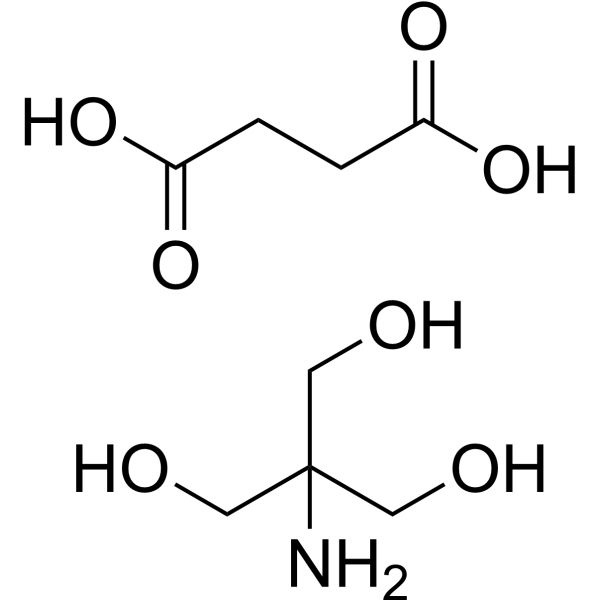
Physicochemical Properties
| Molecular Formula | C4H6O4.2[C4H11NO3] |
| Molecular Weight | 360.35812 |
| Exact Mass | 360.174 |
| CAS # | 84540-64-7 |
| Related CAS # | Succinic acid;110-15-6; 84540-64-7 (Succinic acid tromethamine); 150-90-3 (Disodium succinate); 26776-24-9;14047-56-4 (Succinic acid sodium) |
| PubChem CID | 3086186 |
| Appearance | Typically exists as solid at room temperature |
| Boiling Point | 633.5ºC at 760 mmHg |
| Melting Point | 138-141ºC |
| Flash Point | 336.9ºC |
| Hydrogen Bond Donor Count | 10 |
| Hydrogen Bond Acceptor Count | 12 |
| Rotatable Bond Count | 9 |
| Heavy Atom Count | 24 |
| Complexity | 147 |
| Defined Atom Stereocenter Count | 0 |
| SMILES | C(CC(=O)O)C(=O)O.C(C(CO)(CO)N)O.C(C(CO)(CO)N)O |
| InChi Key | CFJZQNZZGQDONE-UHFFFAOYSA-N |
| InChi Code | InChI=1S/2C4H11NO3.C4H6O4/c2*5-4(1-6,2-7)3-8;5-3(6)1-2-4(7)8/h2*6-8H,1-3,5H2;1-2H2,(H,5,6)(H,7,8) |
| Chemical Name | 2-amino-2-(hydroxymethyl)propane-1,3-diol;butanedioic acid |
| Synonyms | Tris succinate; 85169-32-0; 84540-64-7; Di(tris[hydroxymethyl]aminomethane) succinate; Succinic acid, compound with 2-amino-2-(hydroxymethyl)propane-1,3-diol (1:2); 2-amino-2-(hydroxymethyl)propane-1,3-diol;butanedioic acid; EINECS 285-975-2; EINECS 283-159-0; |
| HS Tariff Code | 2934.99.9001 |
| Storage |
Powder-20°C 3 years 4°C 2 years In solvent -80°C 6 months -20°C 1 month |
| Shipping Condition | Room temperature (This product is stable at ambient temperature for a few days during ordinary shipping and time spent in Customs) |
Biological Activity
| Targets | Microbial Metabolite; Endogenous Metabolite; Flavoring Agents; Alters several flavor and/or taste characteristics; Food additives; Fragrance Ingredients; Cosmetics -> Buffering; Environmental transformation -> Pesticide transformation products (metabolite, successor) |
| ln Vitro |
Fermentation of agricultural carbohydrates yields tromethamine succinate [2]. Succinic acid is considered as an important platform chemical. Succinic acid fermentation with Actinobacillus succinogenes strain BE-1 was optimized by central composite design (CCD) using a response surface methodology (RSM). The optimized production of succinic acid was predicted and the interactive effects between glucose, yeast extract, and magnesium carbonate were investigated. As a result, a model for predicting the concentration of succinic acid production was developed. The accuracy of the model was confirmed by the analysis of variance (ANOVA), and the validity was further proved by verification experiments showing that percentage errors between actual and predicted values varied from 3.02% to 6.38%. In addition, it was observed that the interactive effect between yeast extract and magnesium carbonate was statistically significant. In conclusion, RSM is an effective and useful method for optimizing the medium components and investigating the interactive effects, and can provide valuable information for succinic acid scale-up fermentation using A. succinogenes strain BE-1[1]. |
| ln Vivo | Tromethamine succinate (3, 6 mg/kg; oral) increases the percentage of male mice accessing the open arm and the time spent in the open arm [3]. Tromethamine succinate (3, 6, 12 mg/kg; i.p.) significantly enhanced food intake after 5 minutes of delivery, and rectal temperatures were recorded 40 minutes after administration, at doses of 1.5 mg/kg of amber Acid, prevents stress-induced hyperthermia [3]. |
| Animal Protocol | The putative anxiolytic activity of succinic acid was examined in male mice by using a number of experimental paradigms of anxiety and compared with that of the known anxiolytic compound diazepam. Use of the elevated plus-maze test revealed that diazepam (1.0, 2.0 and 4.0 mg/kg, PO) or succinic acid (3.0 or 6.0 mg/kg, PO) increased the percentage of entries into open arms and of time spent on open arms. In novel food consumption test, succinic acid (3.0, 6.0, and 12.0 mg/kg, IP) caused significant increases in food intake during 5 min when compared with the vehicle. In the stress-induced hyperthermia test, 40 min after drug administration rectal temperature was measured, succinic acid at dose of 1.5 mg/kg, inhibited stress-induced hyperthermia. Thus, these findings indicated that, in contrast with diazepam, succinic acid exhibits anxiolytic-like effect.[3] |
| ADME/Pharmacokinetics |
Absorption, Distribution and Excretion Succinic acid occurs normally in human urine (1.9-8.8 mg/L). Metabolism / Metabolites Succinic acid is a normal intermediary metabolite and a constituent of the citric acid cycle. It is readily metabolized when administered to animals, but may be partly excreted unchanged in the urine if large doses are fed. Succinic acid can be converted into fumaric acid by oxidation via succinate dehydrogenase. Agrochemical Transformations Butanedioic acid is a known environmental transformation product of Sulcotrione. Succinic acid is a known environmental transformation product of Linuron. |
| Toxicity/Toxicokinetics |
Toxicity Summary
Succinate can inhibit the activities of α-KG–dependent oxygenases (KDMs) and the TET family of 5-methlycytosine (5mC) hydroxylases. Succinate also mediates allosteric inhibition of hypoxia inducible factor (HIF) prolyl hydroxylases (PHDs). Inhibition of HIF PHDs leads to activation of HIF-mediated pseudohypoxic response, whereas inhibition of KDMs and TET family of 5mC hydroxylases causes epigenetic alterations that ultimately cause cancer. Succination of KEAP1 in FH deficiency results in the constitutive activation of the antioxidant defense pathway mediated by NRF2, conferring a reductive milieu that promotes cell proliferation. Succination of the Krebs cycle enzyme Aco2 impairs aconitase activity in Fh1-deficient MEFs. Succination also causes irreversible inactivation of glyceraldehyde-3-phosphate dehydrogenase (GAPDH). Health Effects At acute doses or exposures succinic acid is a skin irritant. Chronically high doses of succinate can lead to succinylation or succination of a variety of enzymes. Partial succinate dehydrogenase deficiency (15% to 50% of normal reference enzyme activity) in skeletal muscle leads to elevated succinate levels and causes mitochondrial myopathy with various symptoms, for example, brain involvement, cardiomyopathy, and/or exercise intolerance. Exposure Routes Eye contact, Inhalation, Ingestion. Symptoms Acute Exposure: the clinical signs of acute toxicity are weakness and diarrhea. Adverse Effects Neurotoxin - Other CNS neurotoxin View More
Toxicity Data
Treatment EYES: irrigate opened eyes for several minutes under running water. INGESTION: do not induce vomiting. Rinse mouth with water (never give anything by mouth to an unconscious person). Seek immediate medical advice. SKIN: should be treated immediately by rinsing the affected parts in cold running water for at least 15 minutes, followed by thorough washing with soap and water. If necessary, the person should shower and change contaminated clothing and shoes, and then must seek medical attention. INHALATION: supply fresh air. If required provide artificial respiration. Human Toxicity Excerpts /OTHER TOXICITY INFORMATION/ Primary irritant effects are present with a number of ... /aliphatic dicarboxylic/ acids, particularly in concentrated solution or as dusts- sensitization is rare. /Aliphatic dicarboxylic acids/ International Labour Office. Encyclopedia of Occupational Health and Safety. Volumes I and II. New York: McGraw-Hill Book Co., 1971., p. 30 Non-Human Toxicity Excerpts /LABORATORY ANIMALS: Acute Exposure/ Succinic acid is slight skin irritant and a strong eye irritant in rats. Application of 750 ug of succinic acid as a 15% solution produced severe damage in rabbit eyes. The clinical signs of acute toxicity in rats are weakness and diarrhea. /LABORATORY ANIMALS: Acute Exposure/ Large iv doses of sodium succinate produced vomiting and diarrhea in cats... . /LABORATORY ANIMALS: Subchronic or Prechronic Exposure/ Rats/Fischer (F344) males and females,10 per group /were exposed for/ 13 weeks ad libitum /to/ 0, 0.3, 0.6, 1.25, 2.5, 5, 10% monosodium succinate, purity 100.2%. ...Severe suppression of body weight gain occurred in rats in the 10% group, and all of the rats in this group died during the first 4 weeks of the experiment. However, in the other dose groups all of the rats survived to the end of the experiment. Suppression of body weight gain was observed at >/=2.5%. The volume of drinking water consumed was very small in the highest dose groups, although it was larger in the 5% group than in the other groups. No specific dose-related changes were observed in any parameters in the hematological and biochemical investigations. Rats that died during the experiment were severely emaciated. However, no toxic lesions caused by the test substance were found in any organs of these rats histopathologically, although atrophy of the organs was observed. No specific lesions were observed histologically in any of the other test groups. On the basis of body weight depression, the maximum tolerated dose of monosodium succinate was determined to be approximately 2-2.5% when given in the drinking water. Non-Human Toxicity Values LD50 Rat oral 2260 mg/kg |
| References |
[1]. Optimization of succinic acid fermentation with Actinobacillus succinogenes by response surface methodology (RSM). J Zhejiang Univ Sci B. 2012 Feb;13(2):103-10. [2]. The production of propionic acid by decarboxylation of succinic acid in a bacterial fermentation. Biochem J. 1948;42(1):ii. [3]. Si Wei Chen, Anxiolytic-like effect of succinic acid in mice. Life Sci. 2003 Nov 7;73(25):3257-64. |
| Additional Infomation |
Succinic acid appears as white crystals or shiny white odorless crystalline powder. pH of 0.1 molar solution: 2.7. Very acid taste. (NTP, 1992)
National Toxicology Program, Institute of Environmental Health Sciences, National Institutes of Health (NTP). 1992. National Toxicology Program Chemical Repository Database. Research Triangle Park, North Carolina.
Succinic acid is an alpha,omega-dicarboxylic acid resulting from the formal oxidation of each of the terminal methyl groups of butane to the corresponding carboxy group. It is an intermediate metabolite in the citric acid cycle. It has a role as a nutraceutical, a radiation protective agent, an anti-ulcer drug, a micronutrient and a fundamental metabolite. It is an alpha,omega-dicarboxylic acid and a C4-dicarboxylic acid. It is a conjugate acid of a succinate(1-). A water-soluble, colorless crystal with an acid taste that is used as a chemical intermediate, in medicine, the manufacture of lacquers, and to make perfume esters. It is also used in foods as a sequestrant, buffer, and a neutralizing agent. (Hawley's Condensed Chemical Dictionary, 12th ed, p1099; McGraw-Hill Dictionary of Scientific and Technical Terms, 4th ed, p1851) Succinic acid is a metabolite found in or produced by Escherichia coli (strain K12, MG1655). Succinic Acid has been reported in Camellia sinensis, Phomopsis velata, and other organisms with data available. Succinic acid is a dicarboxylic acid. The anion, succinate, is a component of the citric acid cycle capable of donating electrons to the electron transfer chain. Succinic acid is created as a byproduct of the fermentation of sugar. It lends to fermented beverages such as wine and beer a common taste that is a combination of saltiness, bitterness and acidity. Succinate is commonly used as a chemical intermediate, in medicine, the manufacture of lacquers, and to make perfume esters. It is also used in foods as a sequestrant, buffer, and a neutralizing agent. Succinate plays a role in the citric acid cycle, an energy-yielding process and is metabolized by succinate dehydrogenase to fumarate. Succinate dehydrogenase (SDH) plays an important role in the mitochondria, being both part of the respiratory chain and the Krebs cycle. SDH with a covalently attached FAD prosthetic group, binds enzyme substrates (succinate and fumarate) and physiological regulators (oxaloacetate and ATP). Oxidizing succinate links SDH to the fast-cycling Krebs cycle portion where it participates in the breakdown of acetyl-CoA throughout the whole Krebs cycle. Succinate can readily be imported into the mitochondrial matrix by the n-butylmalonate- (or phenylsuccinate-) sensitive dicarboxylate carrier in exchange with inorganic phosphate or another organic acid, e.g. malate. (A3509) Mutations in the four genes encoding the subunits of succinate dehydrogenase are associated with a wide spectrum of clinical presentations (i.e.: Huntington's disease. (A3510). Succinate also acts as an oncometabolite. Succinate inhibits 2-oxoglutarate-dependent histone and DNA demethylase enzymes, resulting in epigenetic silencing that affects neuroendocrine differentiation. A water-soluble, colorless crystal with an acid taste that is used as a chemical intermediate, in medicine, the manufacture of lacquers, and to make perfume esters. It is also used in foods as a sequestrant, buffer, and a neutralizing agent. View More
Drug Indication
Therapeutic Uses /EXPTL THER/ Succinic acid (100 mM) significantly inhibited systemic anaphylaxis induced by compound 48/80 /a potent mast cell degranulator/ in mice and dose-dependently inhibited local anaphylaxis activated by anti-dinitrophenyl IgE. Further 10 and 100 mM significantly inhibited histamine release from rat peritoneal mast cells activated by compound 48/80 or anti-dinitrophenyl IgE. In addition succinic acid (0.1 and 1 mM) had a significant inhibitory effect on anti-dinitrophenyl IgE-induced tumor necrosis factor-alpha secretion from rat peritoneal mast cells. The level of cyclic AMP in rat peritoneal mast cells, when succinic acid (100 mM) was added, transiently and significantly increased about 4 times compared with that of basal cells. These results suggest a possible use of succinic acid in managing mast cell-dependent anaphylaxis. Mechanism of Action Succinate is an essential component of the Krebs or citric acid cycle and serves an electron donor in the production of fumaric acid and FADH2. It also has been shown to be a good "natural" antibiotic because of its relative acidic or caustic nature (high concentrations can even cause burns). Succinate supplements have been shown to help reduce the effects of hangovers by activating the degradation of acetaldehyde - a toxic byproduct of alcohol metabolism - into CO2 and H2O through aerobic metabolism. Succinic acid has been shown to stimulate neural system recovery and bolster the immune system. Claims have also been made that it boosts awareness, concentration and reflexes. Sources/Uses Found in fossils, fungi, and lichens; [Merck Index] Present in nearly all plant and animal tissues; Used to make lacquers, dyes, esters for perfumes, alkyd resins, pharmaceuticals, plasticizers, lubricants, and pesticides; Also used in photography, as a sequestrant in foods, a buffering and neutralizing agent, for radiation dosimetry, and to promote plant growth and increased yields in food crops Uses of succinic acid range from scientific applications such as radiation dosimetry and standard buffer solutions to applications in agriculture, food, medicine, plastics, cosmetics, textiles, plating, and waste-gas scrubbing Kirk-Othmer Encyclopedia of Chemical Technology. 3rd ed., Volumes 1-26. New York, NY: John Wiley and Sons, 1978-1984., p. V21 848 Succinic acid is used as starting material in the manufacture of alkyd resins, dyes, pharmaceuticals, and pesticides. Reaction with glycols gives polyesters; esters formed by reaction with monoalcohols are important plasticizers and lubricants. In the growing of food, it is a biogenic stimulant leading to faster plant growth and increased yields. Succinic acid is a precursor to some specialized polyesters. It is also a component of some alkyd resins. Succinic acid is used in the food and beverage industry, primarily as an acidity regulator. It is also sold as a food additive and dietary supplement, and is generally recognized as safe by the US FDA. Methods of Manufacturing Hydrogenation of maleic acid, maleic anhydride, or fumaric acid produces good yields of succinic acid. 1,4-Butanediol can be oxidized to succinic acid in several ways: (1) with O2 in an aqueous solution of an alkaline-earth hydroxide at 90-110 °C in the presence of Pd-C; (2) by ozonolysis in aqueous acetic acid; or (3) by reaction with N2O4 at low temperature. Succinic acid can ... be obtained by phase-transfer-catalyzed reaction of 2-haloacetates, electrolytic dimerization of bromoacetic acid or ester, oxidation of 3-cyanopropanal, and fermentation of n-alkanes. |
Solubility Data
| Solubility (In Vitro) | May dissolve in DMSO (in most cases), if not, try other solvents such as H2O, Ethanol, or DMF with a minute amount of products to avoid loss of samples |
| Solubility (In Vivo) |
Note: Listed below are some common formulations that may be used to formulate products with low water solubility (e.g. < 1 mg/mL), you may test these formulations using a minute amount of products to avoid loss of samples. Injection Formulations (e.g. IP/IV/IM/SC) Injection Formulation 1: DMSO : Tween 80: Saline = 10 : 5 : 85 (i.e. 100 μL DMSO stock solution → 50 μL Tween 80 → 850 μL Saline) *Preparation of saline: Dissolve 0.9 g of sodium chloride in 100 mL ddH ₂ O to obtain a clear solution. Injection Formulation 2: DMSO : PEG300 :Tween 80 : Saline = 10 : 40 : 5 : 45 (i.e. 100 μL DMSO → 400 μLPEG300 → 50 μL Tween 80 → 450 μL Saline) Injection Formulation 3: DMSO : Corn oil = 10 : 90 (i.e. 100 μL DMSO → 900 μL Corn oil) Example: Take the Injection Formulation 3 (DMSO : Corn oil = 10 : 90) as an example, if 1 mL of 2.5 mg/mL working solution is to be prepared, you can take 100 μL 25 mg/mL DMSO stock solution and add to 900 μL corn oil, mix well to obtain a clear or suspension solution (2.5 mg/mL, ready for use in animals). Injection Formulation 4: DMSO : 20% SBE-β-CD in saline = 10 : 90 [i.e. 100 μL DMSO → 900 μL (20% SBE-β-CD in saline)] *Preparation of 20% SBE-β-CD in Saline (4°C,1 week): Dissolve 2 g SBE-β-CD in 10 mL saline to obtain a clear solution. Injection Formulation 5: 2-Hydroxypropyl-β-cyclodextrin : Saline = 50 : 50 (i.e. 500 μL 2-Hydroxypropyl-β-cyclodextrin → 500 μL Saline) Injection Formulation 6: DMSO : PEG300 : castor oil : Saline = 5 : 10 : 20 : 65 (i.e. 50 μL DMSO → 100 μLPEG300 → 200 μL castor oil → 650 μL Saline) Injection Formulation 7: Ethanol : Cremophor : Saline = 10: 10 : 80 (i.e. 100 μL Ethanol → 100 μL Cremophor → 800 μL Saline) Injection Formulation 8: Dissolve in Cremophor/Ethanol (50 : 50), then diluted by Saline Injection Formulation 9: EtOH : Corn oil = 10 : 90 (i.e. 100 μL EtOH → 900 μL Corn oil) Injection Formulation 10: EtOH : PEG300:Tween 80 : Saline = 10 : 40 : 5 : 45 (i.e. 100 μL EtOH → 400 μLPEG300 → 50 μL Tween 80 → 450 μL Saline) Oral Formulations Oral Formulation 1: Suspend in 0.5% CMC Na (carboxymethylcellulose sodium) Oral Formulation 2: Suspend in 0.5% Carboxymethyl cellulose Example: Take the Oral Formulation 1 (Suspend in 0.5% CMC Na) as an example, if 100 mL of 2.5 mg/mL working solution is to be prepared, you can first prepare 0.5% CMC Na solution by measuring 0.5 g CMC Na and dissolve it in 100 mL ddH2O to obtain a clear solution; then add 250 mg of the product to 100 mL 0.5% CMC Na solution, to make the suspension solution (2.5 mg/mL, ready for use in animals). Oral Formulation 3: Dissolved in PEG400 Oral Formulation 4: Suspend in 0.2% Carboxymethyl cellulose Oral Formulation 5: Dissolve in 0.25% Tween 80 and 0.5% Carboxymethyl cellulose Oral Formulation 6: Mixing with food powders Note: Please be aware that the above formulations are for reference only. InvivoChem strongly recommends customers to read literature methods/protocols carefully before determining which formulation you should use for in vivo studies, as different compounds have different solubility properties and have to be formulated differently. (Please use freshly prepared in vivo formulations for optimal results.) |
| Preparing Stock Solutions | 1 mg | 5 mg | 10 mg | |
| 1 mM | 2.7750 mL | 13.8750 mL | 27.7500 mL | |
| 5 mM | 0.5550 mL | 2.7750 mL | 5.5500 mL | |
| 10 mM | 0.2775 mL | 1.3875 mL | 2.7750 mL |