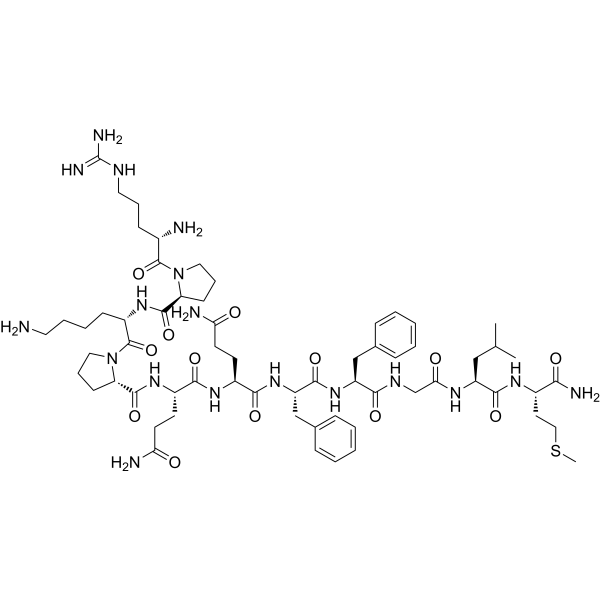
Physicochemical Properties
| Molecular Formula | C63H98N18O13S |
| Molecular Weight | 1347.63002 |
| Exact Mass | 1346.728 |
| CAS # | 33507-63-0 |
| Related CAS # | Substance P TFA;148470-19-3;Substance P, FAM-labeled |
| PubChem CID | 36511 |
| Appearance | White to off-white solid powder |
| Density | 1.4±0.1 g/cm3 |
| Index of Refraction | 1.663 |
| LogP | -0.85 |
| Hydrogen Bond Donor Count | 15 |
| Hydrogen Bond Acceptor Count | 17 |
| Rotatable Bond Count | 42 |
| Heavy Atom Count | 95 |
| Complexity | 2620 |
| Defined Atom Stereocenter Count | 10 |
| SMILES | CC(C)C[C@@H](C(=O)N[C@@H](CCSC)C(=O)N)NC(=O)CNC(=O)[C@H](CC1=CC=CC=C1)NC(=O)[C@H](CC2=CC=CC=C2)NC(=O)[C@H](CCC(=O)N)NC(=O)[C@H](CCC(=O)N)NC(=O)[C@@H]3CCCN3C(=O)[C@H](CCCCN)NC(=O)[C@@H]4CCCN4C(=O)[C@H](CCCN=C(N)N)N |
| InChi Key | ADNPLDHMAVUMIW-CUZNLEPHSA-N |
| InChi Code | InChI=1S/C63H98N18O13S/c1-37(2)33-45(57(89)74-41(53(68)85)27-32-95-3)73-52(84)36-72-54(86)46(34-38-15-6-4-7-16-38)78-58(90)47(35-39-17-8-5-9-18-39)79-56(88)42(23-25-50(66)82)75-55(87)43(24-26-51(67)83)76-59(91)49-22-14-31-81(49)62(94)44(20-10-11-28-64)77-60(92)48-21-13-30-80(48)61(93)40(65)19-12-29-71-63(69)70/h4-9,15-18,37,40-49H,10-14,19-36,64-65H2,1-3H3,(H2,66,82)(H2,67,83)(H2,68,85)(H,72,86)(H,73,84)(H,74,89)(H,75,87)(H,76,91)(H,77,92)(H,78,90)(H,79,88)(H4,69,70,71)/t40-,41-,42-,43-,44-,45-,46-,47-,48-,49-/m0/s1 |
| Chemical Name | (2S)-2-[[(2S)-1-[(2S)-6-amino-2-[[(2S)-1-[(2S)-2-amino-5-(diaminomethylideneamino)pentanoyl]pyrrolidine-2-carbonyl]amino]hexanoyl]pyrrolidine-2-carbonyl]amino]-N-[(2S)-5-amino-1-[[(2S)-1-[[(2S)-1-[[2-[[(2S)-1-[[(2S)-1-amino-4-methylsulfanyl-1-oxobutan-2-yl]amino]-4-methyl-1-oxopentan-2-yl]amino]-2-oxoethyl]amino]-1-oxo-3-phenylpropan-2-yl]amino]-1-oxo-3-phenylpropan-2-yl]amino]-1,5-dioxopentan-2-yl]pentanediamide |
| HS Tariff Code | 2934.99.9001 |
| Storage |
Powder-20°C 3 years 4°C 2 years In solvent -80°C 6 months -20°C 1 month Note: Please store this product in a sealed and protected environment (e.g. under nitrogen), avoid exposure to moisture. |
| Shipping Condition | Room temperature (This product is stable at ambient temperature for a few days during ordinary shipping and time spent in Customs) |
Biological Activity
| Targets | Neurokinin-1 (NK1) receptor [1][2] |
| ln Vitro |
Neurokinin 1 receptor (NK1-R)-mediated desensitization and resensitization of neuropeptide substance P (SP), which may be connected to NK1-R endocytosis and recycling. The same protein-immunoreactive vesicles that internalize SP and NK1-R are subsequently divided into distinct compartments. In early endosomes and on the cell surface, SP is undamaged; however, it gradually deteriorates in perinuclear vesicles. In acidified endosomes, SP causes the SP/NK1-R complex to dissociate. NK1-R is recycled to the cell surface while SP is broken down. In transfected epithelial cells, SP detects the internalization of NK1-R [1]. - Substance P is a natural ligand for the NK1 receptor, mediating receptor endocytosis and signaling. In Chinese hamster ovary (CHO) cells stably expressing human NK1 receptor, fluorescently labeled Substance P (100 nM) bound to cell surface NK1 receptors and induced rapid receptor internalization within 5-15 minutes. The internalized receptor-ligand complexes were localized to early endosomes, late endosomes, and lysosomes, with ~30% of receptors recycled back to the cell surface within 60 minutes (fluorescence microscopy, confocal imaging) [1] - In human breast cancer cells (MCF-7, MDA-MB-231), Substance P (10, 100 nM) dose-dependently promoted cell proliferation (CCK-8 assay): 100 nM concentration increased proliferation rate by ~40% compared with the control group. It inhibited apoptosis, reducing the apoptotic rate from ~12% (control) to ~5% (100 nM) (Annexin V-FITC/PI staining). Substance P reversed miR-34b/c-5p-mediated downregulation of NK1 receptor expression, as evidenced by increased NK1 receptor mRNA and protein levels (qPCR, Western blot). It also upregulated anti-apoptotic protein Bcl-2 and downregulated pro-apoptotic protein Bax (Western blot) [2] |
| Enzyme Assay | - NK1 receptor binding assay: CHO cells expressing NK1 receptor or rat brain membrane preparations were incubated with [³H]-labeled Substance P (0.1-100 nM) at 4°C for 2 hours. Non-specific binding was determined in the presence of excess unlabeled Substance P. Bound radioactivity was measured by liquid scintillation counting to assess specific binding affinity between Substance P and NK1 receptor [1] |
| Cell Assay |
- NK1 receptor endocytosis assay: CHO cells expressing NK1 receptor were seeded on coverslips and incubated with fluorescently labeled Substance P (100 nM) at 37°C for 5-60 minutes. Cells were fixed, permeabilized, and stained with endosome/lysosome markers. Confocal microscopy was used to track the localization of Substance P-NK1 receptor complexes and analyze endocytic pathway dynamics [1] - Breast cancer cell proliferation and apoptosis assay: MCF-7/MDA-MB-231 cells were seeded in 96-well plates or 6-well plates and treated with Substance P (10, 100 nM) for 48-72 hours. Cell proliferation was detected by CCK-8 assay; apoptosis by Annexin V-FITC/PI flow cytometry. For molecular analysis, cells were transfected with miR-34b/c-5p mimic or inhibitor before Substance P treatment, followed by qPCR to detect NK1 receptor mRNA levels and Western blot to analyze Bcl-2, Bax, and NK1 receptor protein expression [2] |
| References |
[1]. Delineation of the endocytic pathway of substance P and its seven-transmembrane domain NK1 receptor. Mol Biol Cell. 1995 May;6(5):509-24. [2]. MiR-34b/c-5p and the neurokinin-1 receptor regulate breast cancer cell proliferation and apoptosis. Cell Prolif. 2018 Oct 17:e12527. |
| Additional Infomation |
Substance P is a neuropeptide consisting of 11-amino acids. It preferentially activates neurokinin-1 receptors, exterting excitatory effects on central and peripheral neurons and involved in pain transmission. It has a role as a neurotransmitter, a vasodilator agent and a neurokinin-1 receptor agonist. It is a conjugate base of a substance P(3+). An eleven-amino acid neurotransmitter that appears in both the central and peripheral nervous systems. It is involved in transmission of PAIN, causes rapid contractions of the gastrointestinal smooth muscle, and modulates inflammatory and immune responses. - Substance P is a naturally occurring neuropeptide belonging to the tachykinin family [1][2] - Its core mechanisms include: binding to the NK1 receptor (a seven-transmembrane domain G protein-coupled receptor) to trigger receptor endocytosis and downstream signaling [1]; promoting breast cancer cell proliferation and inhibiting apoptosis by regulating NK1 receptor expression and the Bcl-2/Bax apoptotic pathway, which is antagonized by miR-34b/c-5p [2] - Substance P plays roles in neural signaling, inflammation, and tumor biology. It is a key research tool for studying GPCR endocytic pathways and NK1 receptor-mediated tumor progression [1][2] |
Solubility Data
| Solubility (In Vitro) |
DMSO : ~25 mg/mL (~18.55 mM) H2O : ≥ 20 mg/mL (~14.84 mM) |
| Solubility (In Vivo) |
Solubility in Formulation 1: ≥ 2.5 mg/mL (1.86 mM) (saturation unknown) in 10% DMSO + 40% PEG300 + 5% Tween80 + 45% Saline (add these co-solvents sequentially from left to right, and one by one), clear solution. For example, if 1 mL of working solution is to be prepared, you can add 100 μL of 25.0 mg/mL clear DMSO stock solution to 400 μL PEG300 and mix evenly; then add 50 μL Tween-80 to the above solution and mix evenly; then add 450 μL normal saline to adjust the volume to 1 mL. Preparation of saline: Dissolve 0.9 g of sodium chloride in 100 mL ddH₂ O to obtain a clear solution. Solubility in Formulation 2: ≥ 2.5 mg/mL (1.86 mM) (saturation unknown) in 10% DMSO + 90% (20% SBE-β-CD in Saline) (add these co-solvents sequentially from left to right, and one by one), clear solution. For example, if 1 mL of working solution is to be prepared, you can add 100 μL of 25.0 mg/mL clear DMSO stock solution to 900 μL of 20% SBE-β-CD physiological saline solution and mix evenly. Preparation of 20% SBE-β-CD in Saline (4°C,1 week): Dissolve 2 g SBE-β-CD in 10 mL saline to obtain a clear solution. Solubility in Formulation 3: ≥ 2.5 mg/mL (1.86 mM) (saturation unknown) in 10% DMSO + 90% Corn Oil (add these co-solvents sequentially from left to right, and one by one), clear solution. For example, if 1 mL of working solution is to be prepared, you can add 100 μL of 25.0 mg/mL clear DMSO stock solution to 900 μL of corn oil and mix evenly. (Please use freshly prepared in vivo formulations for optimal results.) |
| Preparing Stock Solutions | 1 mg | 5 mg | 10 mg | |
| 1 mM | 0.7420 mL | 3.7102 mL | 7.4204 mL | |
| 5 mM | 0.1484 mL | 0.7420 mL | 1.4841 mL | |
| 10 mM | 0.0742 mL | 0.3710 mL | 0.7420 mL |