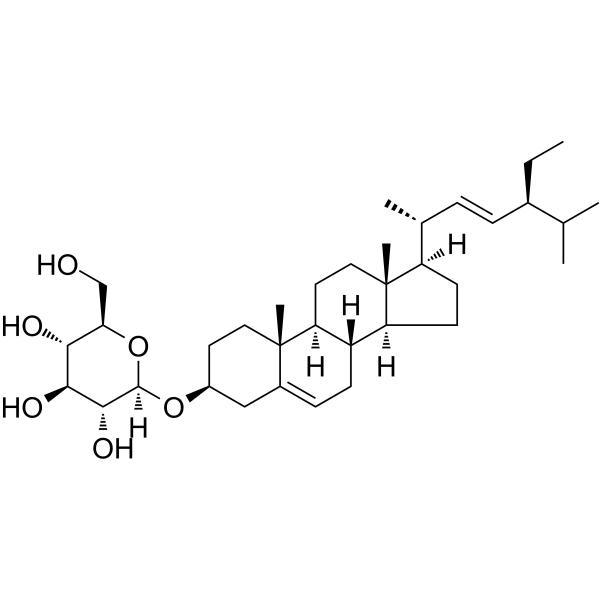
Physicochemical Properties
| Molecular Formula | C35H58O6 |
| Molecular Weight | 574.8314 |
| Exact Mass | 574.423 |
| CAS # | 19716-26-8 |
| PubChem CID | 6602508 |
| Appearance | White to off-white solid powder |
| Density | 1.1±0.1 g/cm3 |
| Boiling Point | 673.6±55.0 °C at 760 mmHg |
| Melting Point | 299 °C |
| Flash Point | 361.2±31.5 °C |
| Vapour Pressure | 0.0±4.7 mmHg at 25°C |
| Index of Refraction | 1.562 |
| LogP | 8.26 |
| Hydrogen Bond Donor Count | 4 |
| Hydrogen Bond Acceptor Count | 6 |
| Rotatable Bond Count | 8 |
| Heavy Atom Count | 41 |
| Complexity | 962 |
| Defined Atom Stereocenter Count | 14 |
| SMILES | CC[C@H](/C=C/[C@@H](C)[C@H]1CC[C@@H]2[C@@]1(CC[C@H]3[C@H]2CC=C4[C@@]3(CC[C@@H](C4)O[C@H]5[C@@H]([C@H]([C@@H]([C@H](O5)CO)O)O)O)C)C)C(C)C |
| InChi Key | VWDLOXMZIGUBKM-AUGXRQBFSA-N |
| InChi Code | InChI=1S/C35H58O6/c1-7-22(20(2)3)9-8-21(4)26-12-13-27-25-11-10-23-18-24(14-16-34(23,5)28(25)15-17-35(26,27)6)40-33-32(39)31(38)30(37)29(19-36)41-33/h8-10,20-22,24-33,36-39H,7,11-19H2,1-6H3/b9-8+/t21-,22-,24+,25+,26-,27+,28+,29-,30-,31+,32-,33-,34+,35-/m1/s1 |
| Chemical Name | (2R,3R,4S,5S,6R)-2-[[(3S,8S,9S,10R,13R,14S,17R)-17-[(E,2R,5S)-5-ethyl-6-methylhept-3-en-2-yl]-10,13-dimethyl-2,3,4,7,8,9,11,12,14,15,16,17-dodecahydro-1H-cyclopenta[a]phenanthren-3-yl]oxy]-6-(hydroxymethyl)oxane-3,4,5-triol |
| HS Tariff Code | 2934.99.9001 |
| Storage |
Powder-20°C 3 years 4°C 2 years In solvent -80°C 6 months -20°C 1 month Note: Please store this product in a sealed and protected environment (e.g. under nitrogen), avoid exposure to moisture and light. |
| Shipping Condition | Room temperature (This product is stable at ambient temperature for a few days during ordinary shipping and time spent in Customs) |
Biological Activity
| ln Vitro |
1. In silver nanoparticle (AgNP) green synthesis system: Stigmasterol glucoside (extracted from related biomass) acted as a capping and reducing agent in the AgNP synthesis using Plectranthus asirensis biomass; it promoted the formation of monodispersed AgNPs with a mean particle size of 22 nm (characterized by UV-Vis spectroscopy, XRD and TEM); the AgNPs synthesized with participation of Stigmasterol glucoside exhibited strong chemiluminescence (CL) activity in the luminol-H₂O₂ system[1] 2. In sequential injection-chemiluminescence (SI-CL) detection: Stigmasterol glucoside showed a specific CL response in the established SI-CL system; the CL intensity had a linear relationship with the concentration of Stigmasterol glucoside in the range of 0.05-10 μM, with a detection limit of 0.02 μM; the response was selective, and luteolin (co-existing compound) did not interfere with its detection[1] |
| Enzyme Assay | 1. Sequential injection-chemiluminescence detection assay for Stigmasterol glucoside: First, construct the SI-CL system consisting of luminol solution, H₂O₂ solution, and the carrier buffer; prepare a series of standard solutions of Stigmasterol glucoside with concentrations ranging from 0.05 μM to 10 μM and the sample solution containing Stigmasterol glucoside; set the sequential injection program (including sample loading volume, reagent mixing ratio, and reaction time) to deliver the sample/standard solution, luminol and H₂O₂ into the reaction coil in sequence; detect the chemiluminescence intensity of the reaction system using a photomultiplier tube; establish a calibration curve based on the CL intensity and standard concentration, then quantify the content of Stigmasterol glucoside in the sample[1] |
| References |
[1]. Sequential injection-chemiluminescence evaluation of stigmasterol glucoside and luteolin via green synthesis of silver nanoparticles using biomass of plectranthus asirensis. 2018, Nov 09, 11(4): 523-533. [2]. Screening of Euphorbiaceae Plant Extracts for Anti-5α-reductase. Biol Pharm Bull. 2018;41(8):1307-1310. |
| Additional Infomation |
Stigmasterol 3-O-beta-D-glucoside is a steroid saponin that is (3beta,22E)-stigmasta-5,22-dien-3-ol attached to a beta-D-glucopyranosyl residue at position 3 via a glycosidic linkage. It is isolated from Symplocos lancifolia. It has a role as a metabolite. It is a member of phytosterols, a steroid saponin, a beta-D-glucoside and a monosaccharide derivative. It is functionally related to a stigmasterol. It derives from a hydride of a stigmastane. Stigmasterol glucoside has been reported in Inula anatolica, Rhinacanthus nasutus, and other organisms with data available. See also: Poriferasterol monoglucoside (annotation moved to). 1. Stigmasterol glucoside is a steroidal glycoside compound that can be extracted from plant biomass (including Plectranthus asirensis), and it has dual functions of reducing and capping in the green synthesis of silver nanoparticles[1] 2. The sequential injection-chemiluminescence method established in literature [1] for Stigmasterol glucoside has advantages of high sensitivity (detection limit 0.02 μM), good linearity (0.05-10 μM) and strong selectivity, which provides a rapid and green detection approach for this compound[1] |
Solubility Data
| Solubility (In Vitro) | May dissolve in DMSO (in most cases), if not, try other solvents such as H2O, Ethanol, or DMF with a minute amount of products to avoid loss of samples |
| Solubility (In Vivo) |
Note: Listed below are some common formulations that may be used to formulate products with low water solubility (e.g. < 1 mg/mL), you may test these formulations using a minute amount of products to avoid loss of samples. Injection Formulations (e.g. IP/IV/IM/SC) Injection Formulation 1: DMSO : Tween 80: Saline = 10 : 5 : 85 (i.e. 100 μL DMSO stock solution → 50 μL Tween 80 → 850 μL Saline) *Preparation of saline: Dissolve 0.9 g of sodium chloride in 100 mL ddH ₂ O to obtain a clear solution. Injection Formulation 2: DMSO : PEG300 :Tween 80 : Saline = 10 : 40 : 5 : 45 (i.e. 100 μL DMSO → 400 μLPEG300 → 50 μL Tween 80 → 450 μL Saline) Injection Formulation 3: DMSO : Corn oil = 10 : 90 (i.e. 100 μL DMSO → 900 μL Corn oil) Example: Take the Injection Formulation 3 (DMSO : Corn oil = 10 : 90) as an example, if 1 mL of 2.5 mg/mL working solution is to be prepared, you can take 100 μL 25 mg/mL DMSO stock solution and add to 900 μL corn oil, mix well to obtain a clear or suspension solution (2.5 mg/mL, ready for use in animals). Injection Formulation 4: DMSO : 20% SBE-β-CD in saline = 10 : 90 [i.e. 100 μL DMSO → 900 μL (20% SBE-β-CD in saline)] *Preparation of 20% SBE-β-CD in Saline (4°C,1 week): Dissolve 2 g SBE-β-CD in 10 mL saline to obtain a clear solution. Injection Formulation 5: 2-Hydroxypropyl-β-cyclodextrin : Saline = 50 : 50 (i.e. 500 μL 2-Hydroxypropyl-β-cyclodextrin → 500 μL Saline) Injection Formulation 6: DMSO : PEG300 : castor oil : Saline = 5 : 10 : 20 : 65 (i.e. 50 μL DMSO → 100 μLPEG300 → 200 μL castor oil → 650 μL Saline) Injection Formulation 7: Ethanol : Cremophor : Saline = 10: 10 : 80 (i.e. 100 μL Ethanol → 100 μL Cremophor → 800 μL Saline) Injection Formulation 8: Dissolve in Cremophor/Ethanol (50 : 50), then diluted by Saline Injection Formulation 9: EtOH : Corn oil = 10 : 90 (i.e. 100 μL EtOH → 900 μL Corn oil) Injection Formulation 10: EtOH : PEG300:Tween 80 : Saline = 10 : 40 : 5 : 45 (i.e. 100 μL EtOH → 400 μLPEG300 → 50 μL Tween 80 → 450 μL Saline) Oral Formulations Oral Formulation 1: Suspend in 0.5% CMC Na (carboxymethylcellulose sodium) Oral Formulation 2: Suspend in 0.5% Carboxymethyl cellulose Example: Take the Oral Formulation 1 (Suspend in 0.5% CMC Na) as an example, if 100 mL of 2.5 mg/mL working solution is to be prepared, you can first prepare 0.5% CMC Na solution by measuring 0.5 g CMC Na and dissolve it in 100 mL ddH2O to obtain a clear solution; then add 250 mg of the product to 100 mL 0.5% CMC Na solution, to make the suspension solution (2.5 mg/mL, ready for use in animals). Oral Formulation 3: Dissolved in PEG400 Oral Formulation 4: Suspend in 0.2% Carboxymethyl cellulose Oral Formulation 5: Dissolve in 0.25% Tween 80 and 0.5% Carboxymethyl cellulose Oral Formulation 6: Mixing with food powders Note: Please be aware that the above formulations are for reference only. InvivoChem strongly recommends customers to read literature methods/protocols carefully before determining which formulation you should use for in vivo studies, as different compounds have different solubility properties and have to be formulated differently. (Please use freshly prepared in vivo formulations for optimal results.) |
| Preparing Stock Solutions | 1 mg | 5 mg | 10 mg | |
| 1 mM | 1.7396 mL | 8.6982 mL | 17.3964 mL | |
| 5 mM | 0.3479 mL | 1.7396 mL | 3.4793 mL | |
| 10 mM | 0.1740 mL | 0.8698 mL | 1.7396 mL |