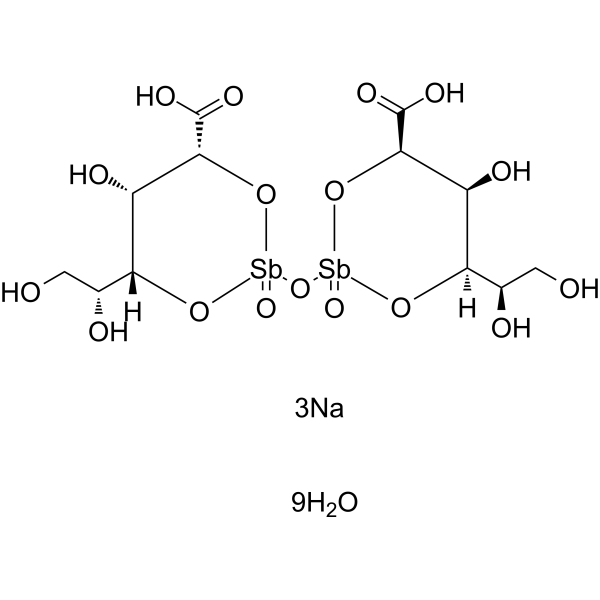
Physicochemical Properties
| Molecular Formula | C12H20O17SB2.3[NA].9[H2O] |
| Molecular Weight | 910.903920000001 |
| Exact Mass | 908.926 |
| CAS # | 16037-91-5 |
| PubChem CID | 16683012 |
| Appearance | White to off-white solid powder |
| Boiling Point | 673.6ºC at 760mmHg |
| Flash Point | 375.2ºC |
| Vapour Pressure | 4.95E-21mmHg at 25°C |
| Hydrogen Bond Donor Count | 15 |
| Hydrogen Bond Acceptor Count | 26 |
| Rotatable Bond Count | 6 |
| Heavy Atom Count | 43 |
| Complexity | 699 |
| Defined Atom Stereocenter Count | 8 |
| SMILES | O=[Sb](O[C@]1([H])[C@H](O)CO)(O[C@@H](C(O)=O)[C@H]1O)O[Sb](O[C@]2([H])[C@H](O)CO)(O[C@@H](C(O)=O)[C@H]2O)=O.[9H2O].[3Na] |
| InChi Key | CUEDNFKBTFCOSV-UZVLBLASSA-L |
| InChi Code | InChI=1S/2C6H10O7.3Na.9H2O.3O.2Sb/c2*7-1-2(8)3(9)4(10)5(11)6(12)13;;;;;;;;;;;;;;;;;/h2*2-5,7-8,10H,1H2,(H,12,13);;;;9*1H2;;;;;/q2*-2;3*+1;;;;;;;;;;;;;2*+2/p-2/t2*2-,3-,4+,5-;;;;;;;;;;;;;;;;;/m11................./s1 |
| Chemical Name | trisodium;(4R,5S,6R)-2-[[(4R,5S,6R)-4-carboxylato-6-[(1R)-1,2-dihydroxyethyl]-5-hydroxy-2-oxo-1,3,2λ5-dioxastibinan-2-yl]oxy]-6-[(1R)-1,2-dihydroxyethyl]-5-hydroxy-2-oxo-1,3,2λ5-dioxastibinane-4-carboxylate;nonahydrate |
| HS Tariff Code | 2934.99.9001 |
| Storage |
Powder-20°C 3 years 4°C 2 years In solvent -80°C 6 months -20°C 1 month Note: Please store this product in a sealed and protected environment, avoid exposure to moisture. |
| Shipping Condition | Room temperature (This product is stable at ambient temperature for a few days during ordinary shipping and time spent in Customs) |
Biological Activity
| ln Vitro | Sodium antimony gluconate (trisodium gluconate nonahydrate) inhibits 99% of SHP-1 activity at 10 μg/mL (the therapeutic concentration of leishmaniasis medicines). Similar degrees of inhibition of SHP-2 and PTP1B require 100 μg/mL sodium antimony gluconate. The inhibitory impact of stibogluconate on cellular PTPases is revealed by its rapid induction of tyrosine phosphorylation of cellular proteins in Baf3 cells and its augmentation of IL-3-induced Janus family inhibitor 2/Stat5 tyrosine phosphorylation and Baf3 cell proliferation. ..Sodium antimony gluconate promotes the opposing effects of GM-CSF and IFN-α on TF-1 cell proliferation, showing its extensive activity in various cytokine signal transductions [1]. |
| ln Vivo | Stibogluconate trisodium nonawater elicited 61% reduction of Renca tumor growth in the BALB/c probe, followed by an increase (2-fold) in tumor circulating macrophages. The combination of sodium antimony gluconate and IL-2 was more effective in suppressing tumor development (91 %) and generating tumor veins (4 times), but IL-2 alone had minimal impact [2]. |
| Toxicity/Toxicokinetics |
Effects During Pregnancy and Lactation ◉ Summary of Use during Lactation Limited information indicates that maternal doses of sodium stibogluconate up to 1.4 grams daily produce low levels in milk and would not be expected to cause any adverse effects in breastfed infants,[1] especially if the infant is older than 2 months. However, if withholding nursing during therapy is elected, breastfeeding can be reinstituted 24 to 48 hours after the last dose. ◉ Effects in Breastfed Infants Relevant published information was not found as of the revision date. ◉ Effects on Lactation and Breastmilk Relevant published information was not found as of the revision date. |
| References |
[1]. Pathak MK, et al. Sodium stibogluconate is a potent inhibitor of protein tyrosine phosphatases and augments cytokine responses in hemopoietic cell lines. J Immunol. 2001 Sep 15;167(6):3391-7. [2]. Fan K et al. Sodium Stibogluconate Interacts with IL-2 in Anti-Renca Tumor Action via a T Cell-Dependent Mechanism in Connection with Induction of Tumor-Infiltrating Macrophages. J Immunol. 2005 Nov 15;175(10):7003-8 |
| Additional Infomation |
Sodium stibogluconate is a medicine used to treat leishmaniasis and is only available for administration by injection. It belongs to the class of medicines known as the pentavalent antimonials. Sodium stibogluconate is sold in the UK as Pentostam (manufactured by GlaxoSmithKline). Widespread resistance has limited the utility of sodium stibogluconate, and in many parts of the world, amphotericin or miltefosine are used instead. It is also being investigated as an anti-tumor agent. Antimony complex where the metal may exist in either the pentavalent or trivalent states. The pentavalent gluconate is used in leishmaniasis. The trivalent gluconate is most frequently used in schistosomiasis. Drug Indication For the treatment of various types of a protozoal infection called leishmaniasis, which may result from sandfly bites in tropical and temperate parts of the world. Also investigated for use/treatment in cancer/tumors (unspecified) and solid tumors. Mechanism of Action Sodium stibogluconate directly inhibits DNA topoisomerase I leading to inhibition of both DNA replication and transcription. Pharmacodynamics The mode of action of sodium stibogluconate is not clearly understood. In vitro exposure of amastigotes to 500 mg pentavalent antimony/ml results in a greater than 50% decrease in parasite DNA, RNA protein and purine nucleoside triphosphate levels. It has been postulated that the reduction in ATP (adenosine triphosphate) and GTP (guanosine triphosphate) synthesis contributes to decreased macromolecular synthesis. |
Solubility Data
| Solubility (In Vitro) |
H2O : ~3 mg/mL (~3.29 mM) DMSO : ~1 mg/mL (~1.10 mM) |
| Solubility (In Vivo) |
Note: Listed below are some common formulations that may be used to formulate products with low water solubility (e.g. < 1 mg/mL), you may test these formulations using a minute amount of products to avoid loss of samples. Injection Formulations (e.g. IP/IV/IM/SC) Injection Formulation 1: DMSO : Tween 80: Saline = 10 : 5 : 85 (i.e. 100 μL DMSO stock solution → 50 μL Tween 80 → 850 μL Saline) *Preparation of saline: Dissolve 0.9 g of sodium chloride in 100 mL ddH ₂ O to obtain a clear solution. Injection Formulation 2: DMSO : PEG300 :Tween 80 : Saline = 10 : 40 : 5 : 45 (i.e. 100 μL DMSO → 400 μLPEG300 → 50 μL Tween 80 → 450 μL Saline) Injection Formulation 3: DMSO : Corn oil = 10 : 90 (i.e. 100 μL DMSO → 900 μL Corn oil) Example: Take the Injection Formulation 3 (DMSO : Corn oil = 10 : 90) as an example, if 1 mL of 2.5 mg/mL working solution is to be prepared, you can take 100 μL 25 mg/mL DMSO stock solution and add to 900 μL corn oil, mix well to obtain a clear or suspension solution (2.5 mg/mL, ready for use in animals). Injection Formulation 4: DMSO : 20% SBE-β-CD in saline = 10 : 90 [i.e. 100 μL DMSO → 900 μL (20% SBE-β-CD in saline)] *Preparation of 20% SBE-β-CD in Saline (4°C,1 week): Dissolve 2 g SBE-β-CD in 10 mL saline to obtain a clear solution. Injection Formulation 5: 2-Hydroxypropyl-β-cyclodextrin : Saline = 50 : 50 (i.e. 500 μL 2-Hydroxypropyl-β-cyclodextrin → 500 μL Saline) Injection Formulation 6: DMSO : PEG300 : castor oil : Saline = 5 : 10 : 20 : 65 (i.e. 50 μL DMSO → 100 μLPEG300 → 200 μL castor oil → 650 μL Saline) Injection Formulation 7: Ethanol : Cremophor : Saline = 10: 10 : 80 (i.e. 100 μL Ethanol → 100 μL Cremophor → 800 μL Saline) Injection Formulation 8: Dissolve in Cremophor/Ethanol (50 : 50), then diluted by Saline Injection Formulation 9: EtOH : Corn oil = 10 : 90 (i.e. 100 μL EtOH → 900 μL Corn oil) Injection Formulation 10: EtOH : PEG300:Tween 80 : Saline = 10 : 40 : 5 : 45 (i.e. 100 μL EtOH → 400 μLPEG300 → 50 μL Tween 80 → 450 μL Saline) Oral Formulations Oral Formulation 1: Suspend in 0.5% CMC Na (carboxymethylcellulose sodium) Oral Formulation 2: Suspend in 0.5% Carboxymethyl cellulose Example: Take the Oral Formulation 1 (Suspend in 0.5% CMC Na) as an example, if 100 mL of 2.5 mg/mL working solution is to be prepared, you can first prepare 0.5% CMC Na solution by measuring 0.5 g CMC Na and dissolve it in 100 mL ddH2O to obtain a clear solution; then add 250 mg of the product to 100 mL 0.5% CMC Na solution, to make the suspension solution (2.5 mg/mL, ready for use in animals). Oral Formulation 3: Dissolved in PEG400 Oral Formulation 4: Suspend in 0.2% Carboxymethyl cellulose Oral Formulation 5: Dissolve in 0.25% Tween 80 and 0.5% Carboxymethyl cellulose Oral Formulation 6: Mixing with food powders Note: Please be aware that the above formulations are for reference only. InvivoChem strongly recommends customers to read literature methods/protocols carefully before determining which formulation you should use for in vivo studies, as different compounds have different solubility properties and have to be formulated differently. (Please use freshly prepared in vivo formulations for optimal results.) |
| Preparing Stock Solutions | 1 mg | 5 mg | 10 mg | |
| 1 mM | 1.0978 mL | 5.4891 mL | 10.9782 mL | |
| 5 mM | 0.2196 mL | 1.0978 mL | 2.1956 mL | |
| 10 mM | 0.1098 mL | 0.5489 mL | 1.0978 mL |