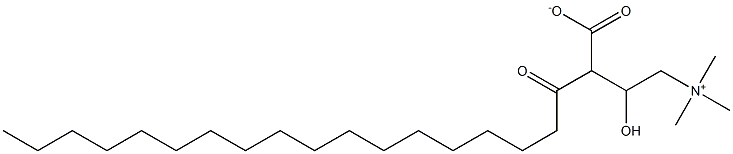
Physicochemical Properties
| Molecular Formula | C25H49NO4 |
| Molecular Weight | 427.660868406296 |
| Exact Mass | 427.366 |
| CAS # | 25597-09-5 |
| PubChem CID | 52922056 |
| Appearance | White to off-white solid powder |
| LogP | 8.8 |
| Hydrogen Bond Donor Count | 0 |
| Hydrogen Bond Acceptor Count | 4 |
| Rotatable Bond Count | 21 |
| Heavy Atom Count | 30 |
| Complexity | 426 |
| Defined Atom Stereocenter Count | 1 |
| SMILES | O(C(CCCCCCCCCCCCCCCCC)=O)[C@H](CC(=O)[O-])C[N+](C)(C)C |
| InChi Key | FNPHNLNTJNMAEE-HSZRJFAPSA-N |
| InChi Code | InChI=1S/C25H49NO4/c1-5-6-7-8-9-10-11-12-13-14-15-16-17-18-19-20-25(29)30-23(21-24(27)28)22-26(2,3)4/h23H,5-22H2,1-4H3/t23-/m1/s1 |
| Chemical Name | (3R)-3-octadecanoyloxy-4-(trimethylazaniumyl)butanoate |
| HS Tariff Code | 2934.99.9001 |
| Storage |
Powder-20°C 3 years 4°C 2 years In solvent -80°C 6 months -20°C 1 month |
| Shipping Condition | Room temperature (This product is stable at ambient temperature for a few days during ordinary shipping and time spent in Customs) |
Biological Activity
| ln Vivo |
In first-trimester (11–14 weeks of gestation) pregnant women, serum levels of Stearoylcarnitine were significantly lower in those who later developed preeclampsia compared to women with normal pregnancies [1] As a potential metabolic marker for preeclampsia prediction, Stearoylcarnitine exhibited certain diagnostic performance, with a measurable area under the receiver operating characteristic curve (AUC) when used alone for preeclampsia screening [1] |
| References |
[1]. First-Trimester Serum Acylcarnitine Levels to Predict Preeclampsia: A Metabolomics Approach. Dis Markers. 2015;2015:857108. |
| Additional Infomation |
O-octadecanoyl-L-carnitine is an O-acyl-L-carnitine in which the acyl group is specified as stearoyl (octadecanoyl). It has a role as a human metabolite. It is a saturated fatty acyl-L-carnitine and a long-chain fatty acyl-L-carnitine. It is functionally related to an octadecanoic acid. Stearoylcarnitine is a long-chain acylcarnitine involved in fatty acid metabolism [1] Literature [1] focused on its serum levels in the first trimester via a metabolomics approach to identify potential predictive markers for preeclampsia [1] The experimental workflow included: collecting serum samples from pregnant women at 11–14 weeks of gestation, sample pretreatment (e.g., protein precipitation, derivatization), detecting Stearoylcarnitine concentration using liquid chromatography-mass spectrometry (LC-MS), statistically comparing levels between preeclampsia and normal control groups, and evaluating its predictive efficacy [1] The study did not investigate the pharmacological activity, molecular targets, toxicity, or pharmacokinetics of Stearoylcarnitine [1] |
Solubility Data
| Solubility (In Vitro) |
DMSO : ~7.14 mg/mL (~16.70 mM) H2O : < 0.1 mg/mL |
| Solubility (In Vivo) |
Solubility in Formulation 1: ≥ 2.5 mg/mL (5.85 mM) (saturation unknown) in 10% DMSO + 40% PEG300 + 5% Tween80 + 45% Saline (add these co-solvents sequentially from left to right, and one by one), clear solution. For example, if 1 mL of working solution is to be prepared, you can add 100 μL of 25.0 mg/mL clear DMSO stock solution to 400 μL PEG300 and mix evenly; then add 50 μL Tween-80 to the above solution and mix evenly; then add 450 μL normal saline to adjust the volume to 1 mL. Preparation of saline: Dissolve 0.9 g of sodium chloride in 100 mL ddH₂ O to obtain a clear solution. Solubility in Formulation 2: ≥ 2.5 mg/mL (5.85 mM) (saturation unknown) in 10% DMSO + 90% (20% SBE-β-CD in Saline) (add these co-solvents sequentially from left to right, and one by one), clear solution. For example, if 1 mL of working solution is to be prepared, you can add 100 μL of 25.0 mg/mL clear DMSO stock solution to 900 μL of 20% SBE-β-CD physiological saline solution and mix evenly. Preparation of 20% SBE-β-CD in Saline (4°C,1 week): Dissolve 2 g SBE-β-CD in 10 mL saline to obtain a clear solution. Solubility in Formulation 3: ≥ 2.5 mg/mL (5.85 mM) (saturation unknown) in 10% DMSO + 90% Corn Oil (add these co-solvents sequentially from left to right, and one by one), clear solution. For example, if 1 mL of working solution is to be prepared, you can add 100 μL of 25.0 mg/mL clear DMSO stock solution to 900 μL of corn oil and mix evenly. Solubility in Formulation 4: 50 mg/mL (116.92 mM) in PBS (add these co-solvents sequentially from left to right, and one by one), clear solution; with ultrasonication. (Please use freshly prepared in vivo formulations for optimal results.) |
| Preparing Stock Solutions | 1 mg | 5 mg | 10 mg | |
| 1 mM | 2.3383 mL | 11.6915 mL | 23.3831 mL | |
| 5 mM | 0.4677 mL | 2.3383 mL | 4.6766 mL | |
| 10 mM | 0.2338 mL | 1.1692 mL | 2.3383 mL |