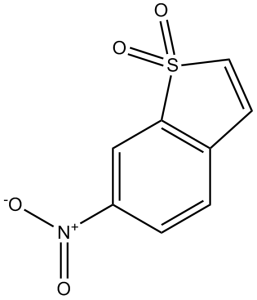
Stattic (6-Nitro-1-benzothiophene 1,1-dioxide) is a small molecule inhibitor of STAT3 that potently inhibits STAT3 activation and nuclear translocation with potential antineoplastic activity. It inhibits STAT3 with an IC50 of 5.1 μM in cell-free assays, and exhibits high selectivity for STAT3 over STAT1. Stattic is the first nonpeptidic small molecule inhibitor of STAT3 with IC50 values of 2.562 ± 0.409 μM, 3.481 ± 0.953 μM, 2.282 ± 0.423 μM and 2.648 ± 0.542 μM, respectively, in UM-SCC-17B, OSC-19, Cal33 and UM-SCC-22B cell lines. Stattic is reported to selectively inhibit dimerization, activation and nuclear translocation of STAT3. It can also induce the apoptosis of STAT3-dependent breast cancer cell lines.
Physicochemical Properties
| Molecular Formula | C8H5NO4S | |
| Molecular Weight | 211.19 | |
| Exact Mass | 210.993 | |
| CAS # | 19983-44-9 | |
| Related CAS # |
|
|
| PubChem CID | 2779853 | |
| Appearance | Light yellow to yellow solid powder | |
| Density | 1.6±0.1 g/cm3 | |
| Boiling Point | 461.1±45.0 °C at 760 mmHg | |
| Melting Point | 184ºC | |
| Flash Point | 232.6±28.7 °C | |
| Vapour Pressure | 0.0±1.1 mmHg at 25°C | |
| Index of Refraction | 1.671 | |
| LogP | 1.31 | |
| Hydrogen Bond Donor Count | 0 | |
| Hydrogen Bond Acceptor Count | 4 | |
| Rotatable Bond Count | 0 | |
| Heavy Atom Count | 14 | |
| Complexity | 375 | |
| Defined Atom Stereocenter Count | 0 | |
| InChi Key | ZRRGOUHITGRLBA-UHFFFAOYSA-N | |
| InChi Code | InChI=1S/C8H5NO4S/c10-9(11)7-2-1-6-3-4-14(12,13)8(6)5-7/h1-5H | |
| Chemical Name | 6-nitro-1-benzothiophene 1,1-dioxide | |
| Synonyms |
|
|
| HS Tariff Code | 2934.99.9001 | |
| Storage |
Powder-20°C 3 years 4°C 2 years In solvent -80°C 6 months -20°C 1 month |
|
| Shipping Condition | Room temperature (This product is stable at ambient temperature for a few days during ordinary shipping and time spent in Customs) |
Biological Activity
| Targets |
Stattic targets signal transducer and activator of transcription 3 (Stat3) with an IC50 of 5.1 μM for inhibiting Stat3 dimerization, and shows no significant inhibition of Stat1, Stat2, Stat4, Stat5a, Stat5b, or Stat6 (IC50>100 μM) [2] Stattic specifically inhibits Stat3 phosphorylation (Tyr705) and DNA binding activity without affecting other STAT family members [1,3] |
| ln Vitro |
In the ALDH+ and D44+/CD24+ subpopulations of Panc-1 and HPAC pancreatic cancer cell lines lacking P-ERK1/ 2, stattic (20 μM; 24 hours) preferentially inhibits P-STAT3 and inhibits STAT3 phosphorylation (Y705), as evidenced by the suppression of [1]. In PC3M-1E8 cells, stattic (2.5, 5, 10 μM; 4 hours) dramatically decreased the nuclear levels of survivin and pSTAT3 at 10 μM. A dose-dependent way is observed in the inhibition of IL-6-induced STAT3 activation by Stattic (2.5-10 μM; 24 hours) [2]. PC3M-1E8 cells, which are prostate cancer cells, exhibit growth inhibition and apoptosis in response to stattic (2.5, 5, 10 μM; 48 hours). At 2.5 μM and 5 μM, stattic does not significantly cause apoptosis [2]. Stattic (2.5, 5, 10 μM; 48 hours) exhibits a notable buildup of S-phase [2]. Stattic leads in very low levels of STAT3 phosphorylation and neither major morphological alterations nor apoptosis in A2780 cells or HUVEC cells [2]. Stattic (5-20 μM) dose-dependently inhibited proliferation of ALDH+ and CD44+/CD24+ stem cell-like pancreatic cancer cells (PANC-1, MiaPaCa-2), with IC50 values of 8.7 μM and 9.2 μM respectively [1] Stattic (10 μM) induced apoptosis in pancreatic cancer stem cells: apoptotic rate increased by 45% (Annexin V/PI staining), caspase-3/-9 activity enhanced by 3.1-fold, and anti-apoptotic proteins Bcl-2 and Survivin downregulated by 0.4-fold and 0.35-fold respectively [1] Stattic (5-15 μM) suppressed Stat3 phosphorylation (Tyr705) and DNA binding activity in pancreatic cancer cells, reducing Stat3 target genes (Cyclin D1, c-Myc, VEGF) mRNA levels by 52-68% [1] Stattic (2-10 μM) directly blocked Stat3 dimerization in a cell-free system, and inhibited Stat3-mediated luciferase reporter gene activity in HeLa cells by 75% at 10 μM [2] Stattic (10-20 μM) reduced fibrosis-related protein expression in renal mesangial cells isolated from Alport syndrome mice: α-SMA and collagen type IV levels decreased by 42-65%, and Stat3 phosphorylation (Tyr705) was inhibited by 70% [3] Stattic (15 μM) suppressed migration and invasion of pancreatic cancer stem cells by 58% and 62% respectively, as measured by Transwell assays [1] |
| ln Vivo |
In Alport syndrome (AS) mice, stattic (10 mg/kg; intraperitoneal injection; three times a week for ten weeks) improves renal dysfunction [3]. Stattic (10 mg/kg, i.p., twice weekly for 4 weeks) inhibited tumor growth in nude mice bearing PANC-1 xenografts: tumor volume reduced by 63% and tumor weight decreased by 59% compared to the vehicle group [1] Stattic treatment in xenograft mice reduced the frequency of ALDH+ and CD44+/CD24+ cancer stem cells in tumors by 55% and 52% respectively, and increased apoptotic index (TUNEL staining) by 3.5-fold [1] Stattic (5 mg/kg, i.p., three times weekly for 8 weeks) improved renal function in Alport syndrome mice: serum creatinine and BUN levels decreased by 38% and 42% respectively [3] Stattic (5 mg/kg, i.p.) attenuated renal fibrosis in Alport syndrome mice: renal α-SMA-positive cells reduced by 58%, collagen type IV deposition decreased by 60%, and renal Stat3 phosphorylation (Tyr705) inhibited by 65% [3] |
| Enzyme Assay |
Recombinant Stat3 protein was incubated with serial concentrations of Stattic (1-20 μM) in binding buffer at 37°C for 1 hour. Stat3 dimerization was detected by non-denaturing polyacrylamide gel electrophoresis, and the inhibition rate was calculated by densitometric analysis of dimer bands. IC50 was determined by fitting dose-response curves [2] HeLa cells transfected with Stat3-responsive luciferase reporter plasmid and Renilla luciferase plasmid were treated with Stattic (2-10 μM) for 24 hours. Luciferase activity was measured using a dual-luciferase assay system, with results normalized to Renilla luciferase activity to evaluate Stat3 transcriptional inhibition [2] |
| Cell Assay |
ALDH+ and CD44+/CD24+ pancreatic cancer cells were isolated from PANC-1 and MiaPaCa-2 cell lines by flow cytometry sorting. Isolated cells were seeded in 96-well plates (5×10^3 cells/well) and treated with Stattic (5-20 μM) for 72 hours. Cell viability was assessed by MTT assay, and IC50 values were calculated [1] Pancreatic cancer stem cells were seeded in 6-well plates (1×10^5 cells/well) and treated with Stattic (5-15 μM) for 24 hours. Cells were lysed, and protein extracts were subjected to western blot analysis using antibodies against phosphorylated Stat3 (Tyr705), total Stat3, Bcl-2, Survivin, Cyclin D1, and c-Myc [1] For apoptosis detection: pancreatic cancer stem cells were treated with Stattic (10 μM) for 24 hours, stained with Annexin V-FITC/PI, and analyzed by flow cytometry. Caspase-3/-9 activity was measured using a colorimetric assay kit [1] Renal mesangial cells from Alport syndrome mice were seeded in 6-well plates (2×10^5 cells/well) and treated with Stattic (10-20 μM) for 48 hours. Western blot was performed to detect α-SMA, collagen type IV, phosphorylated Stat3, and total Stat3 protein levels [3] Transwell migration and invasion assays: pancreatic cancer stem cells were seeded in the upper chamber of Transwell inserts, and Stattic (15 μM) was added to both chambers. After 24 hours (migration) or 48 hours (invasion), migrated/invaded cells were fixed, stained, and counted under a microscope [1] |
| Animal Protocol |
Animal/Disease Models: Age-matched wild-type (WT) C57BL/6 mice[3] Doses: 10 mg/kg Route of Administration: IP; three timesper week for 10 week Experimental Results: Increased levels of proteinuria, BUN and serum creatinine. Dramatically suppressed the gene expression levels of renal injury markers (Lcn2, Kim-1), pro-inflammatory cytokines (Il-6, KC), pro-fibrotic genes (Tgf-β, Col1a1, α-Sma) and Mmp9. Nude mice (6-8 weeks old) were subcutaneously injected with PANC-1 pancreatic cancer cells (1×10^6 cells/mouse) to establish xenografts. When tumors reached 100 mm³, mice were randomly divided into vehicle and Stattic groups (n=6 per group). Stattic was dissolved in DMSO and normal saline (DMSO final concentration <1%) and administered via intraperitoneal injection at 10 mg/kg twice weekly for 4 weeks. Tumor volume was measured every 3 days, and mice were euthanized to harvest tumors for flow cytometry (cancer stem cell frequency) and TUNEL staining [1] Alport syndrome mice (8 weeks old) were randomly divided into vehicle and Stattic groups (n=8 per group). Stattic was dissolved in DMSO and normal saline (DMSO final concentration <0.5%) and administered via intraperitoneal injection at 5 mg/kg three times weekly for 8 weeks. Serum samples were collected to measure creatinine and BUN levels. Mice were euthanized, and kidneys were harvested for histological analysis (fibrosis) and western blot (Stat3 phosphorylation, fibrosis markers) [3] |
| Toxicity/Toxicokinetics |
In nude mice and Alport syndrome mice treated with Stattic (up to 10 mg/kg, i.p., for 8 weeks), no significant weight loss or abnormal clinical signs (e.g., lethargy, diarrhea) were observed [1,3] Serum levels of liver function markers (ALT, AST) and kidney function markers (creatinine, BUN) in Stattic-treated Alport syndrome mice were within the normal range, with no significant difference from the vehicle group [3] |
| References |
[1]. STAT3 as a potential therapeutic target in ALDH+ and CD44+/CD24+ stem cell-like pancreatic cancer cells. Int J Oncol. 2016 Oct 12. [2]. A new small-molecule Stat3 inhibitor. Chem Biol. 2006 Nov;13(11):1123-4. [3]. STAT3 inhibition attenuates the progressive phenotypes of Alport syndrome mouse model. Nephrol Dial Transplant. 2018 Feb 1;33(2):214-223. |
| Additional Infomation |
Stattic is a member of the class of 1-benzothiophenes that is 1-benzothiophene-1,1-dioxide substituted at position 6 by a nitro group. Used as a radiosensitising agent for esophageal squamous cell carcinoma. It has a role as an antineoplastic agent, a STAT3 inhibitor and a radiosensitizing agent. It is a member of 1-benzothiophenes, a C-nitro compound and a sulfone. Stattic is a synthetic small molecule and the first specific non-peptidic inhibitor of Stat3 [2] Stattic exerts its inhibitory effect by binding to the Stat3 SH2 domain, preventing Stat3 dimerization, phosphorylation, and subsequent DNA binding and transcriptional activation [2,3] Stattic targets cancer stem cells by inhibiting Stat3 signaling, which is critical for maintaining stemness, proliferation, and survival of pancreatic cancer stem cells [1] Stattic attenuates renal fibrosis and improves renal function in Alport syndrome by suppressing Stat3-mediated pro-fibrotic signaling in renal cells [3] Stattic has potential therapeutic applications in pancreatic cancer (targeting cancer stem cells) and fibrotic kidney diseases such as Alport syndrome [1,3] |
Solubility Data
| Solubility (In Vitro) |
|
|||
| Solubility (In Vivo) |
Solubility in Formulation 1: ≥ 2.5 mg/mL (11.84 mM) (saturation unknown) in 10% DMSO + 40% PEG300 + 5% Tween80 + 45% Saline (add these co-solvents sequentially from left to right, and one by one), clear solution. For example, if 1 mL of working solution is to be prepared, you can add 100 μL of 25.0 mg/mL clear DMSO stock solution to 400 μL PEG300 and mix evenly; then add 50 μL Tween-80 to the above solution and mix evenly; then add 450 μL normal saline to adjust the volume to 1 mL. Preparation of saline: Dissolve 0.9 g of sodium chloride in 100 mL ddH₂ O to obtain a clear solution. Solubility in Formulation 2: ≥ 2.5 mg/mL (11.84 mM) (saturation unknown) in 10% DMSO + 90% Corn Oil (add these co-solvents sequentially from left to right, and one by one), clear solution. For example, if 1 mL of working solution is to be prepared, you can add 100 μL of 25.0 mg/mL clear DMSO stock solution to 900 μL of corn oil and mix evenly. Solubility in Formulation 3: 2% DMSO +30%PEG 300 +H2O:8 mg/mL (Please use freshly prepared in vivo formulations for optimal results.) |
| Preparing Stock Solutions | 1 mg | 5 mg | 10 mg | |
| 1 mM | 4.7351 mL | 23.6754 mL | 47.3507 mL | |
| 5 mM | 0.9470 mL | 4.7351 mL | 9.4701 mL | |
| 10 mM | 0.4735 mL | 2.3675 mL | 4.7351 mL |