Physicochemical Properties
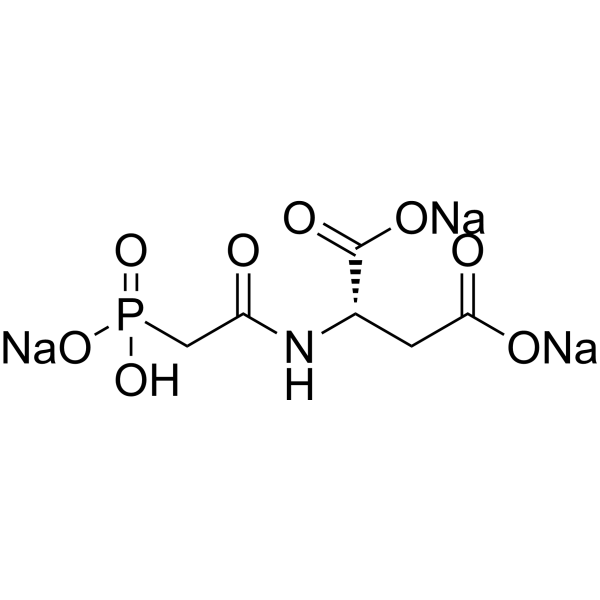
| Molecular Formula | C6H7NNA3O8P |
| Molecular Weight | 321.064755678177 |
| Exact Mass | 320.96 |
| CAS # | 70962-66-2 |
| Related CAS # | Sparfosic acid;51321-79-0 |
| PubChem CID | 154728861 |
| Appearance | Colorless to off-white solid-liquid Mixture |
| Hydrogen Bond Donor Count | 2 |
| Hydrogen Bond Acceptor Count | 8 |
| Rotatable Bond Count | 4 |
| Heavy Atom Count | 19 |
| Complexity | 333 |
| Defined Atom Stereocenter Count | 1 |
| SMILES | C([C@@H](C(=O)[O-])NC(=O)CP(=O)(O)[O-])C(=O)[O-].[Na+].[Na+].[Na+] |
| InChi Key | LKLUEGVLTGGBIX-LHWPGRLPSA-K |
| InChi Code | InChI=1S/C6H10NO8P.3Na/c8-4(2-16(13,14)15)7-3(6(11)12)1-5(9)10;;;/h3H,1-2H2,(H,7,8)(H,9,10)(H,11,12)(H2,13,14,15);;;/q;3*+1/p-3/t3-;;;/m0.../s1 |
| Chemical Name | trisodium;(2S)-2-[[2-[hydroxy(oxido)phosphoryl]acetyl]amino]butanedioate |
| HS Tariff Code | 2934.99.9001 |
| Storage |
Powder-20°C 3 years 4°C 2 years In solvent -80°C 6 months -20°C 1 month Note: (1). This product requires protection from light (avoid light exposure) during transportation and storage.(2). Please store this product in a sealed and protected environment (e.g. under nitrogen), avoid exposure to moisture. |
| Shipping Condition | Room temperature (This product is stable at ambient temperature for a few days during ordinary shipping and time spent in Customs) |
Biological Activity
| ln Vitro | Inflammation is induced in Br1 cells by spafosic acid trisodium (N-(Phosphonacetacet)-L-aspartate, PALA) therapy [1]. Cells in the accumulation phase can be gradually observed using spafosic acid trisodium (PALA, 300 μM), which also results in a blue cell cycle analysis of cell death [1]. |
| ln Vivo | In B16 melanoma-bearing mice, trisodium spadronate (490 mg/kg; i.p.; days 1, 5, and 9) resulted in a 77%–86% increase in lifetime above mortality. Trisodium spadronate has been shown to be particularly sensitive to Lewis lung cancer, and subcutaneous injections on days 1, 5, and 9 can cure 50% of Lewis lung cancer ducts [4]. In a mouse infection model, rezafungin (Biafungin) has demonstrated strong in vivo prophylaxis against Pneumocystis jiroveci [1]. |
| Cell Assay |
Cell Cycle Analysis[1] Cell Types: Br-l established by transplantation of nude mice injected with the human tumor cell line MDA-MB-435 and L-2 cell line. Tested Concentrations: 300 µM. Incubation Duration: 12, 24 and 48 hrs (hours). Experimental Results: Cells in both cell lines were mainly in S phase, but the proportion of S phase cells in L-2 was slightly higher than that in Brl-3prl cells. Western Blot Analysis[1] Cell Types: Br-1 and L-2 cell lines. Tested Concentrations: 300 µM. Incubation Duration: 4, 10 and 24 hrs (hours). Experimental Results: There were moderate differences in the levels of phosphorylated Rb protein in the two cell types. A significant increase in the amount of cyclin A protein was detected in apoptotic L-2 cells, with the highest levels detected 10 hrs (hours) after drug treatment. In contrast, cyclin A levels were not increased in Brl-3prl cells. Cyclin E protein was increased in L-2 cells and Brl-3prl cells compared with respective controls. |
| References |
[1]. Elevated cyclin A associated kinase activity promotes sensitivity of metastatic human cancer cells to DNA antimetabolite drug. Int J Oncol. 2015 Aug;47(2):782-90. [2]. A New, Efficient, Two Step Procedure for the Preparation of the Antineoplastic Agent Sparfosic Acid. [3]. Phase II trial of N-(phosphonacetyl)-L-aspartate (PALA), 5-fluorouracil and recombinant interferon-alpha-2b in patients with advanced gastric carcinoma. Eur J Cancer. 1996;32A(7):1254-1256. [4]. Antitumor activity of N-(phosphonacetyl)-L-aspartic acid, a transition-state inhibitor of aspartate transcarbamylase. Cancer Res. 1976;36(8):2720-2725. |
Solubility Data
| Solubility (In Vitro) |
H2O : ~250 mg/mL (~778.67 mM) DMSO : ~180 mg/mL (~560.64 mM) |
| Solubility (In Vivo) |
Solubility in Formulation 1: ≥ 4.5 mg/mL (14.02 mM) (saturation unknown) in 10% DMSO + 40% PEG300 + 5% Tween80 + 45% Saline (add these co-solvents sequentially from left to right, and one by one), clear solution. For example, if 1 mL of working solution is to be prepared, you can add 100 μL of 45.0 mg/mL clear DMSO stock solution to 400 μL PEG300 and mix evenly; then add 50 μL Tween-80 to the above solution and mix evenly; then add 450 μL normal saline to adjust the volume to 1 mL. Preparation of saline: Dissolve 0.9 g of sodium chloride in 100 mL ddH₂ O to obtain a clear solution. Solubility in Formulation 2: ≥ 4.5 mg/mL (14.02 mM) (saturation unknown) in 10% DMSO + 90% (20% SBE-β-CD in Saline) (add these co-solvents sequentially from left to right, and one by one), clear solution. For example, if 1 mL of working solution is to be prepared, you can add 100 μL of 45.0 mg/mL clear DMSO stock solution to 900 μL of 20% SBE-β-CD physiological saline solution and mix evenly. Preparation of 20% SBE-β-CD in Saline (4°C,1 week): Dissolve 2 g SBE-β-CD in 10 mL saline to obtain a clear solution. Solubility in Formulation 3: ≥ 4.5 mg/mL (14.02 mM) (saturation unknown) in 10% DMSO + 90% Corn Oil (add these co-solvents sequentially from left to right, and one by one), clear solution. For example, if 1 mL of working solution is to be prepared, you can add 100 μL of 45.0 mg/mL clear DMSO stock solution to 900 μL of corn oil and mix evenly. Solubility in Formulation 4: 100 mg/mL (311.47 mM) in PBS (add these co-solvents sequentially from left to right, and one by one), clear solution; with ultrasonication. (Please use freshly prepared in vivo formulations for optimal results.) |
| Preparing Stock Solutions | 1 mg | 5 mg | 10 mg | |
| 1 mM | 3.1147 mL | 15.5734 mL | 31.1468 mL | |
| 5 mM | 0.6229 mL | 3.1147 mL | 6.2294 mL | |
| 10 mM | 0.3115 mL | 1.5573 mL | 3.1147 mL |