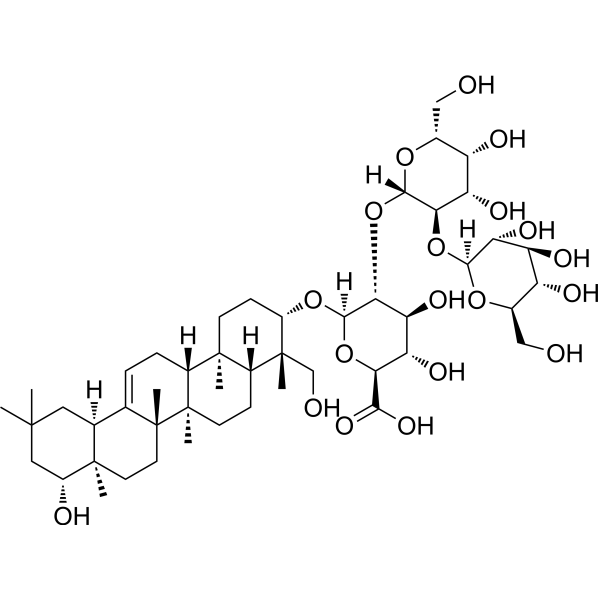
Physicochemical Properties
| Molecular Formula | C48H78O19 |
| Molecular Weight | 959.1215 |
| Exact Mass | 958.513 |
| CAS # | 114590-20-4 |
| PubChem CID | 91973815 |
| Appearance | White to off-white solid powder |
| Density | 1.4±0.1 g/cm3 |
| Boiling Point | 1054.6±65.0 °C at 760 mmHg |
| Flash Point | 300.1±27.8 °C |
| Vapour Pressure | 0.0±0.6 mmHg at 25°C |
| Index of Refraction | 1.631 |
| LogP | 5.85 |
| Hydrogen Bond Donor Count | 12 |
| Hydrogen Bond Acceptor Count | 19 |
| Rotatable Bond Count | 10 |
| Heavy Atom Count | 67 |
| Complexity | 1840 |
| Defined Atom Stereocenter Count | 25 |
| SMILES | C[C@]12CC[C@@H]([C@]([C@@H]1CC[C@@]3([C@@H]2CC=C4[C@]3(CC[C@@]5([C@H]4CC(C[C@H]5O)(C)C)C)C)C)(C)CO)O[C@H]6[C@@H]([C@H]([C@@H]([C@H](O6)C(=O)O)O)O)O[C@H]7[C@@H]([C@H]([C@H]([C@H](O7)CO)O)O)O[C@H]8[C@@H]([C@H]([C@@H]([C@H](O8)CO)O)O)O |
| InChi Key | WFRQIKSNAYYUJZ-BKQVBUAGSA-N |
| InChi Code | InChI=1S/C48H78O19/c1-43(2)16-22-21-8-9-26-45(4)12-11-28(46(5,20-51)25(45)10-13-48(26,7)47(21,6)15-14-44(22,3)27(52)17-43)64-42-38(34(58)33(57)36(65-42)39(60)61)67-41-37(32(56)30(54)24(19-50)63-41)66-40-35(59)31(55)29(53)23(18-49)62-40/h8,22-38,40-42,49-59H,9-20H2,1-7H3,(H,60,61)/t22-,23+,24+,25+,26+,27+,28-,29+,30-,31-,32-,33-,34-,35+,36-,37+,38+,40-,41-,42+,44+,45-,46+,47+,48+/m0/s1 |
| Chemical Name | (2S,3S,4S,5R,6R)-6-[[(3S,4S,4aR,6aR,6bS,8aR,9R,12aS,14aR,14bR)-9-hydroxy-4-(hydroxymethyl)-4,6a,6b,8a,11,11,14b-heptamethyl-1,2,3,4a,5,6,7,8,9,10,12,12a,14,14a-tetradecahydropicen-3-yl]oxy]-5-[(2S,3R,4S,5R,6R)-4,5-dihydroxy-6-(hydroxymethyl)-3-[(2S,3R,4S,5S,6R)-3,4,5-trihydroxy-6-(hydroxymethyl)oxan-2-yl]oxyoxan-2-yl]oxy-3,4-dihydroxyoxane-2-carboxylic acid |
| HS Tariff Code | 2934.99.9001 |
| Storage |
Powder-20°C 3 years 4°C 2 years In solvent -80°C 6 months -20°C 1 month Note: This product requires protection from light (avoid light exposure) during transportation and storage. |
| Shipping Condition | Room temperature (This product is stable at ambient temperature for a few days during ordinary shipping and time spent in Customs) |
Biological Activity
| Targets | Soyasaponin Ba inhibits human recombinant aldose reductase (hAKR1B1). Its IC50 for L-idose reduction is 40 µM (34–47 µM, 95% confidence limits), and for 4-hydroxynonenal (HNE) reduction is 47 µM (37–59 µM, 95% confidence limits). It acts as a mixed-type inhibitor with dissociation constants Ki = 66 µM and K’i = 24 µM for L-idose, and Ki = 65 µM and K’i = 23 µM for HNE. [1] |
| ln Vitro |
Soyasaponin Ba (SSBa) inhibited the reduction of both L-idose and HNE catalyzed by purified human recombinant aldose reductase (hAKR1B1) with similar effectiveness, indicating it functions as a conventional aldose reductase inhibitor (ARI) rather than a differential inhibitor (ARDI). [1] Kinetic analysis revealed that Soyasaponin Ba acts as a mixed-type inhibitor against hAKR1B1 for both substrates (L-idose and HNE), with comparable inhibition constants for each. [1] |
| Enzyme Assay |
The aldose reductase (hAKR1B1) activity was determined spectrophotometrically at 37°C by monitoring the decrease in absorbance at 340 nm due to NADPH oxidation. The standard assay mixture contained sodium phosphate buffer (pH 6.8), NADPH, ammonium sulfate, EDTA, and glyceraldehyde (GAL) as the substrate. For inhibitor testing, L-idose or HNE were used as substrates at specified concentrations instead of GAL. One unit of enzyme activity was defined as the amount catalyzing the conversion of 1 µmol of substrate per minute under the assay conditions. [1] To evaluate the inhibitory activity of fractions or pure compounds, 8 mU of hAKR1B1 was incubated with the inhibitor and either 0.8 mM L-idose or 0.04 mM HNE as substrates. The percentage inhibition was calculated, and differential inhibition (DI) was defined as the difference between the percentage inhibition observed using L-idose versus HNE as substrates. [1] For detailed kinetic characterization (e.g., determination of IC50, Ki, K’i), the activity of the purified enzyme was measured at varying concentrations of the substrate (L-idose or HNE) in the absence and presence of different concentrations of the inhibitor (Soyasaponin Ba or Soyasaponin Bb). Data were analyzed using Hanes-Woolf plots and secondary plots to determine the mode of inhibition and inhibition constants. [1] |
| References |
[1]. Soyasaponins from Zolfino bean as aldose reductase differential inhibitors. J Enzyme Inhib Med Chem. 2019 Dec;34(1):350-360. |
| Additional Infomation |
(2S,3S,4S,5R,6R)-6-[[(3S,4S,4aR,6aR,6bS,8aR,9R,12aS,14aR,14bR)-9-hydroxy-4-(hydroxymethyl)-4,6a,6b,8a,11,11,14b-heptamethyl-1,2,3,4a,5,6,7,8,9,10,12,12a,14,14a-tetradecahydropicen-3-yl]oxy]-5-[(2S,3R,4S,5R,6R)-4,5-dihydroxy-6-(hydroxymethyl)-3-[(2S,3R,4S,5S,6R)-3,4,5-trihydroxy-6-(hydroxymethyl)oxan-2-yl]oxyoxan-2-yl]oxy-3,4-dihydroxyoxane-2-carboxylic acid has been reported in Glycine max, Lotus pedunculatus, and other organisms with data available. Soyasaponin Ba is a triterpenoid saponin identified in the methanolic extract of seeds from the Zolfino bean landrace (Phaseolus vulgaris L.). [1] The study highlights the challenge of identifying aldose reductase differential inhibitors (ARDIs) in complex mixtures, as the presence of conventional, potent inhibitors like Soyasaponin Ba can mask the differential inhibitory effects of other components. [1] The inhibitory action of Soyasaponin Ba does not depend on the nature of the substrate (sugar vs. aldehyde), unlike some other saponins (e.g., Soyasaponin Bb) which exhibit differential inhibition. [1] |
Solubility Data
| Solubility (In Vitro) | DMSO : ~250 mg/mL (~260.66 mM) |
| Solubility (In Vivo) |
Note: Listed below are some common formulations that may be used to formulate products with low water solubility (e.g. < 1 mg/mL), you may test these formulations using a minute amount of products to avoid loss of samples. Injection Formulations (e.g. IP/IV/IM/SC) Injection Formulation 1: DMSO : Tween 80: Saline = 10 : 5 : 85 (i.e. 100 μL DMSO stock solution → 50 μL Tween 80 → 850 μL Saline) *Preparation of saline: Dissolve 0.9 g of sodium chloride in 100 mL ddH ₂ O to obtain a clear solution. Injection Formulation 2: DMSO : PEG300 :Tween 80 : Saline = 10 : 40 : 5 : 45 (i.e. 100 μL DMSO → 400 μLPEG300 → 50 μL Tween 80 → 450 μL Saline) Injection Formulation 3: DMSO : Corn oil = 10 : 90 (i.e. 100 μL DMSO → 900 μL Corn oil) Example: Take the Injection Formulation 3 (DMSO : Corn oil = 10 : 90) as an example, if 1 mL of 2.5 mg/mL working solution is to be prepared, you can take 100 μL 25 mg/mL DMSO stock solution and add to 900 μL corn oil, mix well to obtain a clear or suspension solution (2.5 mg/mL, ready for use in animals). Injection Formulation 4: DMSO : 20% SBE-β-CD in saline = 10 : 90 [i.e. 100 μL DMSO → 900 μL (20% SBE-β-CD in saline)] *Preparation of 20% SBE-β-CD in Saline (4°C,1 week): Dissolve 2 g SBE-β-CD in 10 mL saline to obtain a clear solution. Injection Formulation 5: 2-Hydroxypropyl-β-cyclodextrin : Saline = 50 : 50 (i.e. 500 μL 2-Hydroxypropyl-β-cyclodextrin → 500 μL Saline) Injection Formulation 6: DMSO : PEG300 : castor oil : Saline = 5 : 10 : 20 : 65 (i.e. 50 μL DMSO → 100 μLPEG300 → 200 μL castor oil → 650 μL Saline) Injection Formulation 7: Ethanol : Cremophor : Saline = 10: 10 : 80 (i.e. 100 μL Ethanol → 100 μL Cremophor → 800 μL Saline) Injection Formulation 8: Dissolve in Cremophor/Ethanol (50 : 50), then diluted by Saline Injection Formulation 9: EtOH : Corn oil = 10 : 90 (i.e. 100 μL EtOH → 900 μL Corn oil) Injection Formulation 10: EtOH : PEG300:Tween 80 : Saline = 10 : 40 : 5 : 45 (i.e. 100 μL EtOH → 400 μLPEG300 → 50 μL Tween 80 → 450 μL Saline) Oral Formulations Oral Formulation 1: Suspend in 0.5% CMC Na (carboxymethylcellulose sodium) Oral Formulation 2: Suspend in 0.5% Carboxymethyl cellulose Example: Take the Oral Formulation 1 (Suspend in 0.5% CMC Na) as an example, if 100 mL of 2.5 mg/mL working solution is to be prepared, you can first prepare 0.5% CMC Na solution by measuring 0.5 g CMC Na and dissolve it in 100 mL ddH2O to obtain a clear solution; then add 250 mg of the product to 100 mL 0.5% CMC Na solution, to make the suspension solution (2.5 mg/mL, ready for use in animals). Oral Formulation 3: Dissolved in PEG400 Oral Formulation 4: Suspend in 0.2% Carboxymethyl cellulose Oral Formulation 5: Dissolve in 0.25% Tween 80 and 0.5% Carboxymethyl cellulose Oral Formulation 6: Mixing with food powders Note: Please be aware that the above formulations are for reference only. InvivoChem strongly recommends customers to read literature methods/protocols carefully before determining which formulation you should use for in vivo studies, as different compounds have different solubility properties and have to be formulated differently. (Please use freshly prepared in vivo formulations for optimal results.) |
| Preparing Stock Solutions | 1 mg | 5 mg | 10 mg | |
| 1 mM | 1.0426 mL | 5.2131 mL | 10.4262 mL | |
| 5 mM | 0.2085 mL | 1.0426 mL | 2.0852 mL | |
| 10 mM | 0.1043 mL | 0.5213 mL | 1.0426 mL |