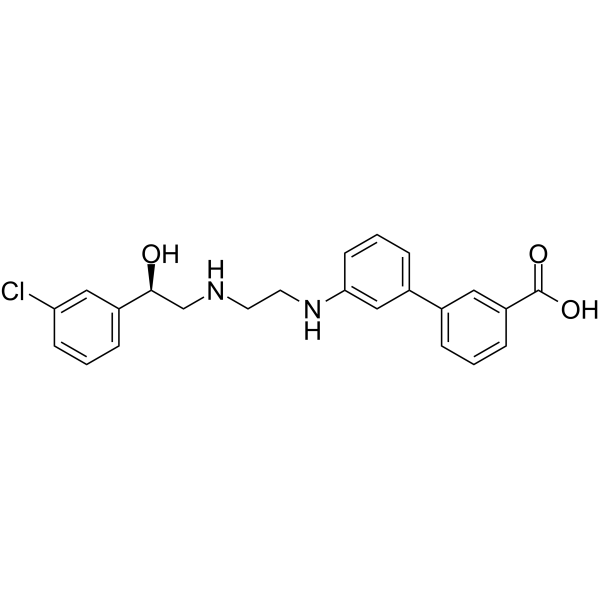
Physicochemical Properties
| Molecular Formula | C23H23CLN2O3 |
| Molecular Weight | 410.8933 |
| Exact Mass | 410.139 |
| CAS # | 252920-94-8 |
| PubChem CID | 9887812 |
| Appearance | Solid powder |
| LogP | 1.8 |
| Hydrogen Bond Donor Count | 4 |
| Hydrogen Bond Acceptor Count | 5 |
| Rotatable Bond Count | 9 |
| Heavy Atom Count | 29 |
| Complexity | 507 |
| Defined Atom Stereocenter Count | 1 |
| SMILES | ClC1=C([H])C([H])=C([H])C(=C1[H])[C@]([H])(C([H])([H])N([H])C([H])([H])C([H])([H])N([H])C1=C([H])C([H])=C([H])C(C2C([H])=C([H])C([H])=C(C(=O)O[H])C=2[H])=C1[H])O[H] |
| InChi Key | LLDXOPKUNJTIRF-QFIPXVFZSA-N |
| InChi Code | InChI=1S/C23H23ClN2O3/c24-20-8-2-6-18(13-20)22(27)15-25-10-11-26-21-9-3-5-17(14-21)16-4-1-7-19(12-16)23(28)29/h1-9,12-14,22,25-27H,10-11,15H2,(H,28,29)/t22-/m0/s1 |
| Chemical Name | 3-[3-[2-[[(2R)-2-(3-chlorophenyl)-2-hydroxyethyl]amino]ethylamino]phenyl]benzoic acid |
| HS Tariff Code | 2934.99.9001 |
| Storage |
Powder-20°C 3 years 4°C 2 years In solvent -80°C 6 months -20°C 1 month Note: This product requires protection from light (avoid light exposure) during transportation and storage. |
| Shipping Condition | Room temperature (This product is stable at ambient temperature for a few days during ordinary shipping and time spent in Customs) |
Biological Activity
| Targets |
β3-adrenergic receptor (Ki = 0.4 nM for human β3; Ki > 10,000 nM for human β1/β2; EC50 = 1.8 nM for cAMP accumulation in human β3-expressing cells) [1] β3-adrenergic receptor (high selectivity over β1 and β2 subtypes; no significant binding to α1, α2-adrenergic receptors or other GPCRs) [2] |
| ln Vitro |
In human β3-adrenergic receptor-expressing CHO cells, Solabegron induced concentration-dependent cAMP accumulation (EC50 = 1.8 nM) and showed full agonist activity (maximal response similar to isoproterenol). Competitive binding assays demonstrated high affinity for human β3 (Ki = 0.4 nM) with negligible binding to β1/β2 (Ki > 10,000 nM) [1] In isolated canine bladder detrusor strips, Solabegron (1-1000 nM) caused concentration-dependent relaxation in a pre-contracted state (carbachol-induced). The relaxation response was antagonized by the β3-selective antagonist L-748,337, confirming β3 receptor-mediated action [1] In human and rat bladder smooth muscle cells, Solabegron (0.1-100 nM) increased cAMP levels and inhibited calcium influx, leading to reduced cell contractility. No significant activation of β1/β2 receptors was observed in cardiac or vascular smooth muscle cells [2] |
| ln Vivo |
Intravenous administration of Solabegron (GW427353) at 3 mg/kg promoted a rise in the urine output threshold in dogs, hence reducing acetic acid-induced decrease in urinary output in dogs. Low dosages (1 mg/kg) demonstrated no meaningful action [1]. In anesthetized male beagle dogs, intravenous administration of Solabegron (0.1-10 mg/kg) dose-dependently increased bladder capacity (maximal 42% increase at 10 mg/kg) and micturition reflex threshold (maximal 58% increase at 10 mg/kg) without altering mean arterial pressure or heart rate [1] In conscious dogs with induced overactive bladder (intravesical acetic acid), oral Solabegron (1-30 mg/kg) reduced micturition frequency (maximal 35% reduction at 30 mg/kg) and increased voided volume per micturition (maximal 40% increase at 30 mg/kg) [1] In rat models of overactive bladder (partial bladder outlet obstruction), Solabegron (0.3-10 mg/kg, oral) improved urodynamic parameters: increased bladder compliance, reduced detrusor overactivity, and prolonged inter-micturition intervals. No significant effects on cardiovascular function were detected [2] |
| Enzyme Assay |
Competitive radioligand binding assay: Human β1/β2/β3-adrenergic receptor-expressing membranes were incubated with [125I]-cyanopindolol (radioligand) and Solabegron (0.01 nM-10 μM) for 60 minutes at 25°C. Bound and free ligand were separated by filtration, and radioactivity was measured. Ki values were calculated using nonlinear regression [1] cAMP accumulation assay: β3-expressing CHO cells were seeded in 96-well plates and incubated with Solabegron (0.01 nM-10 μM) for 30 minutes at 37°C. Cells were lysed, and cAMP levels were quantified via enzyme immunoassay. EC50 values were derived from concentration-response curves [1] Receptor subtype selectivity assay: Cells expressing human β1, β2, α1, α2 receptors or other GPCRs were treated with Solabegron (10 μM), and functional responses (cAMP accumulation, calcium mobilization) were measured. No significant activation of non-target receptors was detected [2] |
| Cell Assay |
Canine bladder detrusor cells were isolated and cultured in DMEM/F12 medium. Confluent cells were pre-treated with Solabegron (0.1-1000 nM) for 20 minutes, then stimulated with carbachol (1 μM) to induce contraction. Cell contractility was assessed via impedance measurement, and cAMP levels were quantified by ELISA [1] Human bladder smooth muscle cells were cultured in collagen-coated plates. Cells were treated with Solabegron (0.1-100 nM) for 30 minutes, and calcium influx was measured using a fluorescent calcium indicator (Fura-2 AM) under fluorescence microscopy. Western blot analysis confirmed increased phosphorylation of PKA (cAMP-dependent protein kinase) [2] |
| Animal Protocol |
Animal/Disease Models: Adult female beagle dog (6-10 kg) [1]. Doses: 1, 3 mg/kg. Doses: IV once. Experimental Results: A dose of 3 mg/kg caused an increase in the urine output threshold. Anesthetized male beagle dogs (8-12 kg) were instrumented with a transurethral bladder catheter and arterial pressure transducer. Solabegron was dissolved in 0.9% saline (intravenous) or 0.5% methylcellulose (oral) and administered at doses of 0.1-10 mg/kg (IV) or 1-30 mg/kg (oral). Bladder pressure, micturition frequency, and cardiovascular parameters were recorded continuously for 4 hours post-administration [1] Conscious dogs with acetic acid-induced overactive bladder: Dogs were acclimated to metabolic cages, and intravesical acetic acid (0.25%) was infused to induce frequent micturition. Solabegron (1-30 mg/kg, oral) was administered, and micturition events, voided volume, and residual urine volume were recorded over 8 hours [1] Male Sprague-Dawley rats (250-300 g) with partial bladder outlet obstruction: Obstruction was induced surgically 2 weeks prior to drug treatment. Solabegron (0.3-10 mg/kg, oral) was given once daily for 7 days. Urodynamic studies were performed under anesthesia to measure bladder compliance, detrusor pressure, and inter-micturition intervals [2] |
| ADME/Pharmacokinetics |
In beagle dogs, oral administration of Solabegron (10 mg/kg) resulted in peak plasma concentration (Cmax) of 89 ng/mL at 2 hours (Tmax), oral bioavailability of 32%, and elimination half-life (t1/2) of 4.6 hours. Intravenous administration (1 mg/kg) showed a t1/2 of 3.8 hours and volume of distribution (Vd) of 1.2 L/kg [2] In rats, Solabegron was well-absorbed after oral dosing (bioavailability 45%), with extensive distribution to bladder tissue (tissue/plasma ratio = 2.3 at 1 hour post-dose). Metabolism occurred primarily via glucuronidation, with >70% of the dose excreted in urine as unchanged drug and glucuronide conjugate [2] |
| Toxicity/Toxicokinetics |
In repeated-dose toxicity studies (28 days) in rats and dogs, Solabegron (up to 100 mg/kg/day, oral) showed no significant adverse effects on body weight, hematology, or liver/kidney function. No histopathological abnormalities were observed in major organs [2] Plasma protein binding: Solabegron bound to human plasma proteins at 82±3% (in vitro), with no concentration-dependent binding (0.1-10 μg/mL) [2] No significant cardiovascular toxicity was detected: In dogs, doses up to 30 mg/kg (oral) did not alter heart rate, QTc interval, or mean arterial pressure. No drug-drug interactions with commonly used antimuscarinic agents were observed [1][2] |
| References |
[1]. GW427353 (solabegron), a novel, selective beta3-adrenergic receptor agonist, evokes bladder relaxation and increases micturition reflex threshold in the dog. J Pharmacol Exp Ther. 2007 Oct;323(1):202-9. [2]. Selective β3-adrenoceptor agonists for the treatment of overactive bladder. J Urol. 2013 Oct;190(4):1173-80. |
| Additional Infomation |
Solabegron is a carboxybiphenyl that is [biphenyl]-3-carboxylic acid carrying a (2-{[(2R)-2-(3-chlorophenyl)-2-hydroxyethyl]amino}ethyl)nitrilo group at the 3' position. A selective beta3-adrenergic receptor agonist currently in clinical development for the treatment of overactive bladder and irritable bowel syndrome. It has a role as a beta-adrenergic agonist. It is a secondary alcohol, a substituted aniline, a member of monochlorobenzenes, a secondary amino compound and a carboxybiphenyl. Solabegron (GW-427,353) is a selective β3 adrenoceptor agonist being developed for the treatment of overactive bladder and irritable bowel syndrome. Drug Indication Investigated for use/treatment in diabetes mellitus type 2, irritable bowel syndrome (IBS), and urinary incontinence. Solabegron is a selective β3-adrenergic receptor agonist that exerts its therapeutic effect by activating β3 receptors in bladder smooth muscle, leading to cAMP accumulation, reduced calcium influx, and bladder relaxation [1][2] The drug is being developed for the treatment of overactive bladder (OAB), targeting symptoms including urinary frequency, urgency, and nocturia [2] Unlike non-selective β-agonists, Solabegron’s high selectivity for β3 receptors avoids β1-mediated cardiac effects and β2-mediated vascular/bronchial effects, improving safety profile [1][2] |
Solubility Data
| Solubility (In Vitro) | DMSO : ≥ 33.33 mg/mL (~81.12 mM) |
| Solubility (In Vivo) |
Solubility in Formulation 1: ≥ 2.17 mg/mL (5.28 mM) (saturation unknown) in 10% DMSO + 40% PEG300 + 5% Tween80 + 45% Saline (add these co-solvents sequentially from left to right, and one by one), clear solution. For example, if 1 mL of working solution is to be prepared, you can add 100 μL of 21.7 mg/mL clear DMSO stock solution to 400 μL PEG300 and mix evenly; then add 50 μL Tween-80 to the above solution and mix evenly; then add 450 μL normal saline to adjust the volume to 1 mL. Preparation of saline: Dissolve 0.9 g of sodium chloride in 100 mL ddH₂ O to obtain a clear solution. Solubility in Formulation 2: ≥ 2.17 mg/mL (5.28 mM) (saturation unknown) in 10% DMSO + 90% (20% SBE-β-CD in Saline) (add these co-solvents sequentially from left to right, and one by one), clear solution. For example, if 1 mL of working solution is to be prepared, you can add 100 μL of 21.7 mg/mL clear DMSO stock solution to 900 μL of 20% SBE-β-CD physiological saline solution and mix evenly. Preparation of 20% SBE-β-CD in Saline (4°C,1 week): Dissolve 2 g SBE-β-CD in 10 mL saline to obtain a clear solution. Solubility in Formulation 3: ≥ 2.17 mg/mL (5.28 mM) (saturation unknown) in 10% DMSO + 90% Corn Oil (add these co-solvents sequentially from left to right, and one by one), clear solution. For example, if 1 mL of working solution is to be prepared, you can add 100 μL of 21.7 mg/mL clear DMSO stock solution to 900 μL of corn oil and mix evenly. (Please use freshly prepared in vivo formulations for optimal results.) |
| Preparing Stock Solutions | 1 mg | 5 mg | 10 mg | |
| 1 mM | 2.4337 mL | 12.1687 mL | 24.3374 mL | |
| 5 mM | 0.4867 mL | 2.4337 mL | 4.8675 mL | |
| 10 mM | 0.2434 mL | 1.2169 mL | 2.4337 mL |