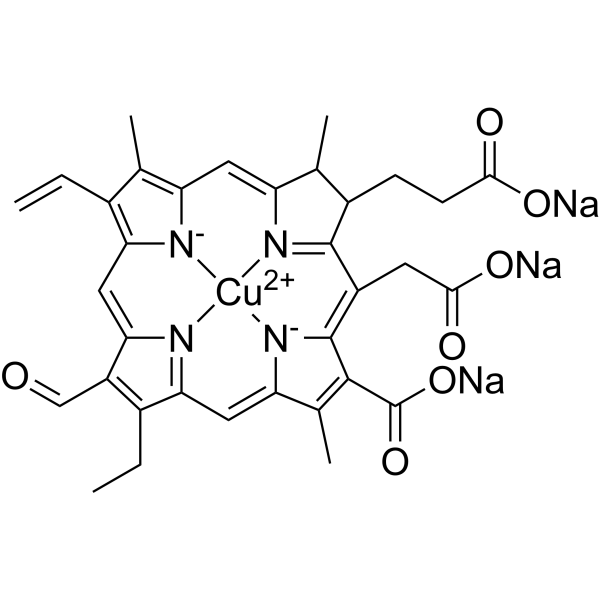
Physicochemical Properties
| Molecular Formula | C34H29CUN4NA3O7 |
| Molecular Weight | 738.14 |
| CAS # | 28302-36-5 |
| Appearance | Black green to black solid powder |
| Boiling Point | 790ºC at 760mmHg |
| Flash Point | 431.6ºC |
| HS Tariff Code | 2934.99.9001 |
| Storage |
Powder-20°C 3 years 4°C 2 years In solvent -80°C 6 months -20°C 1 month Note: Please store this product in a sealed and protected environment, avoid exposure to moisture. |
| Shipping Condition | Room temperature (This product is stable at ambient temperature for a few days during ordinary shipping and time spent in Customs) |
Biological Activity
| ln Vitro | Chlorophyll B sodium copper demonstrated influenza virus adsorption at 200 µM (P<0.05). The IC50 and 50% cytotoxic concentration (CC50) of sodium copper chlorophyllin are 50 to 100 µM and 200 to 400 µM, respectively. Sodium chlorophyll B copper also decreased HIV adsorption at 2.5 mM (P<0.05). The IC50 and CC50 of sodium copper chlorophyllin are 50 to 100 µM and 200 to 400 µM respectively[1]. |
| References |
[1]. In Vitro Inhibition of Cytopathic Effect of Influenza Virus and Human Immunodeficiency Virus by Bamboo Leaf Extract Solution and Sodium Copper Chlorophyllin. Yonago Acta Med. 2016 Mar; 59(1): 61-65. |
Solubility Data
| Solubility (In Vitro) |
H2O : ~10 mg/mL (~13.55 mM) DMSO : ~6.67 mg/mL (~9.04 mM) |
| Solubility (In Vivo) |
Solubility in Formulation 1: ≥ 0.67 mg/mL (0.91 mM) (saturation unknown) in 10% DMSO + 40% PEG300 + 5% Tween80 + 45% Saline (add these co-solvents sequentially from left to right, and one by one), clear solution. For example, if 1 mL of working solution is to be prepared, you can add 100 μL of 6.7 mg/mL clear DMSO stock solution to 400 μL PEG300 and mix evenly; then add 50 μL Tween-80 to the above solution and mix evenly; then add 450 μL normal saline to adjust the volume to 1 mL. Preparation of saline: Dissolve 0.9 g of sodium chloride in 100 mL ddH₂ O to obtain a clear solution. Solubility in Formulation 2: ≥ 0.67 mg/mL (0.91 mM) (saturation unknown) in 10% DMSO + 90% (20% SBE-β-CD in Saline) (add these co-solvents sequentially from left to right, and one by one), clear solution. For example, if 1 mL of working solution is to be prepared, you can add 100 μL of 6.7 mg/mL clear DMSO stock solution to 900 μL of 20% SBE-β-CD physiological saline solution and mix evenly. Preparation of 20% SBE-β-CD in Saline (4°C,1 week): Dissolve 2 g SBE-β-CD in 10 mL saline to obtain a clear solution. Solubility in Formulation 3: ≥ 0.67 mg/mL (0.91 mM) (saturation unknown) in 10% DMSO + 90% Corn Oil (add these co-solvents sequentially from left to right, and one by one), clear solution. For example, if 1 mL of working solution is to be prepared, you can add 100 μL of 6.7 mg/mL clear DMSO stock solution to 900 μL of corn oil and mix evenly. Solubility in Formulation 4: 20 mg/mL (27.10 mM) in PBS (add these co-solvents sequentially from left to right, and one by one), clear solution; with ultrasonication. (Please use freshly prepared in vivo formulations for optimal results.) |
| Preparing Stock Solutions | 1 mg | 5 mg | 10 mg | |
| 1 mM | 1.3548 mL | 6.7738 mL | 13.5476 mL | |
| 5 mM | 0.2710 mL | 1.3548 mL | 2.7095 mL | |
| 10 mM | 0.1355 mL | 0.6774 mL | 1.3548 mL |