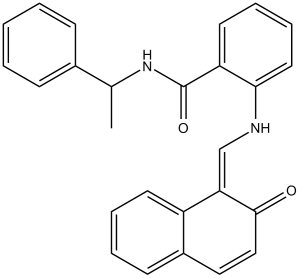
Sirtinol is a cell-permeable and specific inhibitor of the sirtuin deacetylase 1/2 (SIRT1/2) with potential anticancer and anti-inflammatory activity. It inhibits SIRT1/2 with IC50s of 131 μM and 38 μM in cell-free assays, respectively. It attenuates pro-inflammatory cytokine production and protects against hepatic injury following trauma-hemorrhage in male Sprague-Dawley rats. Sirtinol also inhibits the growth of MCF-7 cells in a concentration- and time-dependent manner.
Physicochemical Properties
| Molecular Formula | C26H22N2O2 | |
| Molecular Weight | 394.47 | |
| Exact Mass | 394.168 | |
| CAS # | 410536-97-9 | |
| Related CAS # |
|
|
| PubChem CID | 2827646 | |
| Appearance | Light yellow to yellow solid powder | |
| Density | 1.2±0.1 g/cm3 | |
| Boiling Point | 659.2±50.0 °C at 760 mmHg | |
| Melting Point | 119-120℃ | |
| Flash Point | 352.5±30.1 °C | |
| Vapour Pressure | 0.0±2.1 mmHg at 25°C | |
| Index of Refraction | 1.623 | |
| LogP | 6.2 | |
| Hydrogen Bond Donor Count | 2 | |
| Hydrogen Bond Acceptor Count | 3 | |
| Rotatable Bond Count | 5 | |
| Heavy Atom Count | 30 | |
| Complexity | 586 | |
| Defined Atom Stereocenter Count | 0 | |
| InChi Key | UXJFDYIHRJGPFS-WPWMEQJKSA-N | |
| InChi Code | InChI=1S/C26H22N2O2/c1-18(19-9-3-2-4-10-19)28-26(30)22-13-7-8-14-24(22)27-17-23-21-12-6-5-11-20(21)15-16-25(23)29/h2-18,29H,1H3,(H,28,30)/b27-17+ | |
| Chemical Name | 2-[[(2-Hydroxy-1-naphthalenyl)methylene]amino]- N -(1-phenylethyl)benzamide | |
| Synonyms | Sirtinol | |
| HS Tariff Code | 2934.99.9001 | |
| Storage |
Powder-20°C 3 years 4°C 2 years In solvent -80°C 6 months -20°C 1 month |
|
| Shipping Condition | Room temperature (This product is stable at ambient temperature for a few days during ordinary shipping and time spent in Customs) |
Biological Activity
| ln Vitro | Sirtinol decreases the proliferation of MCF-7 cells in a concentration- and time-dependent way. After 24 and 48 hours of therapy, the IC50 values of sirtinol were 48.6 μM and 43.5 μM, respectively. Sirtinol dramatically lowers SIRT1 expression and increases acetylated p53 levels [1]. Sirtinol attenuates the proliferation and causes apoptosis of non-small cell lung cancer (NSCLC) H1299 cells, and leads to a large increase in the levels of FoxO3a, a pro-apoptotic transcription factor targeted by Sirt1 [2]. | ||
| ln Vivo | Sirtinol has anti-inflammatory properties by directly inhibiting HNE activity and reducing HNE-induced and LPS-mediated tissue or organ damage [3]. | ||
| Animal Protocol |
|
||
| References |
[1]. Sirtinol, a class III HDAC inhibitor, induces apoptotic and autophagic cell death in MCF-7 human breast cancer cells. Int J Oncol. 2012 Sep;41(3):1101-1109. [2]. The antiproliferative and apoptotic effects of sirtinol, a sirtuin inhibitor on human lung cancer cells by modulating Akt/β-catenin-Foxo3a axis. ScientificWorldJournal. 2014;2014:937051. [3]. Design, synthesis, and biological evaluation of sirtinol analogues as class III histone/protein deacetylase (Sirtuin) inhibitors. J Med Chem. 2005 Dec 1;48(24):7789-95. [4]. Sirtinol inhibits neutrophil elastase activity and attenuates lipopolysaccharide-mediated acute lung injury in mice. Sci Rep. 2015 Feb 10;5:8347. |
||
| Additional Infomation | Sirtinol is a benzamide obtained by formal condensation of the carboxy group of 2-{[(2-hydroxy-1-naphthyl)methylene]amino}benzoic acid with the amino group of 1-phenylethylamine. It has a role as an anti-inflammatory agent, an EC 3.5.1.98 (histone deacetylase) inhibitor and a Sir2 inhibitor. It is a member of benzamides, an aldimine and a member of naphthols. It is functionally related to an anthranilic acid. |
Solubility Data
| Solubility (In Vitro) |
|
|||
| Solubility (In Vivo) |
Solubility in Formulation 1: ≥ 1 mg/mL (2.54 mM) (saturation unknown) in 10% DMSO + 40% PEG300 + 5% Tween80 + 45% Saline (add these co-solvents sequentially from left to right, and one by one), clear solution. For example, if 1 mL of working solution is to be prepared, you can add 100 μL of 10.0 mg/mL clear DMSO stock solution to 400 μL of PEG300 and mix evenly; then add 50 μL of Tween-80 to the above solution and mix evenly; then add 450 μL of normal saline to adjust the volume to 1 mL. Preparation of saline: Dissolve 0.9 g of sodium chloride in 100 mL ddH₂ O to obtain a clear solution. Solubility in Formulation 2: 2% DMSO+30% PEG 300+5% Tween 80+ddH2O:0.4 mg/mL (Please use freshly prepared in vivo formulations for optimal results.) |
| Preparing Stock Solutions | 1 mg | 5 mg | 10 mg | |
| 1 mM | 2.5350 mL | 12.6752 mL | 25.3505 mL | |
| 5 mM | 0.5070 mL | 2.5350 mL | 5.0701 mL | |
| 10 mM | 0.2535 mL | 1.2675 mL | 2.5350 mL |