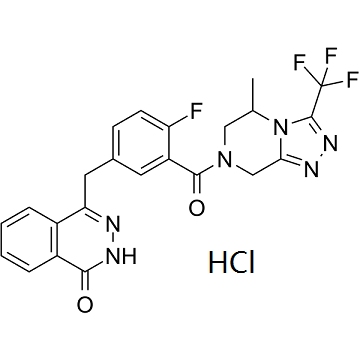
Simmiparib is a novel and potent dual PARP1 and PARP2 inhibitor (IC50 = 1.75/0.22 nM) with anticancer activity. It selectively inhibits PARP1 with >90-fold higher potency than the other PARPs (PARP3, TNKS1, TNKS2).
Physicochemical Properties
| Molecular Formula | C24H20F4N6O |
| Molecular Weight | 484.448818206787 |
| Exact Mass | 486.142 |
| CAS # | 1551355-46-4 |
| PubChem CID | 72736758 |
| Appearance | White to off-white solid powder |
| LogP | 2.2 |
| Hydrogen Bond Donor Count | 1 |
| Hydrogen Bond Acceptor Count | 9 |
| Rotatable Bond Count | 3 |
| Heavy Atom Count | 35 |
| Complexity | 869 |
| Defined Atom Stereocenter Count | 0 |
| SMILES | C1(C)N2C(=NN=C2CN(C(C2C(=CC=C(C=2)CC2C3C(C(NN=2)=O)=CC=CC=3)F)=C)C1)C(F)(F)F |
| InChi Key | QNQFPYADHVFRKQ-UHFFFAOYSA-N |
| InChi Code | InChI=1S/C23H18F4N6O2/c1-12-10-32(11-19-29-31-22(33(12)19)23(25,26)27)21(35)16-8-13(6-7-17(16)24)9-18-14-4-2-3-5-15(14)20(34)30-28-18/h2-8,12H,9-11H2,1H3,(H,30,34) |
| Chemical Name | 4-[[4-fluoro-3-[5-methyl-3-(trifluoromethyl)-6,8-dihydro-5H-[1,2,4]triazolo[4,3-a]pyrazine-7-carbonyl]phenyl]methyl]-2H-phthalazin-1-one |
| HS Tariff Code | 2934.99.9001 |
| Storage |
Powder-20°C 3 years 4°C 2 years In solvent -80°C 6 months -20°C 1 month |
| Shipping Condition | Room temperature (This product is stable at ambient temperature for a few days during ordinary shipping and time spent in Customs) |
Biological Activity
| ln Vitro | Simmiparib has antiproliferative action against a range of cancer cells at concentrations of 0–10 μM for three days [1]. In Capan-1 cells, simmaparib (0–10 μM; 48 hours) causes a classic G2/M arrest [1]. Simmiparib (0.1-2 μM; 24 hours) dose-dependently raises γH2AX levels and causes apoptosis in MDA-MB-436 and V-C8 (BRCA2-/-) cells [1]. Simmiparib (1-10 μM; 48 hours or 72 hours) raises the levels of protein for p-Cyclin B1 (S147), Cyclin B1, p-CDK1 (Y15), and CDK1 as well as the phosphorylation of Chk1 and Chk2[1]. |
| ln Vivo | Simmiparib inhibits the growth of tumors in BRCA2-/- and MDA-MB-436 (BRCA2-/-) xenograft mouse models. It is administered orally once daily for 14 days at doses of 2, 4, and 8 mg/kg. 1]. In a xenograft mouse model, simpliparib (10 and 50 mg/kg; oral; once daily for 42 days) inhibits the growth of BRCA1-mutated breast cancer [1]. |
| Cell Assay |
Cell Proliferation Assay[1] Cell Types: Various cancer cells containing defects in BRCA1, BRCA2, PTEN and EWS-FLI1 Tested Concentrations: 0-10 μM Incubation Duration: 3 days Experimental Results: For MDA-MB-436 (BRCA1-/-) , RD-ES (EWS-FLI1), DoTc2-4510 (BRCA2-/-), Capan-1 (BRCA2-/-) and U251 (PTEN-/-), with IC50 of 0.2 nM, 4.6 nM and 20 respectively. nM, 21 nM and 36 nM. Cell cycle analysis[1] Cell Types: Capan-1 Cell Tested Concentrations: 0, 1, 3 and 10 μM Incubation Duration: 48 hrs (hours) Experimental Results: Induction of typical G2/M arrest in a concentration-dependent manner. Apoptosis analysis [1] Cell Types: MDA-MB-436 Tested Concentrations: 0.1 and 1 μM Incubation Duration: 24 hrs (hours) Experimental Results: 0.1 and 1 μM caused 39.64% and 42.98% of cell apoptosis respectively. γH2AX levels increased in a dose-dependent manner. Apoptosis analysis[1] Cell Types: V-C8 (BRCA2-/-) Tested Concentrations: 0.5 and 2 μM Incubation Duration: 24 hrs (hours) Experimental Results: Caused more than 57% of cells to undergo apoptosis. Western Blot Analysis[1] Cell Types: Capan-1 Tested Concentrations: 1 and 10 μM I |
| Animal Protocol |
Animal/Disease Models: Female BALB/cA nude mice (subcutaneous injection of BRCA2-/- V-C8 cells and BRCA2-/- MDA-MB-436 cells) [1] Doses: 2, 4 and 8 mg/kg Route of Administration: po ; qd, 14 days Experimental Results: 8 mg/kg Dramatically inhibited V-C8 tumor growth, with an inhibition rate of 74.53%. Inhibited the growth of BRCA1-deficient MDA-MB-436 xenografts in a dose-dependent manner, with average inhibition rates of 64.93, 82.98, and 85.79% at 2, 4, and 8 mg/kg. Did not result in significant weight loss. Animal/Disease Models: Female BALB/cA nude mice (subcutaneous injection of BRCA1 mutated BR-05-0028 breast cancer tissue-derived cancer cells) [1] Doses: 10 and 50 mg/kg Route of Administration: po; qd, for 42 days Experimental Results: Produce dose-dependent growth inhibition, the inhibition rates at 10 mg/kg and 50 mg/kg were 76.73% and 93.82% respectively. |
| References |
[1]. Poly(ADP-ribose)polymerase (PARP) inhibition and anticancer activity of simmiparib, a new inhibitor undergoing clinical trials. Cancer Lett. 2017 Feb 1;386:47-56. |
| Additional Infomation | Simmiparib is an orally bioavailable inhibitor of the nuclear enzyme poly(ADP-ribose) polymerase (PARP) 1 (PARP1) and 2 (PARP2), with potential antineoplastic activity. Upon oral administration, simmiparib selectively binds to PARP and prevents PARP-mediated DNA repair of breaks in single-stranded DNA via the base excision repair pathway. This induces the accumulation of DNA strand breaks, promotes genomic instability, induces G2/M arrest and leads to apoptosis. PARP is activated by single-strand DNA breaks and catalyzes post-translational ADP-ribosylation of nuclear proteins, which signal and recruit other proteins to repair damaged DNA. |
Solubility Data
| Solubility (In Vitro) | DMSO : ~100 mg/mL (~205.58 mM) |
| Solubility (In Vivo) |
Note: Listed below are some common formulations that may be used to formulate products with low water solubility (e.g. < 1 mg/mL), you may test these formulations using a minute amount of products to avoid loss of samples. Injection Formulations (e.g. IP/IV/IM/SC) Injection Formulation 1: DMSO : Tween 80: Saline = 10 : 5 : 85 (i.e. 100 μL DMSO stock solution → 50 μL Tween 80 → 850 μL Saline) *Preparation of saline: Dissolve 0.9 g of sodium chloride in 100 mL ddH ₂ O to obtain a clear solution. Injection Formulation 2: DMSO : PEG300 :Tween 80 : Saline = 10 : 40 : 5 : 45 (i.e. 100 μL DMSO → 400 μLPEG300 → 50 μL Tween 80 → 450 μL Saline) Injection Formulation 3: DMSO : Corn oil = 10 : 90 (i.e. 100 μL DMSO → 900 μL Corn oil) Example: Take the Injection Formulation 3 (DMSO : Corn oil = 10 : 90) as an example, if 1 mL of 2.5 mg/mL working solution is to be prepared, you can take 100 μL 25 mg/mL DMSO stock solution and add to 900 μL corn oil, mix well to obtain a clear or suspension solution (2.5 mg/mL, ready for use in animals). Injection Formulation 4: DMSO : 20% SBE-β-CD in saline = 10 : 90 [i.e. 100 μL DMSO → 900 μL (20% SBE-β-CD in saline)] *Preparation of 20% SBE-β-CD in Saline (4°C,1 week): Dissolve 2 g SBE-β-CD in 10 mL saline to obtain a clear solution. Injection Formulation 5: 2-Hydroxypropyl-β-cyclodextrin : Saline = 50 : 50 (i.e. 500 μL 2-Hydroxypropyl-β-cyclodextrin → 500 μL Saline) Injection Formulation 6: DMSO : PEG300 : castor oil : Saline = 5 : 10 : 20 : 65 (i.e. 50 μL DMSO → 100 μLPEG300 → 200 μL castor oil → 650 μL Saline) Injection Formulation 7: Ethanol : Cremophor : Saline = 10: 10 : 80 (i.e. 100 μL Ethanol → 100 μL Cremophor → 800 μL Saline) Injection Formulation 8: Dissolve in Cremophor/Ethanol (50 : 50), then diluted by Saline Injection Formulation 9: EtOH : Corn oil = 10 : 90 (i.e. 100 μL EtOH → 900 μL Corn oil) Injection Formulation 10: EtOH : PEG300:Tween 80 : Saline = 10 : 40 : 5 : 45 (i.e. 100 μL EtOH → 400 μLPEG300 → 50 μL Tween 80 → 450 μL Saline) Oral Formulations Oral Formulation 1: Suspend in 0.5% CMC Na (carboxymethylcellulose sodium) Oral Formulation 2: Suspend in 0.5% Carboxymethyl cellulose Example: Take the Oral Formulation 1 (Suspend in 0.5% CMC Na) as an example, if 100 mL of 2.5 mg/mL working solution is to be prepared, you can first prepare 0.5% CMC Na solution by measuring 0.5 g CMC Na and dissolve it in 100 mL ddH2O to obtain a clear solution; then add 250 mg of the product to 100 mL 0.5% CMC Na solution, to make the suspension solution (2.5 mg/mL, ready for use in animals). Oral Formulation 3: Dissolved in PEG400 Oral Formulation 4: Suspend in 0.2% Carboxymethyl cellulose Oral Formulation 5: Dissolve in 0.25% Tween 80 and 0.5% Carboxymethyl cellulose Oral Formulation 6: Mixing with food powders Note: Please be aware that the above formulations are for reference only. InvivoChem strongly recommends customers to read literature methods/protocols carefully before determining which formulation you should use for in vivo studies, as different compounds have different solubility properties and have to be formulated differently. (Please use freshly prepared in vivo formulations for optimal results.) |
| Preparing Stock Solutions | 1 mg | 5 mg | 10 mg | |
| 1 mM | 2.0642 mL | 10.3210 mL | 20.6420 mL | |
| 5 mM | 0.4128 mL | 2.0642 mL | 4.1284 mL | |
| 10 mM | 0.2064 mL | 1.0321 mL | 2.0642 mL |