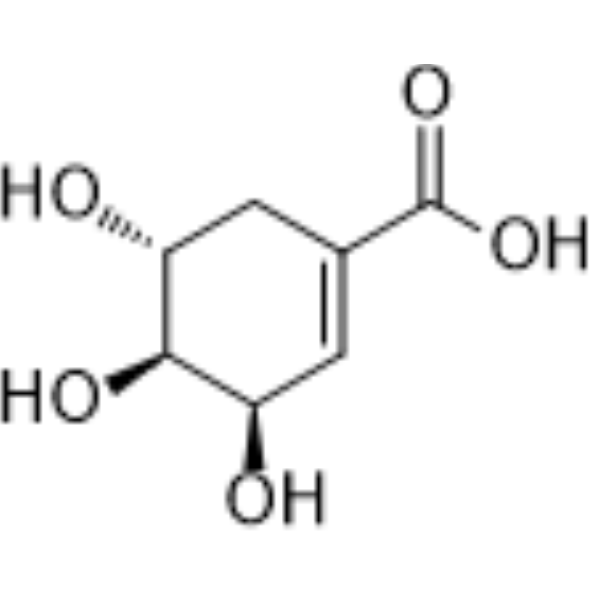
Physicochemical Properties
| Molecular Formula | C7H10O5 |
| Molecular Weight | 174.1513 |
| Exact Mass | 174.052 |
| CAS # | 138-59-0 |
| PubChem CID | 8742 |
| Appearance | White to off-white solid powder |
| Density | 1.7±0.1 g/cm3 |
| Boiling Point | 400.5±45.0 °C at 760 mmHg |
| Melting Point | 185-187 °C(lit.) |
| Flash Point | 210.1±25.2 °C |
| Vapour Pressure | 0.0±2.1 mmHg at 25°C |
| Index of Refraction | 1.680 |
| LogP | -0.92 |
| Hydrogen Bond Donor Count | 4 |
| Hydrogen Bond Acceptor Count | 5 |
| Rotatable Bond Count | 1 |
| Heavy Atom Count | 12 |
| Complexity | 222 |
| Defined Atom Stereocenter Count | 3 |
| SMILES | C1[C@H]([C@@H]([C@@H](C=C1C(=O)O)O)O)O |
| InChi Key | JXOHGGNKMLTUBP-HSUXUTPPSA-N |
| InChi Code | InChI=1S/C7H10O5/c8-4-1-3(7(11)12)2-5(9)6(4)10/h1,4-6,8-10H,2H2,(H,11,12)/t4-,5-,6-/m1/s1 |
| Chemical Name | (3R,4S,5R)-3,4,5-trihydroxycyclohexene-1-carboxylic acid |
| HS Tariff Code | 2934.99.9001 |
| Storage |
Powder-20°C 3 years 4°C 2 years In solvent -80°C 6 months -20°C 1 month Note: Please store this product in a sealed and protected environment, avoid exposure to moisture. |
| Shipping Condition | Room temperature (This product is stable at ambient temperature for a few days during ordinary shipping and time spent in Customs) |
Biological Activity
| ln Vitro | An essential metabolic intermediate with a wide range of uses is shikimic acid. An essential industrial component, shikimic acid serves as a precursor to numerous other chemicals, including oseltamivir phosphate[1]. |
| Enzyme Assay |
Shikimate dehydrogenase (SDH) activity was measured by monitoring the reduction of NADP+ at 340 nm and 22°C in the presence of shikimate. The reaction was carried out in 100 mM Tris–HCl buffer (pH 7.0). For determination of apparent steady-state kinetics parameters (Vmax and Km) for the forward reaction (using 3-dehydroshikimate (DHS) and NADPH), the concentration of one substrate was varied (5, 10, 20, 30, 50, 100, and 200 µM) while the other was maintained at a constant saturation level. The reaction was initiated with 6 pmol of homogeneous SD enzyme and monitored for 1 min. Kinetic data were analyzed with double reciprocal plots.[1] The reverse reaction (oxidation of shikimate) was performed under the same conditions (pH, temperature, substrate concentrations). Activity was measured by following the increase in absorbance at 340 nm due to the NADP+ dependent oxidation of D-shikimate to form NADPH and DHS.[1] |
| ADME/Pharmacokinetics |
Metabolism / Metabolites SHIKIMIC ACID IS METABOLIZED INTO CYCLOHEXANECARBOXYLIC ACID BY THE INTESTINAL MICROFLORA, BUT THE AROMATIZATION OF CYCLOHEXANECARBOXYLIC ACID OCCURS IN MAMMALIAN TISSUES. IN RATS, THIS ACID IS METABOLIZED AND EXCRETED IN THE URINE MAINLY AS HIPPURIC ACID, TOGETHER WITH 3,4,5,6-TETRAHYDROHIPPURIC ACID & HEXAHYDROHIPPURIC ACID AND SMALL AMT OF BENZOYL & CYCLOHEXYLCARBONYL GLUCURONIDES. RATS METABOLIZED (14)C-LABELED SHIKIMIC ACID TO HIPPURIC ACID & CATECHOL IN VIVO; RAT CECAL CONTENTS CONVERTED IT TO CYCLOHEXANECARBOXYLIC ACID IN VITRO, THIS CONVERSION BEING ALMOST TOTALLY INHIBITED BY ANTIBIOTICS. |
| References |
[1]. Improvement of shikimic acid production in Escherichia coli with growth phase-dependent regulation in the biosynthetic pathway from glycerol. World J Microbiol Biotechnol. 2017 Feb;33(2):25. |
| Additional Infomation |
Shikimic acid is a cyclohexenecarboxylic acid that is cyclohex-1-ene-1-carboxylic acid substituted by hydroxy groups at positions 3, 4 and 5 (the 3R,4S,5R stereoisomer). It is an intermediate metabolite in plants and microorganisms. It has a role as an Escherichia coli metabolite, a Saccharomyces cerevisiae metabolite and a plant metabolite. It is a cyclohexenecarboxylic acid, a hydroxy monocarboxylic acid and an alpha,beta-unsaturated monocarboxylic acid. It is a conjugate acid of a shikimate. Shikimic acid is a metabolite found in or produced by Escherichia coli (strain K12, MG1655). Shikimic acid has been reported in Streptomyces nigra, Castanopsis fissa, and other organisms with data available. Shikimic acid is a metabolite found in or produced by Saccharomyces cerevisiae. A tri-hydroxy cyclohexene carboxylic acid metabolite of the shikimate pathway. It is important in the biosynthesis of aromatic amino acids, flavonoids and alkaloids in plants and microorganisms. Shikimic acid (SA) is an industrially important metabolic intermediate that acts as a precursor in the synthesis of oseltamivir phosphate (Tamiflu). It is a key intermediate in the aromatic amino acid biosynthesis pathway in microbes and plants.[1] Shikimic acid has applications in the formulation of various chemical products such as aromatic amino acids, indole derivatives, alkaloids, and other aromatic metabolites. It also has roles in dermo-cosmetic preparations, exhibits anti-enzymatic activity, and can act as an exfoliating agent for the stratum corneum.[1] The study presents a metabolic engineering strategy in Escherichia coli to improve shikimic acid production. A growth phase-dependent regulation of the aroK gene (encoding shikimate kinase I) was implemented instead of complete gene knockout, to avoid auxotrophy and improve production yield.[1] The engineered strain SK4/rpsM, with growth phase-dependent aroK expression, accumulated 1.28-fold more shikimic acid than the control strain SK4/pLac in flask cultures.[1] A novel pathway combining expression of a heterologous, codon-optimized dehydroquinate dehydratase-shikimate dehydrogenase (DHQ-SDH) enzyme from Populus trichocarpa was constructed. The final engineered strain SK5/pSK6, utilizing this pathway and growth phase-dependent regulation, achieved a shikimic acid titer of 5.33 g/L in shake flask cultures, which was 1.69-fold higher than the control strain SK5/pSK5.[1] Kinetic parameters for the purified DHQ-SDH enzyme were determined: For the forward reaction (DHS reduction), Km for DHS was 57.9 µM and Vmax was 250 U/mg; Km for NADPH was 29.7 µM and Vmax was 179.5 U/mg. For the reverse reaction (shikimate oxidation), Km for SA was 81.8 µM and Vmax was 16.4 U/mg; Km for NADP+ was 27.8 µM and Vmax was 20.1 U/mg.[1] |
Solubility Data
| Solubility (In Vitro) | H2O : ~130 mg/mL (~746.48 mM) |
| Solubility (In Vivo) |
Solubility in Formulation 1: 100 mg/mL (574.22 mM) in PBS (add these co-solvents sequentially from left to right, and one by one), clear solution; with sonication. (Please use freshly prepared in vivo formulations for optimal results.) |
| Preparing Stock Solutions | 1 mg | 5 mg | 10 mg | |
| 1 mM | 5.7422 mL | 28.7109 mL | 57.4218 mL | |
| 5 mM | 1.1484 mL | 5.7422 mL | 11.4844 mL | |
| 10 mM | 0.5742 mL | 2.8711 mL | 5.7422 mL |