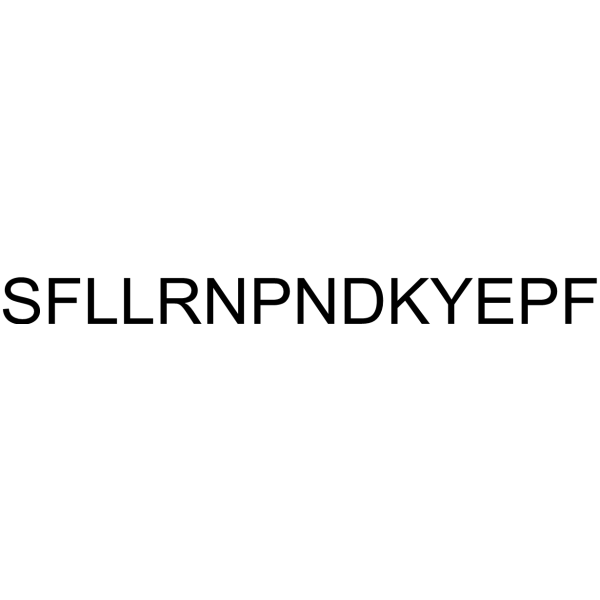
Physicochemical Properties
| Molecular Formula | C81H118N20O23 |
| Molecular Weight | 1739.92000 |
| Exact Mass | 1738.87 |
| CAS # | 137339-65-2 |
| PubChem CID | 16131180 |
| Appearance | White to off-white solid powder |
| LogP | 2.881 |
| Hydrogen Bond Donor Count | 23 |
| Hydrogen Bond Acceptor Count | 26 |
| Rotatable Bond Count | 54 |
| Heavy Atom Count | 124 |
| Complexity | 3670 |
| Defined Atom Stereocenter Count | 14 |
| SMILES | CC(C)C[C@@H](C(=O)N[C@@H](CC(C)C)C(=O)N[C@@H](CCCNC(=N)N)C(=O)N[C@@H](CC(=O)N)C(=O)N1CCC[C@H]1C(=O)N[C@@H](CC(=O)N)C(=O)N[C@@H](CC(=O)O)C(=O)N[C@@H](CCCCN)C(=O)N[C@@H](CC2=CC=C(C=C2)O)C(=O)N[C@@H](CCC(=O)O)C(=O)N3CCC[C@H]3C(=O)N[C@@H](CC4=CC=CC=C4)C(=O)O)NC(=O)[C@H](CC5=CC=CC=C5)NC(=O)[C@H](CO)N |
| InChi Key | OXHYRVSBKWIFES-WWSDOYNLSA-N |
| InChi Code | InChI=1S/C81H118N20O23/c1-43(2)34-53(93-71(114)54(35-44(3)4)94-73(116)55(92-67(110)49(83)42-102)36-45-16-7-5-8-17-45)70(113)90-51(21-13-31-88-81(86)87)69(112)98-59(40-64(85)105)79(122)101-33-15-22-61(101)76(119)97-57(39-63(84)104)74(117)96-58(41-66(108)109)75(118)89-50(20-11-12-30-82)68(111)95-56(37-47-24-26-48(103)27-25-47)72(115)91-52(28-29-65(106)107)78(121)100-32-14-23-62(100)77(120)99-60(80(123)124)38-46-18-9-6-10-19-46/h5-10,16-19,24-27,43-44,49-62,102-103H,11-15,20-23,28-42,82-83H2,1-4H3,(H2,84,104)(H2,85,105)(H,89,118)(H,90,113)(H,91,115)(H,92,110)(H,93,114)(H,94,116)(H,95,111)(H,96,117)(H,97,119)(H,98,112)(H,99,120)(H,106,107)(H,108,109)(H,123,124)(H4,86,87,88)/t49-,50-,51-,52-,53-,54-,55-,56-,57-,58-,59-,60-,61-,62-/m0/s1 |
| Chemical Name | (4S)-4-[[(2S)-2-[[(2S)-6-amino-2-[[(2S)-2-[[(2S)-4-amino-2-[[(2S)-1-[(2S)-4-amino-2-[[(2S)-2-[[(2S)-2-[[(2S)-2-[[(2S)-2-[[(2S)-2-amino-3-hydroxypropanoyl]amino]-3-phenylpropanoyl]amino]-4-methylpentanoyl]amino]-4-methylpentanoyl]amino]-5-carbamimidamidopentanoyl]amino]-4-oxobutanoyl]pyrrolidine-2-carbonyl]amino]-4-oxobutanoyl]amino]-3-carboxypropanoyl]amino]hexanoyl]amino]-3-(4-hydroxyphenyl)propanoyl]amino]-5-[(2S)-2-[[(1S)-1-carboxy-2-phenylethyl]carbamoyl]pyrrolidin-1-yl]-5-oxopentanoic acid |
| HS Tariff Code | 2934.99.9001 |
| Storage |
Powder-20°C 3 years 4°C 2 years In solvent -80°C 6 months -20°C 1 month Note: Please store this product in a sealed and protected environment, avoid exposure to moisture. |
| Shipping Condition | Room temperature (This product is stable at ambient temperature for a few days during ordinary shipping and time spent in Customs) |
Biological Activity
| ln Vitro | At arginine 41, thrombin cleaves its receptor, creating a new receptor NH2 terminus containing the sequence TRAP-14. Multiple thrombin reactions may be signaled by this peptide (TRAP-14) [1]. It was discovered that TRAP-14, which stands for the 14 amino acids beginning with the human thrombin receptor Ser-42, mimics the effects of thrombin on platelets. A novel N terminus that functions as a potential tethering ligand is revealed upon thrombin's cleavage of the human platelet thrombin receptor. The novel N-terminal region known as TRAP-14 is responsible for activating and inducing serotonin secretion and platelet aggregation. The smallest peptide length that can still fully induce [14C]serotonin secretion is TRAP-14 [2]. HUVEC underwent fast morphological changes as a result of TRAP, and prostacyclin, endothelin, platelet-activating factor, tissue plasminogen activator, and plasminogen activator inhibitor 1 were released in significantly higher amounts. Cell surface thrombomodulin also rapidly decreases when cells are incubated with TRAP [3]. |
| References |
[1]. Thrombin receptor 14-amino acid peptide mediates endothelial hyperadhesivity and neutrophil adhesion by P-selectin-dependent mechanism. Circ Res. 1992 Oct;71(4):1015-9. [2]. Structure-activity studies of the thrombin receptor activating peptide. Biochem Biophys Res Commun. 1992 Oct 30;188(2):604-10. [3]. Thrombin receptor agonist peptide decreases thrombomodulin activity in cultured human umbilical vein endothelial cells. Biochem Biophys Res Commun. 1994 Mar 30;199(3):1262-9. |
Solubility Data
| Solubility (In Vitro) | H2O : ≥ 100 mg/mL (~57.47 mM) |
| Solubility (In Vivo) |
Solubility in Formulation 1: ≥ 2.5 mg/mL (1.44 mM) (saturation unknown) in 10% DMSO + 40% PEG300 + 5% Tween80 + 45% Saline (add these co-solvents sequentially from left to right, and one by one), clear solution. For example, if 1 mL of working solution is to be prepared, you can add 100 μL of 25.0 mg/mL clear DMSO stock solution to 400 μL PEG300 and mix evenly; then add 50 μL Tween-80 to the above solution and mix evenly; then add 450 μL normal saline to adjust the volume to 1 mL. Preparation of saline: Dissolve 0.9 g of sodium chloride in 100 mL ddH₂ O to obtain a clear solution. Solubility in Formulation 2: ≥ 2.5 mg/mL (1.44 mM) (saturation unknown) in 10% DMSO + 90% (20% SBE-β-CD in Saline) (add these co-solvents sequentially from left to right, and one by one), clear solution. For example, if 1 mL of working solution is to be prepared, you can add 100 μL of 25.0 mg/mL clear DMSO stock solution to 900 μL of 20% SBE-β-CD physiological saline solution and mix evenly. Preparation of 20% SBE-β-CD in Saline (4°C,1 week): Dissolve 2 g SBE-β-CD in 10 mL saline to obtain a clear solution. Solubility in Formulation 3: ≥ 2.5 mg/mL (1.44 mM) (saturation unknown) in 10% DMSO + 90% Corn Oil (add these co-solvents sequentially from left to right, and one by one), clear solution. For example, if 1 mL of working solution is to be prepared, you can add 100 μL of 25.0 mg/mL clear DMSO stock solution to 900 μL of corn oil and mix evenly. Solubility in Formulation 4: 50 mg/mL (28.74 mM) in PBS (add these co-solvents sequentially from left to right, and one by one), clear solution; with ultrasonication. (Please use freshly prepared in vivo formulations for optimal results.) |
| Preparing Stock Solutions | 1 mg | 5 mg | 10 mg | |
| 1 mM | 0.5747 mL | 2.8737 mL | 5.7474 mL | |
| 5 mM | 0.1149 mL | 0.5747 mL | 1.1495 mL | |
| 10 mM | 0.0575 mL | 0.2874 mL | 0.5747 mL |