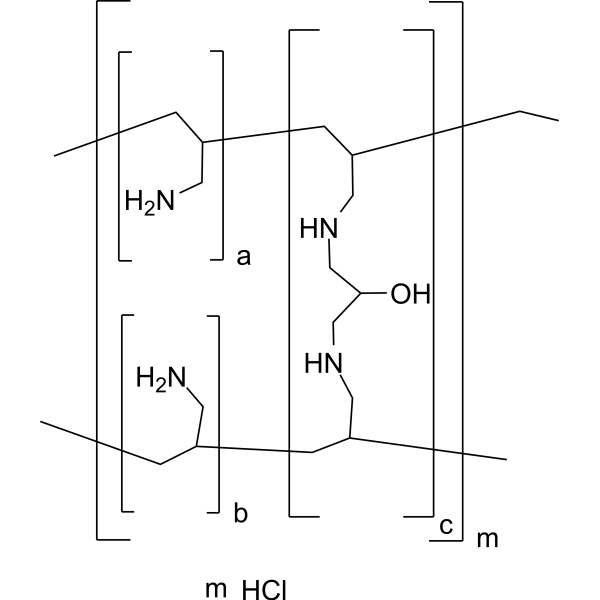
Physicochemical Properties
| Molecular Formula | C6H12CLNO |
| Molecular Weight | 149.61900 |
| Exact Mass | 185.037 |
| CAS # | 152751-57-0 |
| Related CAS # | Sevelamer carbonate;845273-93-0;Sevelamer;52757-95-6 |
| PubChem CID | 159247 |
| Appearance | White to off-white solid powder |
| Boiling Point | 116.1ºC at 760 mmHg |
| Flash Point | 33.9ºC |
| Vapour Pressure | 22mmHg at 25°C |
| LogP | 1.455 |
| Hydrogen Bond Donor Count | 2 |
| Hydrogen Bond Acceptor Count | 2 |
| Rotatable Bond Count | 2 |
| Heavy Atom Count | 10 |
| Complexity | 55.1 |
| Defined Atom Stereocenter Count | 0 |
| InChi Key | KHNXRSIBRKBJDI-UHFFFAOYSA-N |
| InChi Code | InChI=1S/C3H5ClO.C3H7N.ClH/c4-1-3-2-5-3;1-2-3-4;/h3H,1-2H2;2H,1,3-4H2;1H |
| Chemical Name | 2-(chloromethyl)oxirane;prop-2-en-1-amine;hydrochloride |
| HS Tariff Code | 2934.99.9001 |
| Storage |
Powder-20°C 3 years 4°C 2 years In solvent -80°C 6 months -20°C 1 month Note: Please store this product in a sealed and protected environment, avoid exposure to moisture. |
| Shipping Condition | Room temperature (This product is stable at ambient temperature for a few days during ordinary shipping and time spent in Customs) |
Biological Activity
| Targets | Sevelamer hydrochloride (15 mg/mL; pH=6 or 8) may reduce serum levels of enterogenic uremic toxins (e.g., IAA) or restrict the rise in enterogenic uremic toxins (initial concentration = 1 μg/ mL or 10 μg/mL) [2]. |
| ln Vitro |
Sevelamer hydrochloride (15 mg/mL; pH=6 or 8) may reduce serum levels of enterogenic uremic toxins (e.g., IAA) or restrict the rise in enterogenic uremic toxins (initial concentration = 1 μg/ mL or 10 μg/mL) [2]. The present study primarily evaluated sevelamer carbonate. It referenced a previous study (De Smet et al.) which reported that sevelamer hydrochloride (2.5 mg/mL) chelated (adsorbed) indole, p-cresol, indoxyl sulfate (IS), and phosphate in vitro at pH 4, 7, and 8. [2] In contrast, the authors' own in vitro experiments with sevelamer carbonate showed it did not adsorb the precursors indole and p-cresol, but did adsorb indole acetic acid (IAA) at high concentration (15 mg/mL). [2] |
| ln Vivo |
In Npt2b-deficient mice, sevelamer hydrochloride (1% mixed in diet; oral; once daily for 5 weeks) lowers serum phosphate levels, but not in uremic WT animals [3]. In uremic WT mice, sevelamer hydrochloride significantly reduces osteoclast counts, and Npt2b-/- animals show a tendency toward even greater reductions [3]. Npt2b protein expression is significantly increased by sevelamer hydrochloride [3]. In the cited study by Brandenburg et al., which included 57 hemodialysis patients, treatment with sevelamer hydrochloride for 8 weeks resulted in no significant change in serum levels of IS and IAA, but led to a significant increase in serum p-cresyl sulfate (pCS) levels. [2] The current clinical trial (using sevelamer carbonate) in stage 3b/4 CKD patients showed that a 12-week treatment was not associated with significant changes in serum concentrations of pCS, IS, or IAA compared to placebo. [2] |
| ADME/Pharmacokinetics |
The polymer Sevelamer hydrochloride is not absorbed from the gastrointestinal tract and thus has a solely local action within the gut. [2] No other pharmacokinetic parameters (e.g., half-life, bioavailability, distribution, metabolism, excretion) for sevelamer hydrochloride are provided in this manuscript. [2] |
| Toxicity/Toxicokinetics |
The study by Brandenburg et al. reported a significant increase in serum pCS levels in hemodialysis patients treated with sevelamer hydrochloride for 8 weeks, which was an unexpected adverse effect regarding uremic toxin accumulation. [2] The manuscript discusses that Sevelamer hydrochloride can adsorb other molecules in the gut, including uric acid, bile acids, vitamin C, vitamin K, folic acid, ciprofloxacin, and levothyroxine, which may lead to potential drug-nutrient interactions and deficiencies if not managed. [2] |
| References |
[1]. Sevelamer, From Wikipedia. [2]. The Effect of Sevelamer on Serum Levels of Gut-Derived Uremic Toxins: Results from In Vitro Experiments and A Multicenter, Double-Blind, Placebo-Controlled, Randomized Clinical Trial. Toxins (Basel). 2019 May 17;11(5):279. [3]. Npt2b deletion attenuates hyperphosphatemia associated with CKD. J Am Soc Nephrol. 2012 Oct;23(10):1691-700. |
| Additional Infomation |
Sevelamer hydrochloride is an epoxide. A polymeric amine that binds phosphate and is used to treat HYPERPHOSPHATEMIA in patients with kidney disease. See also: Sevelamer Hydrochloride (annotation moved to). Sevelamer hydrochloride is a poly(allylamine) phosphate-binding polymer used to treat hyperphosphatemia in chronic kidney disease (CKD) patients. [2] It is taken with meals to bind dietary phosphate in the gut, preventing its absorption. [2] The literature presents conflicting results on the ability of sevelamer (both hydrochloride and carbonate forms) to adsorb gut-derived uremic toxins. While some in vitro data suggest adsorption of certain toxins, well-controlled clinical trials in predialysis patients (like the one reported here) have not shown significant reductions in serum levels of key toxins like pCS, IS, and IAA. [2] The study hypothesizes that the intestinal concentration of sevelamer in humans and the baseline levels of toxins might be crucial factors influencing its efficacy in reducing serum toxin concentrations. [2] |
Solubility Data
| Solubility (In Vitro) |
H2O : < 0.1 mg/mL DMSO :< 1 mg/mL |
| Solubility (In Vivo) |
Note: Listed below are some common formulations that may be used to formulate products with low water solubility (e.g. < 1 mg/mL), you may test these formulations using a minute amount of products to avoid loss of samples. Injection Formulations (e.g. IP/IV/IM/SC) Injection Formulation 1: DMSO : Tween 80: Saline = 10 : 5 : 85 (i.e. 100 μL DMSO stock solution → 50 μL Tween 80 → 850 μL Saline) *Preparation of saline: Dissolve 0.9 g of sodium chloride in 100 mL ddH ₂ O to obtain a clear solution. Injection Formulation 2: DMSO : PEG300 :Tween 80 : Saline = 10 : 40 : 5 : 45 (i.e. 100 μL DMSO → 400 μLPEG300 → 50 μL Tween 80 → 450 μL Saline) Injection Formulation 3: DMSO : Corn oil = 10 : 90 (i.e. 100 μL DMSO → 900 μL Corn oil) Example: Take the Injection Formulation 3 (DMSO : Corn oil = 10 : 90) as an example, if 1 mL of 2.5 mg/mL working solution is to be prepared, you can take 100 μL 25 mg/mL DMSO stock solution and add to 900 μL corn oil, mix well to obtain a clear or suspension solution (2.5 mg/mL, ready for use in animals). Injection Formulation 4: DMSO : 20% SBE-β-CD in saline = 10 : 90 [i.e. 100 μL DMSO → 900 μL (20% SBE-β-CD in saline)] *Preparation of 20% SBE-β-CD in Saline (4°C,1 week): Dissolve 2 g SBE-β-CD in 10 mL saline to obtain a clear solution. Injection Formulation 5: 2-Hydroxypropyl-β-cyclodextrin : Saline = 50 : 50 (i.e. 500 μL 2-Hydroxypropyl-β-cyclodextrin → 500 μL Saline) Injection Formulation 6: DMSO : PEG300 : castor oil : Saline = 5 : 10 : 20 : 65 (i.e. 50 μL DMSO → 100 μLPEG300 → 200 μL castor oil → 650 μL Saline) Injection Formulation 7: Ethanol : Cremophor : Saline = 10: 10 : 80 (i.e. 100 μL Ethanol → 100 μL Cremophor → 800 μL Saline) Injection Formulation 8: Dissolve in Cremophor/Ethanol (50 : 50), then diluted by Saline Injection Formulation 9: EtOH : Corn oil = 10 : 90 (i.e. 100 μL EtOH → 900 μL Corn oil) Injection Formulation 10: EtOH : PEG300:Tween 80 : Saline = 10 : 40 : 5 : 45 (i.e. 100 μL EtOH → 400 μLPEG300 → 50 μL Tween 80 → 450 μL Saline) Oral Formulations Oral Formulation 1: Suspend in 0.5% CMC Na (carboxymethylcellulose sodium) Oral Formulation 2: Suspend in 0.5% Carboxymethyl cellulose Example: Take the Oral Formulation 1 (Suspend in 0.5% CMC Na) as an example, if 100 mL of 2.5 mg/mL working solution is to be prepared, you can first prepare 0.5% CMC Na solution by measuring 0.5 g CMC Na and dissolve it in 100 mL ddH2O to obtain a clear solution; then add 250 mg of the product to 100 mL 0.5% CMC Na solution, to make the suspension solution (2.5 mg/mL, ready for use in animals). Oral Formulation 3: Dissolved in PEG400 Oral Formulation 4: Suspend in 0.2% Carboxymethyl cellulose Oral Formulation 5: Dissolve in 0.25% Tween 80 and 0.5% Carboxymethyl cellulose Oral Formulation 6: Mixing with food powders Note: Please be aware that the above formulations are for reference only. InvivoChem strongly recommends customers to read literature methods/protocols carefully before determining which formulation you should use for in vivo studies, as different compounds have different solubility properties and have to be formulated differently. (Please use freshly prepared in vivo formulations for optimal results.) |
| Preparing Stock Solutions | 1 mg | 5 mg | 10 mg | |
| 1 mM | 6.6836 mL | 33.4180 mL | 66.8360 mL | |
| 5 mM | 1.3367 mL | 6.6836 mL | 13.3672 mL | |
| 10 mM | 0.6684 mL | 3.3418 mL | 6.6836 mL |