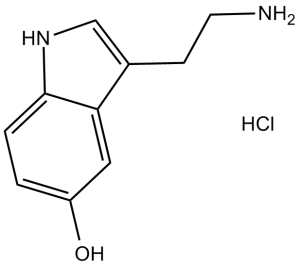
Serotonin HCl (5-HT HCl; 5-Hydroxytryptamine), the hydrochloride salt of Serotonin, is an endogenous monoamine neurotransmitter found in the brain and also an endogenous agonist of 5-HT receptor.
Physicochemical Properties
| Molecular Formula | C10H13CLN2O | |
| Molecular Weight | 212.68 | |
| Exact Mass | 212.071 | |
| CAS # | 153-98-0 | |
| Related CAS # | Serotonin; 50-67-9 | |
| PubChem CID | 5202 | |
| Appearance | Gray to dark gray powder | |
| Boiling Point | 416.1ºC at 760 mmHg | |
| Melting Point | 149-154 °C(lit.) | |
| Flash Point | 205.4ºC | |
| Vapour Pressure | 1.63E-07mmHg at 25°C | |
| LogP | 2.877 | |
| Hydrogen Bond Donor Count | 3 | |
| Hydrogen Bond Acceptor Count | 2 | |
| Rotatable Bond Count | 2 | |
| Heavy Atom Count | 13 | |
| Complexity | 174 | |
| Defined Atom Stereocenter Count | 0 | |
| SMILES | O([H])C1C([H])=C([H])C2=C(C=1[H])C(=C([H])N2[H])C([H])([H])C([H])([H])N([H])[H] |
|
| InChi Key | MDIGAZPGKJFIAH-UHFFFAOYSA-N | |
| InChi Code | InChI=1S/C10H12N2O.ClH/c11-4-3-7-6-12-10-2-1-8(13)5-9(7)10;/h1-2,5-6,12-13H,3-4,11H2;1H | |
| Chemical Name | 3-(2-aminoethyl)-1H-indol-5-ol;hydrochloride | |
| Synonyms |
|
|
| HS Tariff Code | 2934.99.9001 | |
| Storage |
Powder-20°C 3 years 4°C 2 years In solvent -80°C 6 months -20°C 1 month Note: Please store this product in a sealed and protected environment (e.g. under nitrogen), avoid exposure to moisture and light. |
|
| Shipping Condition | Room temperature (This product is stable at ambient temperature for a few days during ordinary shipping and time spent in Customs) |
Biological Activity
| Targets | Human Endogenous Metabolite; Microbial Metabolite; serotonin | |
| ln Vitro |
|
|
| ln Vivo |
|
|
| Enzyme Assay | The subcutaneous and systemic injection of serotonin reduces cutaneous and visceral pain thresholds and increases responses to noxious stimuli. Different subtypes of 5-hydroxytryptamine (5-HT) receptors are suggested to be associated with different types of pain responses. Here we show that serotonin also inhibits catechol O-methyltransferase (COMT), an enzyme that contributes to modultion the perception of pain, via non-competitive binding to the site bound by catechol substrates with a binding affinity comparable to the binding affinity of catechol itself (K(i) = 44 μM). Using computational modeling, biochemical tests and cellular assays we show that serotonin actively competes with the methyl donor S-adenosyl-L-methionine (SAM) within the catalytic site. Binding of serotonin to the catalytic site inhibits the access of SAM, thus preventing methylation of COMT substrates. The results of in vivo animal studies show that serotonin-induced pain hypersensitivity in mice is reduced by either SAM pretreatment or by the combined administration of selective antagonists for β(2)- and β(3)-adrenergic receptors, which have been previously shown to mediate COMT-dependent pain signaling. Our results suggest that inhibition of COMT via serotonin binding contributes to pain hypersensitivity, providing additional strategies for the treatment of clinical pain conditions [1]. | |
| Cell Assay | Peritoneal cavity cells from WT and IL-13-/- mice are harvested and cultured, either with or without dextran sodium sulfate (DSS) treatment, for the purpose of macrophage culture. Following a 24-hour treatment with lipopolysaccharides (LPS; 100 ng/mL) or serotonin hydrochloride (10–10 M), cells are plated at a concentration of 3.0×10⁶ cells per milliliter. After being collected, the culture supernatant is kept at -80°C until the protein array system is used to determine the levels of cytokines[2]. | |
| Animal Protocol | Oral administration of 5% DSS in drinking water for five days induces diarrhea caused by dextran sodium sulfate (DSS). A different experiment involves injecting 100 mg/kg of serotonin hydrochloride (5-HTP) subcutaneously into IL-13-/-mice twice a day for 8 days, starting 3 days before DSS colitis is induced. In contrast, saline is used as a vehicle in the IL-13-/-modified mice. Upon reaching a predefined end point (such as losing more than 20% of their body weight or experiencing a notable decline in their physical state), animals are put to sleep before being put to death by cervical dislocation at the end of each experiment[2]. | |
| ADME/Pharmacokinetics |
Metabolism / Metabolites Serotonin has known human metabolites that include (2S,3S,4S,5R)-6-[[3-(2-Aminoethyl)-1H-indol-5-yl]oxy]-3,4,5-trihydroxy-2-oxanecarboxylic acid and 3-Ethyl-1H-indol-5-ol. Serotonin is a known human metabolite of 5-methoxytryptamine. |
|
| References |
[1]. Serotonin-induced hypersensitivity via inhibition of catechol O-methyltransferase activity. Mol Pain. 2012 Apr 13;8:25. [2]. Interleukin 13 and serotonin: linking the immune and endocrine systems in murine models of intestinal inflammation. PLoS One. 2013 Aug 28;8(8):e72774. |
|
| Additional Infomation |
Serotonin is a primary amino compound that is the 5-hydroxy derivative of tryptamine. It has a role as a human metabolite, a mouse metabolite and a neurotransmitter. It is a monoamine molecular messenger, a primary amino compound, a member of phenols, a member of hydroxyindoles and a member of tryptamines. It is functionally related to a tryptamine. It is a conjugate base of a serotonin(1+). For temporary relief of nervousness, anxiety, mood swings, joint pains, weakness, drowsiness, itching and lethargy. Not evaluated by the FDA, homeopathic product. Serotonin has been reported in Mamestra brassicae, Bufo gargarizans, and other organisms with data available. A biochemical messenger and regulator, synthesized from the essential amino acid L-TRYPTOPHAN. In humans it is found primarily in the central nervous system, gastrointestinal tract, and blood platelets. Serotonin mediates several important physiological functions including neurotransmission, gastrointestinal motility, hemostasis, and cardiovascular integrity. Multiple receptor families (RECEPTORS, SEROTONIN) explain the broad physiological actions and distribution of this biochemical mediator. See also: Serotonin Hydrochloride (active moiety of); Serotonin; tryptophan (component of); Acetylcholine Chloride; Histamine; Serotonin (component of) ... View More ... |
Solubility Data
| Solubility (In Vitro) |
|
|||
| Solubility (In Vivo) |
Solubility in Formulation 1: ≥ 2.08 mg/mL (9.78 mM) (saturation unknown) in 10% DMSO + 40% PEG300 + 5% Tween80 + 45% Saline (add these co-solvents sequentially from left to right, and one by one), clear solution. For example, if 1 mL of working solution is to be prepared, you can add 100 μL of 20.8 mg/mL clear DMSO stock solution to 400 μL PEG300 and mix evenly; then add 50 μL Tween-80 to the above solution and mix evenly; then add 450 μL normal saline to adjust the volume to 1 mL. Preparation of saline: Dissolve 0.9 g of sodium chloride in 100 mL ddH₂ O to obtain a clear solution. Solubility in Formulation 2: ≥ 2.08 mg/mL (9.78 mM) (saturation unknown) in 10% DMSO + 90% (20% SBE-β-CD in Saline) (add these co-solvents sequentially from left to right, and one by one), clear solution. For example, if 1 mL of working solution is to be prepared, you can add 100 μL of 20.8 mg/mL clear DMSO stock solution to 900 μL of 20% SBE-β-CD physiological saline solution and mix evenly. Preparation of 20% SBE-β-CD in Saline (4°C,1 week): Dissolve 2 g SBE-β-CD in 10 mL saline to obtain a clear solution. Solubility in Formulation 3: ≥ 2.08 mg/mL (9.78 mM) (saturation unknown) in 10% DMSO + 90% Corn Oil (add these co-solvents sequentially from left to right, and one by one), clear solution. For example, if 1 mL of working solution is to be prepared, you can add 100 μL of 20.8 mg/mL clear DMSO stock solution to 900 μL of corn oil and mix evenly. (Please use freshly prepared in vivo formulations for optimal results.) |
| Preparing Stock Solutions | 1 mg | 5 mg | 10 mg | |
| 1 mM | 4.7019 mL | 23.5095 mL | 47.0190 mL | |
| 5 mM | 0.9404 mL | 4.7019 mL | 9.4038 mL | |
| 10 mM | 0.4702 mL | 2.3509 mL | 4.7019 mL |