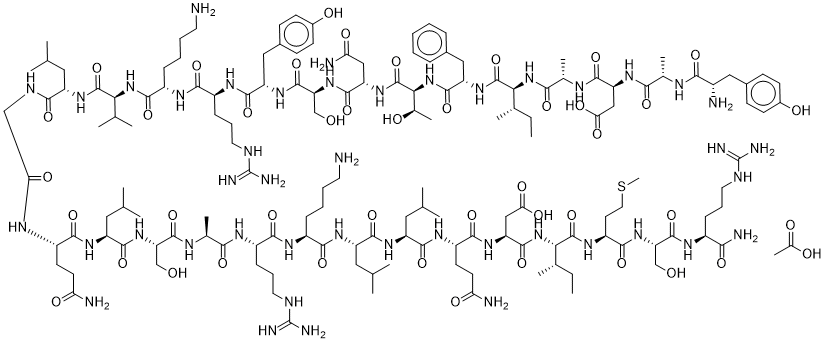
Sermorelin acetate [GRF (1-29) amide (human)] is a peptide compound composed of 29-amino acids, and is a growth hormone-releasing hormone (GHRH) analogue used as a diagnostic agent. It is the shortest fully functional fragment of GHRH and is used as a diagnostic agent to assess growth hormone (GH) secretion. It is also used as doping agent in sports due to its correlation with increased growth of muscular and skeletal tissue.[citation needed] Sermorelin use is also hypothesized to improve deep rapid eye movement sleep.
Physicochemical Properties
| Molecular Formula | C151H250N44O44S |
| Molecular Weight | 3417.93413305283 |
| Exact Mass | 3355.82 |
| Elemental Analysis | C, 53.06; H, 7.37; N, 18.03; O, 20.60; S, 0.94 |
| CAS # | 114466-38-5 |
| Related CAS # | 114466-38-5 (acetate); 86168-78-7; |
| PubChem CID | 16132412 |
| Sequence | H-Tyr-Ala-Asp-Ala-Ile-Phe-Thr-Asn-Ser-Tyr-Arg-Lys-Val-Leu-Gly-Gln-Leu-Ser-Ala-Arg-Lys-Leu-Leu-Gln-Asp-Ile-Met-Ser-Arg-NH2.CH3CO2H; L-tyrosyl-L-alanyl-L-alpha-aspartyl-L-alanyl-L-isoleucyl-L-phenylalanyl-L-threonyl-L-asparagyl-L-seryl-L-tyrosyl-L-arginyl-L-lysyl-L-valyl-L-leucyl-glycyl-L-glutaminyl-L-leucyl-L-seryl-L-alanyl-L-arginyl-L-lysyl-L-leucyl-L-leucyl-L-glutaminyl-L-alpha-aspartyl-L-isoleucyl-L-methionyl-L-seryl-L-argininamide acetic acid |
| SequenceShortening | YADAIFTNSYRKVLGQLSARKLLQDIMSR |
| Appearance | Typically exists as solid at room temperature |
| LogP | 5.07 |
| Hydrogen Bond Donor Count | 53 |
| Hydrogen Bond Acceptor Count | 51 |
| Rotatable Bond Count | 118 |
| Heavy Atom Count | 240 |
| Complexity | 7670 |
| Defined Atom Stereocenter Count | 31 |
| SMILES | S(C)CC[C@@H](C(N[C@H](C(N[C@H](C(N)=O)CCCNC(=N)N)=O)CO)=O)NC([C@H]([C@@H](C)CC)NC([C@H](CC(=O)O)NC([C@H](CCC(N)=O)NC([C@H](CC(C)C)NC([C@H](CC(C)C)NC([C@H](CCCCN)NC([C@H](CCCNC(=N)N)NC([C@H](C)NC([C@H](CO)NC([C@H](CC(C)C)NC([C@H](CCC(N)=O)NC(CNC([C@H](CC(C)C)NC([C@H](C(C)C)NC([C@H](CCCCN)NC([C@H](CCCNC(=N)N)NC([C@H](CC1C=CC(=CC=1)O)NC([C@H](CO)NC([C@H](CC(N)=O)NC([C@H]([C@@H](C)O)NC([C@H](CC1C=CC=CC=1)NC([C@H]([C@@H](C)CC)NC([C@H](C)NC([C@H](CC(=O)O)NC([C@H](C)NC([C@H](CC1C=CC(=CC=1)O)N)=O)=O)=O)=O)=O)=O)=O)=O)=O)=O)=O)=O)=O)=O)=O)=O)=O)=O)=O)=O)=O)=O)=O)=O)=O)=O.OC(C)=O |
| InChi Key | BVLCEKWPOSAKSZ-YQMCHIOTSA-N |
| InChi Code | InChI=1S/C149H246N44O42S.C2H4O2/c1-20-77(13)116(191-122(211)81(17)168-132(221)104(66-113(204)205)178-121(210)79(15)167-123(212)88(152)62-84-39-43-86(198)44-40-84)145(234)185-102(63-83-32-23-22-24-33-83)138(227)193-118(82(18)197)146(235)186-103(65-111(155)202)137(226)189-108(71-196)142(231)182-101(64-85-41-45-87(199)46-42-85)136(225)175-93(38-31-56-165-149(161)162)126(215)174-91(35-26-28-53-151)131(220)190-115(76(11)12)143(232)184-97(58-72(3)4)124(213)166-68-112(203)170-94(47-49-109(153)200)128(217)180-100(61-75(9)10)135(224)188-106(69-194)140(229)169-80(16)120(209)172-92(37-30-55-164-148(159)160)125(214)173-90(34-25-27-52-150)127(216)179-99(60-74(7)8)134(223)181-98(59-73(5)6)133(222)176-95(48-50-110(154)201)129(218)183-105(67-114(206)207)139(228)192-117(78(14)21-2)144(233)177-96(51-57-236-19)130(219)187-107(70-195)141(230)171-89(119(156)208)36-29-54-163-147(157)158;1-2(3)4/h22-24,32-33,39-46,72-82,88-108,115-118,194-199H,20-21,25-31,34-38,47-71,150-152H2,1-19H3,(H2,153,200)(H2,154,201)(H2,155,202)(H2,156,208)(H,166,213)(H,167,212)(H,168,221)(H,169,229)(H,170,203)(H,171,230)(H,172,209)(H,173,214)(H,174,215)(H,175,225)(H,176,222)(H,177,233)(H,178,210)(H,179,216)(H,180,217)(H,181,223)(H,182,231)(H,183,218)(H,184,232)(H,185,234)(H,186,235)(H,187,219)(H,188,224)(H,189,226)(H,190,220)(H,191,211)(H,192,228)(H,193,227)(H,204,205)(H,206,207)(H4,157,158,163)(H4,159,160,164)(H4,161,162,165);1H3,(H,3,4)/t77-,78-,79-,80-,81-,82+,88-,89-,90-,91-,92-,93-,94-,95-,96-,97-,98-,99-,100-,101-,102-,103-,104-,105-,106-,107-,108-,115-,116-,117-,118-;/m0./s1 |
| Chemical Name | H-Tyr-Ala-Asp-Ala-Ile-Phe-Thr-Asn-Ser-Tyr-Arg-Lys-Val-Leu-Gly-Gln-Leu-Ser-Ala-Arg-Lys-Leu-Leu-Gln-Asp-Ile-Met-Ser-Arg-NH2 |
| Synonyms | GHRH (1-29); Sermorelin acetate; trade name: Geref. |
| HS Tariff Code | 2934.99.9001 |
| Storage |
Powder-20°C 3 years 4°C 2 years In solvent -80°C 6 months -20°C 1 month |
| Shipping Condition | Room temperature (This product is stable at ambient temperature for a few days during ordinary shipping and time spent in Customs) |
Biological Activity
| Targets | GHRH analog |
| ln Vitro | Sermorelin binds to the growth hormone releasing hormone receptor and mimics native GRF in its ability to stimulate growth hormone secretion. |
| ln Vivo | Sermorelin is used in the treatment of children with growth hormone deficiency or growth failure. Geref increases plasma growth hormone (GH) concentration by stimulating the pituitary gland to release GH. Geref is similar to the full-length native hormone (44 residues) in its ability to stimulate GH secretion in humans. |
| ADME/Pharmacokinetics | Biological Half-Life: 11-12 min |
| Toxicity/Toxicokinetics | Sermorelin Acetate can cause developmental toxicity according to state or federal government labeling requirements. |
| References | [1]. Drug Test Anal. 2016 Mar;8(3-4):398-401. |
| Additional Infomation |
Sermorelin Acetate can cause developmental toxicity according to state or federal government labeling requirements. The biologically active fragment of human growth hormone-releasing factor, consisting of GHRH(1-29)-amide. This N-terminal sequence is identical in several mammalian species, such as human, pig, and cattle. It is used to diagnose or treat patients with GROWTH HORMONE deficiency. See also: Sermorelin Acetate (annotation moved to). Sermorelin is a 29 amino acid polypeptide that is used to treat growth problems (usually in children) due to growth hormone deficiency. It is the biologically active fragment of human growth hormone-releasing factor (GHRH). It has a role as a diagnostic agent. It is a polypeptide and a peptide hormone. Sermorelin acetate is the acetate salt of an amidated synthetic 29-amino acid peptide (GRF 1-29 NH 2 ) that corresponds to the amino-terminal segment of the naturally occurring human growth hormone-releasing hormone (GHRH or GRF) consisting of 44 amino acid residues The biologically active fragment of human growth hormone-releasing factor, consisting of GHRH(1-29)-amide. This N-terminal sequence is identical in several mammalian species, such as human, pig, and cattle. It is used to diagnose or treat patients with GROWTH HORMONE deficiency. See also: Sermorelin (annotation moved to). Drug Indication For the treatment of dwarfism, prevention of HIV-induced weight loss Mechanism of Action Sermorelin binds to the growth hormone releasing hormone receptor and mimics native GRF in its ability to stimulate growth hormone secretion. Pharmacodynamics Sermorelin is used in the treatment of children with growth hormone deficiency or growth failure. Geref increases plasma growth hormone (GH) concentration by stimulating the pituitary gland to release GH. Geref is similar to the full-length native hormone (44 residues) in its ability to stimulate GH secretion in humans. Operation Pangea is an annual international week of action combating pharmaceutical crime. In this study, called Operation Resistance, we asked the national agencies in Europe to search for falsified antibiotics and biopharmaceutical injectables (peptides and proteins) amongst the medicines seized in Pangea 7 (2014). Reports were received from Belgium, Cyprus, Czech Republic, Denmark, France, the Netherlands, Portugal, Sweden, Spain, the United Kingdom, Norway, and Switzerland. The countries reported seizing about 21,000 dose units (e.g. tablets, capsules) of falsified antibiotics in total. Most of the antibiotics were unlicensed medicines with common antibiotic drugs. In this study week, very few falsified biopharmaceutical injectables were reported. Laboratories reported human growth hormone, sermorelin, melanotan II, and no active ingredients. The average shipment size seemed too large for personal use indicating that a substantial part was intended for resale. This study provides a snapshot of the falsified antibiotics and biopharmaceuticals that enter European countries. How much is actually reaching users during Pangea week - in on other weeks - remains unknown. The shipment sizes indicate falsified antibiotics and biopharmaceuticals are imported for both personal use and resale. The use of antibiotics from unreliable sources is a health risk, contributes to antimicrobial resistance, and may obscure a source of infection from health agencies. The falsified biopharmaceuticals are a health risk because they lack all labelling and may contain unlicensed drugs for injection. It seems important to raise awareness among health-care professionals that falsified medicines in Europe are not restricted to erectile dysfunction drugs. [1] |
Solubility Data
| Solubility (In Vitro) | May dissolve in DMSO (in most cases), if not, try other solvents such as H2O, Ethanol, or DMF with a minute amount of products to avoid loss of samples |
| Solubility (In Vivo) |
Note: Listed below are some common formulations that may be used to formulate products with low water solubility (e.g. < 1 mg/mL), you may test these formulations using a minute amount of products to avoid loss of samples. Injection Formulations (e.g. IP/IV/IM/SC) Injection Formulation 1: DMSO : Tween 80: Saline = 10 : 5 : 85 (i.e. 100 μL DMSO stock solution → 50 μL Tween 80 → 850 μL Saline) *Preparation of saline: Dissolve 0.9 g of sodium chloride in 100 mL ddH ₂ O to obtain a clear solution. Injection Formulation 2: DMSO : PEG300 :Tween 80 : Saline = 10 : 40 : 5 : 45 (i.e. 100 μL DMSO → 400 μLPEG300 → 50 μL Tween 80 → 450 μL Saline) Injection Formulation 3: DMSO : Corn oil = 10 : 90 (i.e. 100 μL DMSO → 900 μL Corn oil) Example: Take the Injection Formulation 3 (DMSO : Corn oil = 10 : 90) as an example, if 1 mL of 2.5 mg/mL working solution is to be prepared, you can take 100 μL 25 mg/mL DMSO stock solution and add to 900 μL corn oil, mix well to obtain a clear or suspension solution (2.5 mg/mL, ready for use in animals). Injection Formulation 4: DMSO : 20% SBE-β-CD in saline = 10 : 90 [i.e. 100 μL DMSO → 900 μL (20% SBE-β-CD in saline)] *Preparation of 20% SBE-β-CD in Saline (4°C,1 week): Dissolve 2 g SBE-β-CD in 10 mL saline to obtain a clear solution. Injection Formulation 5: 2-Hydroxypropyl-β-cyclodextrin : Saline = 50 : 50 (i.e. 500 μL 2-Hydroxypropyl-β-cyclodextrin → 500 μL Saline) Injection Formulation 6: DMSO : PEG300 : castor oil : Saline = 5 : 10 : 20 : 65 (i.e. 50 μL DMSO → 100 μLPEG300 → 200 μL castor oil → 650 μL Saline) Injection Formulation 7: Ethanol : Cremophor : Saline = 10: 10 : 80 (i.e. 100 μL Ethanol → 100 μL Cremophor → 800 μL Saline) Injection Formulation 8: Dissolve in Cremophor/Ethanol (50 : 50), then diluted by Saline Injection Formulation 9: EtOH : Corn oil = 10 : 90 (i.e. 100 μL EtOH → 900 μL Corn oil) Injection Formulation 10: EtOH : PEG300:Tween 80 : Saline = 10 : 40 : 5 : 45 (i.e. 100 μL EtOH → 400 μLPEG300 → 50 μL Tween 80 → 450 μL Saline) Oral Formulations Oral Formulation 1: Suspend in 0.5% CMC Na (carboxymethylcellulose sodium) Oral Formulation 2: Suspend in 0.5% Carboxymethyl cellulose Example: Take the Oral Formulation 1 (Suspend in 0.5% CMC Na) as an example, if 100 mL of 2.5 mg/mL working solution is to be prepared, you can first prepare 0.5% CMC Na solution by measuring 0.5 g CMC Na and dissolve it in 100 mL ddH2O to obtain a clear solution; then add 250 mg of the product to 100 mL 0.5% CMC Na solution, to make the suspension solution (2.5 mg/mL, ready for use in animals). Oral Formulation 3: Dissolved in PEG400 Oral Formulation 4: Suspend in 0.2% Carboxymethyl cellulose Oral Formulation 5: Dissolve in 0.25% Tween 80 and 0.5% Carboxymethyl cellulose Oral Formulation 6: Mixing with food powders Note: Please be aware that the above formulations are for reference only. InvivoChem strongly recommends customers to read literature methods/protocols carefully before determining which formulation you should use for in vivo studies, as different compounds have different solubility properties and have to be formulated differently. (Please use freshly prepared in vivo formulations for optimal results.) |
| Preparing Stock Solutions | 1 mg | 5 mg | 10 mg | |
| 1 mM | 0.2926 mL | 1.4629 mL | 2.9257 mL | |
| 5 mM | 0.0585 mL | 0.2926 mL | 0.5851 mL | |
| 10 mM | 0.0293 mL | 0.1463 mL | 0.2926 mL |