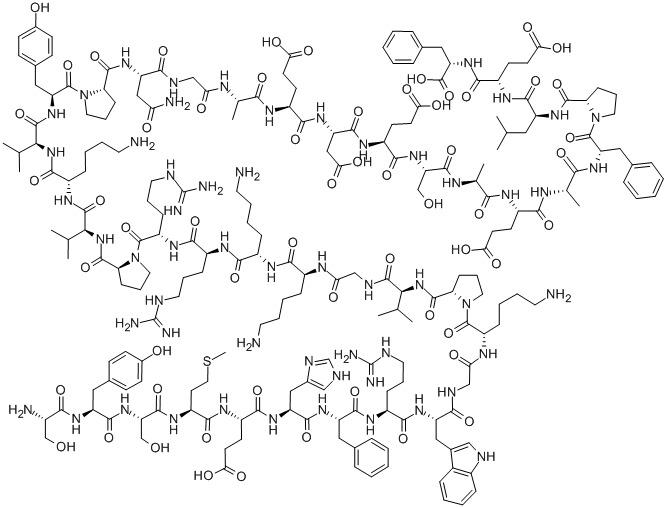
Seractide,also known as ACTH (1-39) , is a novel and potent endogenous melanocortin receptor 2 (MC2) agonist (EC50 = 57 pM).
Physicochemical Properties
| Molecular Formula | C207H308N56O58S |
| Molecular Weight | 4541.06581999998 |
| Exact Mass | 4538.26 |
| CAS # | 12279-41-3 |
| Related CAS # | Adrenocorticotropic Hormone (ACTH) (1-39), human(TFA);Adrenocorticotropic Hormone (ACTH) (1-39), human acetate |
| PubChem CID | 90488848 |
| Appearance | White to off-white solid powder |
| LogP | 5.654 |
| Hydrogen Bond Donor Count | 63 |
| Hydrogen Bond Acceptor Count | 68 |
| Rotatable Bond Count | 148 |
| Heavy Atom Count | 322 |
| Complexity | 11200 |
| Defined Atom Stereocenter Count | 0 |
| SMILES | N1(CCC[C@H]1C(=O)N[C@H](C(=O)NCC(=O)N[C@@H](C)C(=O)N[C@@H](CCC(O)=O)C(=O)N[C@@H](CC(O)=O)C(=O)N[C@@H](CCC(O)=O)C(=O)N[C@@H](CO)C(=O)N[C@@H](C)C(=O)N[C@@H](CCC(O)=O)C(=O)N[C@@H](C)C(=O)N[C@@H](CC1C=CC=CC=1)C(=O)N1CCC[C@H]1C(=O)N[C@@H](CC(C)C)C(=O)N[C@@H](CCC(O)=O)C(=O)N[C@@H](CC1C=CC=CC=1)C(O)=O)CC(N)=O)C(=O)[C@H](CC1C=CC(=CC=1)O)NC(=O)[C@H](C(C)C)NC(=O)[C@H](CCCCN)NC(=O)[C@H](C(C)C)NC(=O)[C@@H]1CCCN1C(=O)[C@H](CCCNC(N)=N)NC(=O)[C@H](CCCNC(N)=N)NC(=O)[C@H](CCCCN)NC(=O)[C@H](CCCCN)NC(CNC(=O)[C@H](C(C)C)NC(=O)[C@@H]1CCCN1C(=O)[C@H](CCCCN)NC(CNC(=O)[C@H](CC1C2C=CC=CC=2NC=1)NC(=O)[C@H](CCCNC(N)=N)NC(=O)[C@H](CC1=CC=CC=C1)NC(=O)[C@H](CC1=CNC=N1)NC(=O)[C@H](CCC(O)=O)NC(=O)[C@H](CCSC)NC(=O)[C@H](CO)NC(=O)[C@H](CC1C=CC(=CC=1)O)NC(=O)[C@H](CO)N)=O)=O |
| InChi Key | IDLFZVILOHSSID-UHFFFAOYSA-N |
| InChi Code | InChI=1S/C207H308N56O58S/c1-108(2)89-140(186(302)240-135(69-74-163(279)280)182(298)254-149(204(320)321)94-117-43-20-15-21-44-117)250-193(309)152-54-35-86-262(152)202(318)147(92-116-41-18-14-19-42-116)252-171(287)114(11)230-175(291)132(66-71-160(273)274)234-170(286)113(10)231-191(307)150(105-265)255-183(299)136(70-75-164(281)282)241-190(306)146(98-165(283)284)249-180(296)133(67-72-161(275)276)235-169(285)112(9)229-157(270)101-225-174(290)145(97-156(213)269)251-194(310)153-55-36-87-263(153)203(319)148(93-119-60-64-123(268)65-61-119)253-199(315)167(110(5)6)257-185(301)129(49-26-30-79-210)243-198(314)168(111(7)8)259-196(312)155-57-38-85-261(155)201(317)139(53-34-83-223-207(218)219)244-178(294)130(51-32-81-221-205(214)215)237-177(293)128(48-25-29-78-209)236-176(292)127(47-24-28-77-208)232-158(271)103-227-197(313)166(109(3)4)258-195(311)154-56-37-84-260(154)200(316)138(50-27-31-80-211)233-159(272)102-226-173(289)143(95-120-99-224-126-46-23-22-45-124(120)126)247-179(295)131(52-33-82-222-206(216)217)238-187(303)142(90-115-39-16-13-17-40-115)246-189(305)144(96-121-100-220-107-228-121)248-181(297)134(68-73-162(277)278)239-184(300)137(76-88-322-12)242-192(308)151(106-266)256-188(304)141(245-172(288)125(212)104-264)91-118-58-62-122(267)63-59-118/h13-23,39-46,58-65,99-100,107-114,125,127-155,166-168,224,264-268H,24-38,47-57,66-98,101-106,208-212H2,1-12H3,(H2,213,269)(H,220,228)(H,225,290)(H,226,289)(H,227,313)(H,229,270)(H,230,291)(H,231,307)(H,232,271)(H,233,272)(H,234,286)(H,235,285)(H,236,292)(H,237,293)(H,238,303)(H,239,300)(H,240,302)(H,241,306)(H,242,308)(H,243,314)(H,244,294)(H,245,288)(H,246,305)(H,247,295)(H,248,297)(H,249,296)(H,250,309)(H,251,310)(H,252,287)(H,253,315)(H,254,298)(H,255,299)(H,256,304)(H,257,301)(H,258,311)(H,259,312)(H,273,274)(H,275,276)(H,277,278)(H,279,280)(H,281,282)(H,283,284)(H,320,321)(H4,214,215,221)(H4,216,217,222)(H4,218,219,223) |
| Chemical Name | 4-[2-[[2-[[2-[[2-[[2-[2-[[2-[[4-amino-2-[[1-[2-[[2-[[6-amino-2-[[2-[[1-[2-[[2-[[6-amino-2-[[6-amino-2-[[2-[[2-[[1-[6-amino-2-[[2-[[2-[[2-[[2-[[2-[[2-[[2-[[2-[[2-[(2-amino-3-hydroxypropanoyl)amino]-3-(4-hydroxyphenyl)propanoyl]amino]-3-hydroxypropanoyl]amino]-4-methylsulfanylbutanoyl]amino]-4-carboxybutanoyl]amino]-3-(1H-imidazol-4-yl)propanoyl]amino]-3-phenylpropanoyl]amino]-5-carbamimidamidopentanoyl]amino]-3-(1H-indol-3-yl)propanoyl]amino]acetyl]amino]hexanoyl]pyrrolidine-2-carbonyl]amino]-3-methylbutanoyl]amino]acetyl]amino]hexanoyl]amino]hexanoyl]amino]-5-carbamimidamidopentanoyl]amino]-5-carbamimidamidopentanoyl]pyrrolidine-2-carbonyl]amino]-3-methylbutanoyl]amino]hexanoyl]amino]-3-methylbutanoyl]amino]-3-(4-hydroxyphenyl)propanoyl]pyrrolidine-2-carbonyl]amino]-4-oxobutanoyl]amino]acetyl]amino]propanoylamino]-4-carboxybutanoyl]amino]-3-carboxypropanoyl]amino]-4-carboxybutanoyl]amino]-3-hydroxypropanoyl]amino]propanoylamino]-5-[[1-[[1-[2-[[1-[[4-carboxy-1-[(1-carboxy-2-phenylethyl)amino]-1-oxobutan-2-yl]amino]-4-methyl-1-oxopentan-2-yl]carbamoyl]pyrrolidin-1-yl]-1-oxo-3-phenylpropan-2-yl]amino]-1-oxopropan-2-yl]amino]-5-oxopentanoic acid |
| Synonyms | ACTH (1-39) Seractide |
| HS Tariff Code | 2934.99.9001 |
| Storage |
Powder-20°C 3 years 4°C 2 years In solvent -80°C 6 months -20°C 1 month Note: Please store this product in a sealed and protected environment (e.g. under nitrogen), avoid exposure to moisture and light. |
| Shipping Condition | Room temperature (This product is stable at ambient temperature for a few days during ordinary shipping and time spent in Customs) |
Biological Activity
| Targets | In humans, the melanocortin family member adrenocorticotropic hormone (ACTH) (1-39) increases the production of CS first, but it also does so in the immune system and central nervous system (CNS). Neuronal platforms are externally protected by ACTH 1-39 against various cellular, excitotoxic, and hazard-related insults [1]. Astrocytes (AS) cultures that were left untreated and AS cultures that were exposed to 200 nM ACTH 1-39 for 24 hours, rinsed to remove ACTH 1-39, and then in DMEM Dye for an additional 24 hours were used to generate conditioned medium (CM). In the first trials, 2% newborn calf serum (NCS) or AS CM (made in DMEM with clear serum) in the OL-formulated media did not result in oligodendrocyte (OL) viability. distinction. When OL was introduced at 1% to 4% MG (MG) CM, most cases of OL introduction showed similar results on OL viability after 24 hours. In the tests that followed, OL in predefined cells with 2% NCS served as the control in every trial [2]. |
| ln Vitro |
In humans, the melanocortin family member adrenocorticotropic hormone (ACTH) (1-39) increases the production of CS first, but it also does so in the immune system and central nervous system (CNS). Neuronal platforms are externally protected by ACTH 1-39 against various cellular, excitotoxic, and hazard-related insults [1]. Astrocytes (AS) cultures that were left untreated and AS cultures that were exposed to 200 nM ACTH 1-39 for 24 hours, rinsed to remove ACTH 1-39, and then in DMEM Dye for an additional 24 hours were used to generate conditioned medium (CM). In the first trials, 2% newborn calf serum (NCS) or AS CM (made in DMEM with clear serum) in the OL-formulated media did not result in oligodendrocyte (OL) viability. distinction. When OL was introduced at 1% to 4% MG (MG) CM, most cases of OL introduction showed similar results on OL viability after 24 hours. In the tests that followed, OL in predefined cells with 2% NCS served as the control in every trial [2]. Seractide (ACTH 1–39) at concentrations of 200 nM or 400 nM protected highly enriched rat forebrain neurons from cell death induced by a variety of toxic insults over a 24-hour period. It protected neurons from excitotoxicity induced by glutamate (100 µM), NMDA (1 mM), AMPA (50 µM), and kainate (25 µM). Protection against NMDA, AMPA, and kainate was more substantial at 400 nM compared to 200 nM. It protected neurons from the inflammation-related toxin quinolinic acid (25 µM) but did not protect against kynurenic acid (25 µM). It protected neurons from reactive oxygen species generated by H₂O₂ (2 µM), with greater protection at 400 nM. It provided modest protection against rapid nitric oxide (NO) release from NOC-12 but not against slow NO release from NOC-18. It protected neurons from apoptosis induced by staurosporine (10-20 nM), reducing cell death from approximately 80% to 55%. Using the TUNEL (Apoptag) assay combined with neurofilament-H immunostaining, Seractide (ACTH 1–39) (400 nM) significantly reduced the percentage of apoptotic neurons induced by staurosporine, glutamate, NMDA, AMPA, kainate, and quinolinic acid. [1] |
| Cell Assay |
Primary Neuronal Cultures: Highly enriched neuronal cultures were isolated from the forebrains of 2-3 day old rats. Cells were characterized using antibodies against NeuN and phosphorylated neurofilament-H (NF-H) for neurons, GFAP for astrocytes, and the lectin IB4 for microglia. Neurons comprised 85-90% of the culture. Neuroprotection Assay: After 4-7 days in culture, neurons were pre-treated with or without Seractide (ACTH 1–39) (200 or 400 nM) for 30 minutes, followed by the addition of various toxic agents. The cultures were then incubated for 24 hours. Cell Death Measurement: Neuronal death was assessed by trypan blue uptake. Three or more independent experiments were performed for each condition, with duplicate coverslips in each experiment. Apoptosis Measurement: Neuronal apoptosis was measured using the Apoptag in situ apoptosis detection kit (TUNEL assay). After the 24-hour treatment period, cells were fixed and processed for TUNEL staining, followed by immunolabeling with antibodies to NF-H to identify neurons. The percentage of NF-H-positive cells that were also TUNEL-positive was quantified. [1] |
| References |
[1]. Melanocortin receptor agonist ACTH 1-39 protects rat forebrain neurons from apoptotic, excitotoxic and inflammation-related damage. Exp Neurol. 2015 Nov;273:161-7. [2]. The melanocortin ACTH 1-39 promotes protection of oligodendrocytes by astroglia. J Neurol Sci. 2016 Mar 15;362:21-6. |
| Additional Infomation |
Seractide (ACTH 1–39) is a melanocortin peptide and an agonist of melanocortin receptors. It is produced within the central nervous system (CNS) and is also known for stimulating corticosteroid production by the adrenal glands. This study demonstrates its direct, corticosteroid-independent, neuroprotective effects in vitro. It protects neurons from apoptotic, excitotoxic (via multiple glutamate receptor subtypes), and inflammation-related damage (quinolinic acid, reactive oxygen species). The protection is likely mediated through melanocortin receptors, including MC4R, which were confirmed to be expressed on the cultured neurons. The findings suggest a potential therapeutic role for Seractide in protecting gray matter in CNS disorders involving these damage pathways, such as multiple sclerosis. [1] |
Solubility Data
| Solubility (In Vitro) | H2O : ≥ 50 mg/mL (~11.01 mM) |
| Solubility (In Vivo) |
Solubility in Formulation 1: 100 mg/mL (22.02 mM) in PBS (add these co-solvents sequentially from left to right, and one by one), clear solution; with sonication. (Please use freshly prepared in vivo formulations for optimal results.) |
| Preparing Stock Solutions | 1 mg | 5 mg | 10 mg | |
| 1 mM | 0.2202 mL | 1.1011 mL | 2.2021 mL | |
| 5 mM | 0.0440 mL | 0.2202 mL | 0.4404 mL | |
| 10 mM | 0.0220 mL | 0.1101 mL | 0.2202 mL |