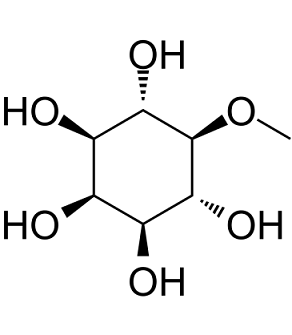
Sequoyitol (5-O-Methyl-myo-inositol; Sequoia alcohol) is a naturally occuring and extremely weak basic (essentially neutral) compound (based on its pKa) isolated from plants with an antidiabetic property. Sequoyitol (5-O-Methyl-myo-inositol) is an insulin sensitizer that decreases blood glucose, improves glucose intolerance, and is used to treat diabetes. Sequoyitol may similarly protect β-cells from oxidative injury by acting as an antioxidant. Both oral and subcutaneous administrations of sequoyitol improve hyperglycemia and glucose intolerance in both ob/ob and STZ-treated mice.
Physicochemical Properties
| Molecular Formula | C7H14O6 |
| Molecular Weight | 194.18 |
| Exact Mass | 194.079 |
| CAS # | 523-92-2 |
| PubChem CID | 439990 |
| Appearance | White to off-white solid powder |
| Density | 1.6±0.1 g/cm3 |
| Boiling Point | 317.2±42.0 °C at 760 mmHg |
| Flash Point | 145.6±27.9 °C |
| Vapour Pressure | 0.0±1.5 mmHg at 25°C |
| Index of Refraction | 1.588 |
| Source | Nephrolepis cordifolia, Glycine max |
| LogP | -0.74 |
| Hydrogen Bond Donor Count | 5 |
| Hydrogen Bond Acceptor Count | 6 |
| Rotatable Bond Count | 1 |
| Heavy Atom Count | 13 |
| Complexity | 158 |
| Defined Atom Stereocenter Count | 4 |
| SMILES | COC1[C@@H]([C@H](C([C@H]([C@@H]1O)O)O)O)O |
| InChi Key | DSCFFEYYQKSRSV-MVWKSXLKSA-N |
| InChi Code | InChI=1S/C7H14O6/c1-13-7-5(11)3(9)2(8)4(10)6(7)12/h2-12H,1H3/t2?,3-,4+,5+,6-,7? |
| Chemical Name | (1S,2R,4S,5R)-6-methoxycyclohexane-1,2,3,4,5-pentol |
| Synonyms | Sequoyitol; 523-92-2; 5-O-Methyl-myo-inositol; 1D-5-O-Methyl-myo-inositol; O-Methyl-scyllo-inositol; 1-O-Methyl-scyllo-inositol; (1R,2S,4R,5S)-6-methoxycyclohexane-1,2,3,4,5-pentol; (1S,2R,4S,5R)-6-methoxycyclohexane-1,2,3,4,5-pentol; |
| HS Tariff Code | 2934.99.9001 |
| Storage |
Powder-20°C 3 years 4°C 2 years In solvent -80°C 6 months -20°C 1 month Note: This product requires protection from light (avoid light exposure) during transportation and storage. |
| Shipping Condition | Room temperature (This product is stable at ambient temperature for a few days during ordinary shipping and time spent in Customs) |
Biological Activity
| Targets | Natural anti-diabetic |
| ln Vivo | Sequoyitol decreases blood glucose, improves glucose intolerance, and enhances insulin signaling in ob/ob mice. The aim of this study was to investigate the effects of sequoyitol on diabetic nephropathy in rats with type 2 diabetes mellitus and the mechanism of action. Diabetic rats, induced with a high-fat diet and a low dose of streptozotocin, and were administered sequoyitol (12.5, 25.0, and 50.0 mg·(kg body mass)(-1)·d(-1)) for 6 weeks. The levels of fasting blood glucose (FBG), serum insulin, blood urea nitrogen (BUN), and serum creatinine (SCr) were measured. The expression levels of p22(phox), p47(phox), NF-κB, and TGF-β1 were measured using immunohistochemisty, real-time PCR, and (or) Western blot. The total antioxidative capacity (T-AOC), as well as the levels of malondialdehyde (MDA) and reactive oxygen species (ROS) were also determined. The results showed that sequoyitol significantly decreased FBG, BUN, and SCr levels, and increased the insulin levels in diabetic rats. The level of T-AOC was significantly increased, while ROS and MDA levels and the expression of p22(phox), p47(phox), NF-κB, and TGF-β1 were decreased with sequoyitol treatment both in vivo and in vitro. These results suggested that sequoyitol ameliorates the progression of diabetic nephropathy in rats, as induced by a high-fat diet and a low dose of streptozotocin, through its glucose-lowering effects, antioxidant activity, and regulation of TGF-β1 expression.[1] |
| References | Sequoyitol decreases blood glucose, improves glucose intolerance, and enhances insulin signaling in vivo. Can J Physiol Pharmacol. 2014 May;92(5):405-17. |
| Additional Infomation |
1D-5-O-methyl-myo-inositol is a member of the class of methyl myo-inositols that is cyclohexane-1,2,3,4,5-pentol substituted by a methoxy group at position 6 (the 1R,2S,3r,4R,5S,6r-stereoisomer). It has a role as a plant metabolite. Sequoyitol has been reported in Nephrolepis cordifolia, Glycine max, and other organisms with data available. |
Solubility Data
| Solubility (In Vitro) | H2O : ~100 mg/mL (~514.99 mM) |
| Solubility (In Vivo) |
Solubility in Formulation 1: 100 mg/mL (514.99 mM) in PBS (add these co-solvents sequentially from left to right, and one by one), clear solution; with sonication. (Please use freshly prepared in vivo formulations for optimal results.) |
| Preparing Stock Solutions | 1 mg | 5 mg | 10 mg | |
| 1 mM | 5.1499 mL | 25.7493 mL | 51.4986 mL | |
| 5 mM | 1.0300 mL | 5.1499 mL | 10.2997 mL | |
| 10 mM | 0.5150 mL | 2.5749 mL | 5.1499 mL |