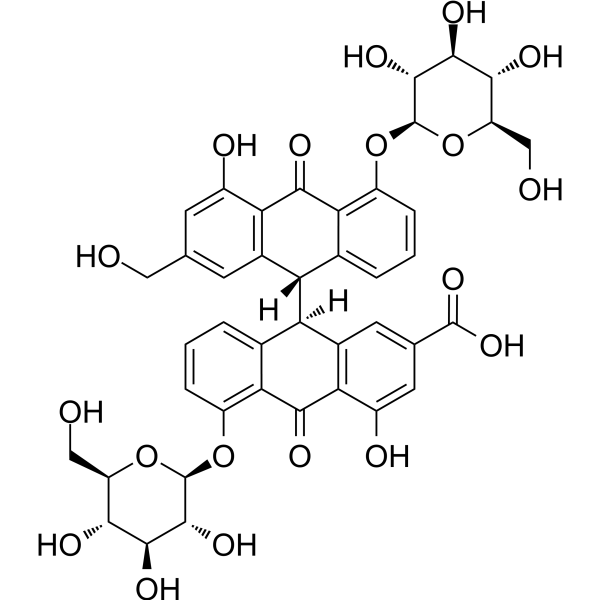
Physicochemical Properties
| Molecular Formula | C42H40O19 |
| Molecular Weight | 848.7556 |
| Exact Mass | 848.216 |
| CAS # | 37271-17-3 |
| PubChem CID | 46173830 |
| Appearance | Light yellow to brown solid powder |
| Density | 1.7±0.1 g/cm3 |
| Boiling Point | 1130.3±65.0 °C at 760 mmHg |
| Flash Point | 344.4±27.8 °C |
| Vapour Pressure | 0.0±0.3 mmHg at 25°C |
| Index of Refraction | 1.758 |
| LogP | 0.68 |
| Hydrogen Bond Donor Count | 12 |
| Hydrogen Bond Acceptor Count | 19 |
| Rotatable Bond Count | 9 |
| Heavy Atom Count | 61 |
| Complexity | 1580 |
| Defined Atom Stereocenter Count | 12 |
| SMILES | C1=CC2=C(C(=C1)O[C@H]3[C@@H]([C@H]([C@@H]([C@H](O3)CO)O)O)O)C(=O)C4=C([C@H]2[C@@H]5C6=C(C(=CC=C6)O[C@H]7[C@@H]([C@H]([C@@H]([C@H](O7)CO)O)O)O)C(=O)C8=C5C=C(C=C8O)C(=O)O)C=C(C=C4O)CO |
| InChi Key | ZFWOUNNKSHIAFK-MIIKWYNKSA-N |
| InChi Code | InChI=1S/C42H40O19/c43-11-14-7-18-26(16-3-1-5-22(30(16)34(50)28(18)20(46)8-14)58-41-38(54)36(52)32(48)24(12-44)60-41)27-17-4-2-6-23(59-42-39(55)37(53)33(49)25(13-45)61-42)31(17)35(51)29-19(27)9-15(40(56)57)10-21(29)47/h1-10,24-27,32-33,36-39,41-49,52-55H,11-13H2,(H,56,57)/t24-,25-,26+,27-,32-,33-,36+,37+,38-,39-,41-,42-/m1/s1 |
| Chemical Name | (9R)-4-hydroxy-9-[(9S)-4-hydroxy-2-(hydroxymethyl)-10-oxo-5-[(2S,3R,4S,5S,6R)-3,4,5-trihydroxy-6-(hydroxymethyl)oxan-2-yl]oxy-9H-anthracen-9-yl]-10-oxo-5-[(2S,3R,4S,5S,6R)-3,4,5-trihydroxy-6-(hydroxymethyl)oxan-2-yl]oxy-9H-anthracene-2-carboxylic acid |
| HS Tariff Code | 2934.99.9001 |
| Storage |
Powder-20°C 3 years 4°C 2 years In solvent -80°C 6 months -20°C 1 month Note: Please store this product in a sealed and protected environment (e.g. under nitrogen), avoid exposure to moisture and light. |
| Shipping Condition | Room temperature (This product is stable at ambient temperature for a few days during ordinary shipping and time spent in Customs) |
Biological Activity
| References |
[1]. Next Generation Sequencing and Transcriptome Analysis Predicts Biosynthetic Pathway of Sennosides from Senna (Cassia angustifolia Vahl.), a Non-Model Plant with Potent Laxative Properties. PLoS One. 2015 Jun 22;10(6):e0129422. |
| Additional Infomation |
Sennoside D is a member of sennosides. Sennoside D has been reported in Senna alexandrina and Brassica napus with data available. - Sennoside D is an anthraquinone glycoside, a member of the sennoside family, and is naturally present in the leaves of Cassia angustifolia Vahl. (Senna), a plant widely recognized for its potent laxative properties [1] - The study focused on predicting the biosynthetic pathway of sennosides (including Sennoside D) using next-generation sequencing (NGS) and transcriptome analysis of Cassia angustifolia . It identified candidate genes potentially involved in Sennoside D biosynthesis, such as genes encoding cytochrome P450 monooxygenases, glycosyltransferases, and polyketide synthases, though no experimental validation of these genes’ direct role in Sennoside D synthesis was conducted [1] |
Solubility Data
| Solubility (In Vitro) | DMSO : ≥ 50 mg/mL (~58.91 mM) |
| Solubility (In Vivo) |
Solubility in Formulation 1: ≥ 1.25 mg/mL (1.47 mM) (saturation unknown) in 10% DMSO + 40% PEG300 + 5% Tween80 + 45% Saline (add these co-solvents sequentially from left to right, and one by one), clear solution. For example, if 1 mL of working solution is to be prepared, you can add 100 μL of 12.5 mg/mL clear DMSO stock solution to 400 μL PEG300 and mix evenly; then add 50 μL Tween-80 to the above solution and mix evenly; then add 450 μL normal saline to adjust the volume to 1 mL. Preparation of saline: Dissolve 0.9 g of sodium chloride in 100 mL ddH₂ O to obtain a clear solution. Solubility in Formulation 2: ≥ 1.25 mg/mL (1.47 mM) (saturation unknown) in 10% DMSO + 90% (20% SBE-β-CD in Saline) (add these co-solvents sequentially from left to right, and one by one), clear solution. For example, if 1 mL of working solution is to be prepared, you can add 100 μL of 12.5 mg/mL clear DMSO stock solution to 900 μL of 20% SBE-β-CD physiological saline solution and mix evenly. Preparation of 20% SBE-β-CD in Saline (4°C,1 week): Dissolve 2 g SBE-β-CD in 10 mL saline to obtain a clear solution. (Please use freshly prepared in vivo formulations for optimal results.) |
| Preparing Stock Solutions | 1 mg | 5 mg | 10 mg | |
| 1 mM | 1.1782 mL | 5.8909 mL | 11.7819 mL | |
| 5 mM | 0.2356 mL | 1.1782 mL | 2.3564 mL | |
| 10 mM | 0.1178 mL | 0.5891 mL | 1.1782 mL |