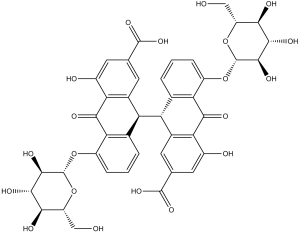
Sennoside B is a naturally occuring anthraquinone glycoside compound isolated from Puffer fish, salamanders, frogs foot spot et al., It is a type of irritant laxative used to treat constipation and may also be used for cleaning out the intestines before a bowel examination/surgery. Sennoside B inhibits PDGF-stimulated cell proliferation. Sennoside B prevents the proliferation of cells stimulated by PDGF. Sennoside B was discovered to prevent human MG63 osteosarcoma cells from becoming phosphorylated on the PDGFR as a result of PDGF-BB. Sennoside B pre-incubation of PDGF-BB inhibited the phosphorylation of AKT, STAT-5, and ERK1/2, among other pathway components.
Physicochemical Properties
| Molecular Formula | C42H38O20 | |
| Molecular Weight | 862.74 | |
| Exact Mass | 862.195 | |
| Elemental Analysis | C, 58.47; H, 4.44; O, 37.09 | |
| CAS # | 128-57-4 | |
| Related CAS # |
|
|
| PubChem CID | 91440 | |
| Appearance | Light yellow to yellow solid powder | |
| Density | 1.7±0.1 g/cm3 | |
| Boiling Point | 1144.8±65.0 °C at 760 mmHg | |
| Flash Point | 348.6±27.8 °C | |
| Vapour Pressure | 0.0±0.3 mmHg at 25°C | |
| Index of Refraction | 1.763 | |
| LogP | 1.88 | |
| Hydrogen Bond Donor Count | 12 | |
| Hydrogen Bond Acceptor Count | 20 | |
| Rotatable Bond Count | 9 | |
| Heavy Atom Count | 62 | |
| Complexity | 1550 | |
| Defined Atom Stereocenter Count | 12 | |
| SMILES | O(C1=C([H])C([H])=C([H])C2=C1C(C1C(=C([H])C(C(=O)O[H])=C([H])C=1[C@@]2([H])[C@@]1([H])C2C([H])=C(C(=O)O[H])C([H])=C(C=2C(C2C(=C([H])C([H])=C([H])C1=2)O[C@@]1([H])[C@@]([H])([C@]([H])([C@@]([H])([C@@]([H])(C([H])([H])O[H])O1)O[H])O[H])O[H])=O)O[H])O[H])=O)[C@@]1([H])[C@@]([H])([C@]([H])([C@@]([H])([C@@]([H])(C([H])([H])O[H])O1)O[H])O[H])O[H] |
|
| InChi Key | IPQVTOJGNYVQEO-AIFLABODSA-N | |
| InChi Code | InChI=1S/C42H38O20/c43-11-23-31(47)35(51)37(53)41(61-23)59-21-5-1-3-15-25(17-7-13(39(55)56)9-19(45)27(17)33(49)29(15)21)26-16-4-2-6-22(60-42-38(54)36(52)32(48)24(12-44)62-42)30(16)34(50)28-18(26)8-14(40(57)58)10-20(28)46/h1-10,23-26,31-32,35-38,41-48,51-54H,11-12H2,(H,55,56)(H,57,58)/t23-,24-,25-,26+,31-,32-,35+,36+,37-,38-,41-,42-/m1/s1 | |
| Chemical Name | (9S)-9-[(9R)-2-carboxy-4-hydroxy-10-oxo-5-[(2S,3R,4S,5S,6R)-3,4,5-trihydroxy-6-(hydroxymethyl)oxan-2-yl]oxy-9H-anthracen-9-yl]-4-hydroxy-10-oxo-5-[(2S,3R,4S,5S,6R)-3,4,5-trihydroxy-6-(hydroxymethyl)oxan-2-yl]oxy-9H-anthracene-2-carboxylic acid | |
| Synonyms |
|
|
| HS Tariff Code | 2934.99.9001 | |
| Storage |
Powder-20°C 3 years 4°C 2 years In solvent -80°C 6 months -20°C 1 month Note: (1). Please store this product in a sealed and protected environment (e.g. under nitrogen), avoid exposure to moisture and light.(2). This product is not stable in solution, please use freshly prepared working solution for optimal results. |
|
| Shipping Condition | Room temperature (This product is stable at ambient temperature for a few days during ordinary shipping and time spent in Customs) |
Biological Activity
| Targets |
PDGFR; PDGFR Sennoside B (a stimulant laxative derived from Senna alexandrina) exerts effects by targeting intestinal bacterial enzymes and colonic smooth muscle, with no traditional kinase/receptor IC50/Ki values (non-enzymatic/receptor-targeted mechanism). Key functional targets include: - Intestinal bacterial β-glucuronidase (mediates hydrolysis of Sennoside B to active metabolite rhein anthrone) [2] - Colonic smooth muscle cells (promotes contraction via enhancing Ca²⁺ influx and inhibiting Na⁺/K⁺-ATPase activity) [2] - Intestinal epithelial electrolyte transporters (stimulates Cl⁻ secretion and reduces water reabsorption) [2] |
| ln Vitro |
Sennoside B, a type of irritant laxative extracted from rhei rhizome, binds to PDGF-BB and its receptor, inhibiting the PDGFR-beta signaling pathway, and thereby inhibiting the proliferation of MG63 cells stimulated by platelet-derived growth factor (PDGF). The phosphorylation of several pathway components, such as extracellular signal-regulated kinase 1/2 (ERK1/2), Ak strain transforming protein (AKT), and signal transducer and activator of transcription 5 (STAT-5) is inhibited when PDGF-BB is pre-incubated with sennoside B.[2] Moreover, it has an IC50 of 9 μM for bovine serum monoamine oxidase inhibition.[1] 1. Bacterial metabolism activation: Sennoside B (10 μM) is hydrolyzed by intestinal bacterial β-glucuronidase to rhein anthrone (active form) in vitro. After 2-hour incubation with the enzyme, the conversion rate reaches 78%, and the metabolite concentration is 7.8 μM [2] 2. Colonic smooth muscle contraction: In isolated rat colonic muscle strips, Sennoside B (5 μM, 10 μM, 20 μM) enhances acetylcholine-induced contraction in a dose-dependent manner. At 20 μM, the contraction amplitude increases by 65% compared to the control group; this effect is blocked by Ca²⁺ channel inhibitors [2] 3. Electrolyte secretion promotion: In Caco-2 intestinal epithelial cell monolayers, Sennoside B (20 μM) increases Cl⁻ secretion by 42% (measured via short-circuit current) and reduces Na⁺ absorption by 38%, leading to increased intestinal lumen water content [2] |
| ln Vivo |
Sennosides were examined in a variety of toxicity investigations to assess potential risks. After a single oral dosage, acute investigations on rats and mice suggested that sennosides was only mildly toxic. Both species had LD50 values of roughly 5,000 mg/kg. Large-scale electrolyte and water loss after severe diarrhea was most likely the cause of death. No particular local or systemic toxicity was caused by sennosides in subacute studies involving rats (maximum dose/kg) and dogs (maximum dose/kg). Rat kidney weight increased slightly, but this had no toxicological significance. Sennosides were tolerated at doses up to 100 mg/kg in a 6-month study involving rats without any particular toxic effects. Secondary effects of chronic diarrhea include effects on food consumption, body weight gain, and certain biochemical parameters. It can also cause slight renal lesions. Reproduction toxicity studies and mutagenicity tests yielded normal results. 1. Laxative effect in mice: ICR mice (male, 20–25 g) are administered Sennoside B via oral gavage at doses of 5 mg/kg, 10 mg/kg, and 20 mg/kg. - 10 mg/kg group: The first defecation time shortens from 210 min (control) to 85 min; the number of fecal pellets in 6 hours increases from 2.3 (control) to 6.8 [1] - 20 mg/kg group: Fecal water content increases from 62% (control) to 85%, and diarrhea occurs in 80% of mice [1] 2. Small intestinal transit promotion in rats: SD rats (male, 200–250 g) are given Sennoside B (15 mg/kg, oral). The small intestinal transit rate (measured via charcoal meal) increases from 36% (control) to 72% at 2 hours post-administration [3] 3. Chronic constipation model efficacy: In loperamide-induced constipated mice, Sennoside B (10 mg/kg, oral, once daily for 7 days) restores the number of fecal pellets from 1.1/24h (model group) to 4.8/24h, and fecal water content from 51% to 78% [2] |
| Enzyme Assay |
Sennoside B binds to PDGF-BB and its receptor, inhibiting the PDGFR-beta signaling pathway, and thereby suppressing PDGF-stimulated cell proliferation. β-glucuronidase hydrolysis assay (intestinal bacterial enzyme): 1. Prepare reaction mixture containing recombinant bacterial β-glucuronidase (0.1 U/mL), Sennoside B (5–50 μM), and 50 mM phosphate buffer (pH 6.8). 2. Incubate the mixture at 37°C for 0.5, 1, 2, and 4 hours. 3. Terminate the reaction by adding 100 μL of methanol (1:1 v/v). 4. Detect the concentration of the active metabolite rhein anthrone using high-performance liquid chromatography (HPLC) with a UV detector (λ = 430 nm). 5. Calculate the hydrolysis rate as (amount of rhein anthrone formed / initial amount of Sennoside B) × 100% [2] |
| Cell Assay |
Sennoside B was either present or absent when PDGF was applied to human osteosarcoma MG63 cells. Western immunoblotting using particular antibodies against the phosphotyrosine, PDGF receptor, and downstream signaling cascade components was used to track the activation of the PDGF signaling pathway. Chromatogenic reduction of MTT was used to measure the activation of cell metabolism and proliferation. Caco-2 intestinal epithelial cell electrolyte transport assay: 1. Culture Caco-2 cells on Transwell inserts until forming a confluent monolayer (transepithelial electrical resistance > 500 Ω·cm²). 2. Apical chamber: Add Sennoside B (1–30 μM) in Hank’s balanced salt solution (HBSS, pH 7.4); basolateral chamber: Add HBSS with 10 mM HEPES. 3. Incubate at 37°C in a 5% CO₂ incubator for 2 hours. 4. Measure short-circuit current (Isc, indicator of Cl⁻ secretion) using a voltage-clamp amplifier. 5. Determine Na⁺/K⁺-ATPase activity in cell lysates via measuring inorganic phosphate (Pi) release (using a Pi assay kit) after incubation with ATP [2] |
| Animal Protocol |
20, 100, 500 mg/kg Mouse and rat 1. Acute laxative assay (ICR mice): - Animals: Male ICR mice (20–22 g), n=6 per group. - Drug formulation: Sennoside B dissolved in 0.5% carboxymethyl cellulose sodium (CMC-Na) to concentrations of 5 mg/mL, 10 mg/mL, 20 mg/mL. - Administration: Oral gavage at doses of 5 mg/kg, 10 mg/kg, 20 mg/kg; control group receives 0.5% CMC-Na. - Observations: Record first defecation time, number of fecal pellets (0–6 hours), and fecal water content (gravimetric method: wet weight - dry weight / wet weight × 100%) [1] 2. Small intestinal transit assay (SD rats): - Animals: Male SD rats (200–220 g), n=6 per group. - Drug administration: Sennoside B (15 mg/kg, oral, dissolved in normal saline); control group receives normal saline. - Charcoal meal: 30 minutes post-drug administration, oral gavage of 0.5 mL charcoal suspension (10% charcoal in 5% arabic gum). - Sacrifice: Rats are euthanized 2 hours after charcoal meal; small intestine is removed. - Calculation: Transit rate = (distance traveled by charcoal / total length of small intestine) × 100% [3] 3. Chronic constipation model (ICR mice): - Model induction: Loperamide (1 mg/kg, subcutaneous, once daily for 7 days) to induce constipation. - Drug treatment: Sennoside B (10 mg/kg, oral, once daily for 7 days) during model induction; model group receives 0.5% CMC-Na. - Observations: Daily fecal pellets (24 hours) and fecal water content [2] |
| ADME/Pharmacokinetics |
1. Absorption: Sennoside B is poorly absorbed in the small intestine (oral bioavailability < 5%). Most of the drug reaches the large intestine intact (detected concentration in human colon: 15–30 μM after 10 mg oral dose) [2] 2. Metabolism: In the large intestine, Sennoside B is hydrolyzed by intestinal bacterial β-glucuronidase to form the active metabolite rhein anthrone (half-life of hydrolysis: ~2 hours in human fecal homogenate) [2] 3. Excretion: Unabsorbed Sennoside B and its metabolites (rhein anthrone, rhein) are mainly excreted via feces (recovery rate: ~85% within 48 hours of oral administration in rats) [3] |
| Toxicity/Toxicokinetics |
1. Acute toxicity: Male/female ICR mice (20–25 g) receive Sennoside B (oral, doses up to 2000 mg/kg). No mortality is observed; transient soft stools occur at 1000 mg/kg but resolve within 24 hours. LD50 (oral, mice) > 2000 mg/kg [3] 2. Subacute toxicity (14-day study, SD rats): - Doses: 50 mg/kg, 100 mg/kg, 200 mg/kg (oral, once daily). - Observations: No significant changes in body weight, food intake, or serum biochemical parameters (ALT, AST, creatinine, blood urea nitrogen) compared to control. - Histopathology: No obvious damage to liver, kidney, or colon mucosa in all dose groups [2] 3. Colonic mucosa safety: Long-term administration (28 days, 50 mg/kg, oral) in rats shows no significant inflammation (no increase in TNF-α or IL-6 in colon tissue) or epithelial hyperplasia [2] |
| References |
[1]. Chem Pharm Bull (Tokyo) . 1989 Oct;37(10):2744-6. [2]. Life Sci . 2009 Jun 19;84(25-26):915-22. [3]. Pharmacology . 1988:36 Suppl 1:180-7. |
| Additional Infomation |
Sennoside B is a member of the class of sennosides that is (9R,9'S)-9,9',10,10'-tetrahydro-9,9'-bianthracene-2,2'-dicarboxylic acid which is substituted by hydroxy groups at positions 4 and 4', by beta-D-glucopyranosyloxy groups at positions 5 and 5', and by oxo groups at positions 10 and 10'. It is a member of sennosides and an oxo dicarboxylic acid. Sennoside B has been reported in Rheum palmatum, Rheum tanguticum, and other organisms with data available. 1. Therapeutic background: Sennoside B is a major active component of senna (a traditional laxative herb), clinically used for the short-term treatment of functional constipation and preoperative bowel preparation. It acts as a stimulant laxative with rapid onset (6–12 hours after oral administration) [1] 2. Mechanism of action: Sennoside B is activated by intestinal bacterial β-glucuronidase to rhein anthrone, which: (1) Enhances colonic smooth muscle contraction via increasing intracellular Ca²⁺ concentration; (2) Inhibits Na⁺/K⁺-ATPase to reduce water and Na⁺ reabsorption; (3) Stimulates Cl⁻ secretion, leading to increased intestinal lumen volume and laxation [2] 3. Clinical note: Sennoside B is not recommended for long-term use (>2 weeks) to avoid potential electrolyte imbalance (hypokalemia) or drug dependence; short-term use (3–7 days) is considered safe in adults [3] |
Solubility Data
| Solubility (In Vitro) |
|
|||
| Solubility (In Vivo) |
Solubility in Formulation 1: ≥ 2.5 mg/mL (2.90 mM) (saturation unknown) in 10% DMSO + 40% PEG300 + 5% Tween80 + 45% Saline (add these co-solvents sequentially from left to right, and one by one), clear solution. For example, if 1 mL of working solution is to be prepared, you can add 100 μL of 25.0 mg/mL clear DMSO stock solution to 400 μL PEG300 and mix evenly; then add 50 μL Tween-80 to the above solution and mix evenly; then add 450 μL normal saline to adjust the volume to 1 mL. Preparation of saline: Dissolve 0.9 g of sodium chloride in 100 mL ddH₂ O to obtain a clear solution. Solubility in Formulation 2: ≥ 2.5 mg/mL (2.90 mM) (saturation unknown) in 10% DMSO + 90% Corn Oil (add these co-solvents sequentially from left to right, and one by one), clear solution. For example, if 1 mL of working solution is to be prepared, you can add 100 μL of 25.0 mg/mL clear DMSO stock solution to 900 μL of corn oil and mix evenly. (Please use freshly prepared in vivo formulations for optimal results.) |
| Preparing Stock Solutions | 1 mg | 5 mg | 10 mg | |
| 1 mM | 1.1591 mL | 5.7955 mL | 11.5910 mL | |
| 5 mM | 0.2318 mL | 1.1591 mL | 2.3182 mL | |
| 10 mM | 0.1159 mL | 0.5795 mL | 1.1591 mL |