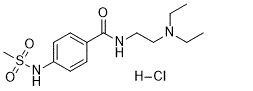
Sematilide (formerly known as CK-1752) is a novel class III antiarrhythmic agent. It acts as a selective delayed rectifier K+ current (IKr) channel blocker. I The sematilide-sensitive current, which was recorded by means of a triangular voltage command, showed a strong inward rectification and had a peak at about -40 mV, suggesting that sematilide inhibits the rapidly activating delayed rectifier K+ current. The Ca2+-independent transient K+ and the inward rectifier K+ currents were not affected significantly by application of 100 microM sematilide. Moreover, voltage-dependent Na+ and Ca2+ currents were not affected significantly by 100 microM sematilide. These findings indicate that sematilide selectively blocks the rapidly activating delayed rectifier K+ current in atrial myocytes and provide evidence supporting the usefulness of the drug as a class III antiarrhythmic agent.
Physicochemical Properties
| Molecular Formula | C14H24CLN3O3S | |
| Molecular Weight | 349.87 | |
| Exact Mass | 349.123 | |
| Elemental Analysis | C, 48.06; H, 6.91; Cl, 10.13; N, 12.01; O, 13.72; S, 9.16 | |
| CAS # | 101526-62-9 | |
| Related CAS # | Sematilide;101526-83-4 | |
| PubChem CID | 58504 | |
| Appearance | White to yellow solid powder | |
| Boiling Point | 511.9ºC at 760 mmHg | |
| Flash Point | 263.4ºC | |
| Vapour Pressure | 7.59E-11mmHg at 25°C | |
| LogP | 3.476 | |
| Hydrogen Bond Donor Count | 3 | |
| Hydrogen Bond Acceptor Count | 5 | |
| Rotatable Bond Count | 8 | |
| Heavy Atom Count | 22 | |
| Complexity | 408 | |
| Defined Atom Stereocenter Count | 0 | |
| SMILES | Cl.CCN(CCNC(C1C=CC(NS(=O)(C)=O)=CC=1)=O)CC |
|
| InChi Key | OKXAJGDKHKNFAX-UHFFFAOYSA-N | |
| InChi Code | InChI=1S/C14H23N3O3S.ClH/c1-4-17(5-2)11-10-15-14(18)12-6-8-13(9-7-12)16-21(3,19)20;/h6-9,16H,4-5,10-11H2,1-3H3,(H,15,18);1H | |
| Chemical Name |
|
|
| Synonyms |
|
|
| HS Tariff Code | 2934.99.9001 | |
| Storage |
Powder-20°C 3 years 4°C 2 years In solvent -80°C 6 months -20°C 1 month Note: Please store this product in a sealed and protected environment, avoid exposure to moisture. |
|
| Shipping Condition | Room temperature (This product is stable at ambient temperature for a few days during ordinary shipping and time spent in Customs) |
Biological Activity
| Targets | Applying 10, 30, 100, and 300 μM of sematilide inhibits delayed rectifier K+ current (IC50=25 μM) in a concentration-dependent manner [1]. |
| ln Vitro |
Applying 10, 30, 100, and 300 μM of sematilide inhibits delayed rectifier K+ current (IC50=25 μM) in a concentration-dependent manner [1]. Sematilide (10, 30, 100, 300 µM) causes a concentration-dependent inhibition of the delayed rectifier K⁺ current (I_K) tail current (I_K-tail) in enzymatically isolated rabbit left atrial myocytes, with an IC50 of approximately 25 µM. Application of 300 µM sematilide almost completely blocks I_K-tail. [1] The sematilide-sensitive current (I_sema) exhibits strong inward rectification and peaks around -40 mV, characteristic of the rapidly activating component I_Kr. The inhibition of I_K by sematilide is not voltage-dependent over the range of +1 to +41 mV. [1] Sematilide (100 µM) does not significantly affect the Ca²⁺-independent transient outward K⁺ current (I_t) in rabbit atrial myocytes. [1] Sematilide (100 µM) does not significantly affect the inward rectifier K⁺ current (I_K1) in rabbit atrial myocytes. [1] Sematilide (100 µM) does not significantly affect the voltage-dependent Na⁺ current (I_Na) in rabbit atrial myocytes. [1] Sematilide (100 µM) does not significantly affect the voltage-dependent Ca²⁺ current (I_Ca, primarily L-type) in rabbit atrial myocytes. [1] |
| ln Vivo | In dogs with arrhythmia models, simalide (0.3–1.0 mg/kg, intravenous injection) works well [2]. |
| Cell Assay |
Isolation of Rabbit Atrial Myocytes: Hearts from young male rabbits were perfused on a Langendorff system with normal Krebs solution, followed by Ca²⁺-free Krebs solution, and then Ca²⁺-free Krebs solution containing collagenase. After enzyme washout with KB solution, the left atrium was dissociated by gentle agitation. Cells were stored in a high Mg²⁺, Ca²⁺-free HEPES-buffered solution with gradual addition of Ca²⁺ and used within 12 hours. [1] Whole-Cell Voltage Clamp Recording: Ionic currents were recorded from single atrial myocytes using the whole-cell patch-clamp technique at 36°C. Pipettes were filled with an internal solution containing K-aspartate, KCl, MgCl₂, CaCl₂, EGTA, Na₂ATP, and HEPES (pCa 7.5). The standard external solution contained NaCl, KCl, CaCl₂, MgCl₂, glucose, and HEPES. Specific current isolations: I_K was recorded in the presence of CoCl₂ to block I_Ca; I_t was recorded in the presence of CdCl₂ to block I_Ca; I_K1 was recorded as the Ba²⁺-sensitive current in the presence of CdCl₂; I_Na was recorded at 10°C in a solution with reduced Na⁺ (replaced by tetraethylammonium) and CdCl₂; I_Ca was recorded in the presence of 4-aminopyridine to block I_t. Drugs were applied via the bathing solution. Currents were digitized and analyzed using computer software. [1] |
| Animal Protocol |
Animal/Disease Models: Mongrel dogs of either sex (body weight 10-18 kg) [2] Doses: 0.3, 1, 3 and 10 mg/kg Route of Administration: intravenous (iv) (iv)infusion Experimental Results: 0.3 and 3.0 mg/kg demonstrated antirhythmic effects Abnormal effects. |
| Toxicity/Toxicokinetics |
This study does not provide systemic toxicity, toxicokinetic, or protein binding data for sematilide. At the cellular level, sematilide (100 µM) showed high selectivity for I_Kr over other major cardiac currents (I_t, I_K1, I_Na, I_Ca), suggesting a potentially favorable safety profile regarding electrophysiological side effects. [1] |
| References |
[1]. Effects of Sematilide, a novel class III antiarrhythmic agent, on membrane currents in rabbit atrial myocytes. Eur J Pharmacol. 1997 Jul 23;331(2-3):295-302. [2]. Pharmacology of Sematilide, a non-quaternary class III antiarrhythmic agent. |
| Additional Infomation |
See also: Sematilide (annotation moved to). Sematilide is a novel class III antiarrhythmic agent. Its primary mechanism of action is selective blockade of the rapidly activating delayed rectifier K⁺ current (I_Kr), which prolongs the action potential duration and effective refractory period in cardiac tissue. [1] The high selectivity of sematilide for I_Kr over other repolarizing currents (I_t, I_K1) and depolarizing currents (I_Na, I_Ca) in atrial myocytes supports its classification as a "pure" class III agent and may underlie its clinical effects in prolonging atrial and ventricular refractory periods. [1] |
Solubility Data
| Solubility (In Vitro) |
|
|||
| Solubility (In Vivo) |
Solubility in Formulation 1: 0.5 mg/mL (1.43 mM) in 10% DMSO + 40% PEG300 + 5% Tween80 + 45% Saline (add these co-solvents sequentially from left to right, and one by one), clear solution; with sonication. For example, if 1 mL of working solution is to be prepared, you can add 100 μL of 5.0 mg/mL clear DMSO stock solution to 400 μL PEG300 and mix evenly; then add 50 μL Tween-80 to the above solution and mix evenly; then add 450 μL normal saline to adjust the volume to 1 mL. Preparation of saline: Dissolve 0.9 g of sodium chloride in 100 mL ddH₂ O to obtain a clear solution. Solubility in Formulation 2: 0.5 mg/mL (1.43 mM) in 10% DMSO + 90% (20% SBE-β-CD in Saline) (add these co-solvents sequentially from left to right, and one by one), clear solution; with ultrasonication. For example, if 1 mL of working solution is to be prepared, you can add 100 μL of 5.0 mg/mL clear DMSO stock solution to 900 μL of 20% SBE-β-CD physiological saline solution and mix evenly. Preparation of 20% SBE-β-CD in Saline (4°C,1 week): Dissolve 2 g SBE-β-CD in 10 mL saline to obtain a clear solution. Solubility in Formulation 3: 0.5 mg/mL (1.43 mM) in 10% DMSO + 90% Corn Oil (add these co-solvents sequentially from left to right, and one by one), clear solution; with ultrasonication. For example, if 1 mL of working solution is to be prepared, you can add 100 μL of 5.0 mg/mL clear DMSO stock solution to 900 μL of corn oil and mix evenly. (Please use freshly prepared in vivo formulations for optimal results.) |
| Preparing Stock Solutions | 1 mg | 5 mg | 10 mg | |
| 1 mM | 2.8582 mL | 14.2910 mL | 28.5820 mL | |
| 5 mM | 0.5716 mL | 2.8582 mL | 5.7164 mL | |
| 10 mM | 0.2858 mL | 1.4291 mL | 2.8582 mL |