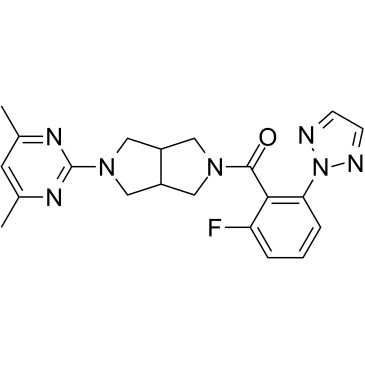
Seltorexant (also known as MIN-202 and JNJ-42847922), is a novel, potent and selective orexin-2 receptor antagonist. It can promote sleep in various species and is under development for the treatment of insomnia and major depressive disorder.
Physicochemical Properties
| Molecular Formula | C21H22FN7O |
| Molecular Weight | 407.444086551666 |
| Exact Mass | 407.187 |
| Elemental Analysis | C, 61.90; H, 5.44; F, 4.66; N, 24.06; O, 3.93 |
| CAS # | 1293281-49-8 |
| Related CAS # | Seltorexant hydrochloride;1293284-49-7 |
| PubChem CID | 67116280 |
| Appearance | White to yellow solid powder |
| LogP | 2.8 |
| Hydrogen Bond Donor Count | 0 |
| Hydrogen Bond Acceptor Count | 7 |
| Rotatable Bond Count | 3 |
| Heavy Atom Count | 30 |
| Complexity | 609 |
| Defined Atom Stereocenter Count | 0 |
| SMILES | FC1C=CC=C(C=1C(N1CC2CN(C3N=C(C)C=C(C)N=3)CC2C1)=O)N1N=CC=N1 |
| InChi Key | SQOCEMCKYDVLMM-UHFFFAOYSA-N |
| InChi Code | InChI=1S/C21H22FN7O/c1-13-8-14(2)26-21(25-13)28-11-15-9-27(10-16(15)12-28)20(30)19-17(22)4-3-5-18(19)29-23-6-7-24-29/h3-8,15-16H,9-12H2,1-2H3 |
| Chemical Name | ((3aR,6aS)-5-(4,6-dimethylpyrimidin-2-yl)hexahydropyrrolo[3,4-c]pyrrol-2(1H)-yl)(2-fluoro-6-(2H-1,2,3-triazol-2-yl)phenyl)methanone |
| Synonyms | MIN-202; JNJ42847922; MIN 202; JNJ-42847922; MIN202; JNJ 42847922; Seltorexant |
| HS Tariff Code | 2934.99.9001 |
| Storage |
Powder-20°C 3 years 4°C 2 years In solvent -80°C 6 months -20°C 1 month |
| Shipping Condition | Room temperature (This product is stable at ambient temperature for a few days during ordinary shipping and time spent in Customs) |
Biological Activity
| Targets |
JNJ-42847922 is a high-affinity, potent, and selective orexin-2 receptor (OX2R) antagonist. It has an approximate 2-log selectivity ratio versus the human orexin-1 receptor (OX1R). Binding affinity (pKi) for human OX2R is 8.0 ± 0.1, and for rat OX2R is 8.1 ± 0.1. Binding affinity (pKi) for human OX1R is 6.1 ± 0.2, and for rat OX1R is 6.2 ± 0.1. Functional antagonism potency (pKb) for human OX2R is 8.8 ± 0.2, and for rat OX2R is 8.0 ± 0.1. Functional antagonism potency (pKb) for human OX1R is 6.3 ± 0.3, and for rat OX1R is <6.0 ± 0.01 [1]. |
| ln Vitro |
In radioligand binding assays, JNJ-42847922 demonstrated high-affinity binding to both human and rat OX2R. In a panel of 50 receptors, ion channels, and transporter assays, JNJ-42847922 at 1 μM showed no significant affinity ( < 50% inhibition) for any target other than OX2R, indicating high selectivity. In calcium mobilization functional assays, JNJ-42847922 acted as a potent antagonist, with its pKb values correlating well with its pKi values for both human and rat OX2R [1]. |
| ln Vivo |
In rats, oral administration of JNJ-42847922 (3-30 mg/kg) during the light phase dose-dependently reduced the latency to non-rapid eye movement (NREM) sleep and prolonged NREM sleep time in the first 2 hours, with minimal effects on REM sleep. Sleep consolidation was enhanced, as indicated by a prolonged NREM bout duration. The sleep-promoting effects were maintained upon 7-day repeated dosing (30 mg/kg/day) without evidence of rebound upon discontinuation. JNJ-42847922 (30 mg/kg, p.o.) promoted sleep in wild-type mice but had no effect on sleep parameters in OX2R knockout mice, confirming the specific OX2R-mediated mechanism of action. The compound (30 mg/kg, p.o.) did not increase dopamine release in the rat nucleus accumbens, nor did it produce conditioned place preference in mice (10 mg/kg, i.p.), suggesting a lack of intrinsic motivational properties, unlike zolpidem. Furthermore, JNJ-42847922 (30 mg/kg, p.o.) did not affect motor coordination or exacerbate alcohol-induced ataxia in rats, in contrast to zolpidem. In a first-in-human trial, single oral doses (10-80 mg) increased somnolence in healthy subjects, with the effect appearing dose-dependent [1]. At doses up to Sprague-Dawley weight, seltorexant (JNJ-42847922) (3–30 mg/kg; flour) initiates and prolongs sleep [1]. 30 mg/kg seltorexant (wall; daily for 7 days) |
| Enzyme Assay | The affinity of JNJ-42847922 for human and rat orexin receptors was determined using competitive radioligand binding assays. For OX2R, cell membranes from HEK-293 cells (transfected with human OX2R) or CHO-K1 cells (transfected with rat OX2R) were incubated with 2 nM of the OX2R radioligand [³H]EMPA and various concentrations of the test compound for 60 minutes at room temperature. Nonspecific binding was defined using 10 μM almorexant. Bound radioactivity was separated by filtration and counted. For OX1R, cell membranes from CHO-K1 cells (human OX1R) or HEK-293 cells (rat OX1R) were incubated with 4 nM of the OX1R radioligand [³H]SB-674042 and the test compound. Nonspecific binding was also determined with 10 μM almorexant. Ki values were calculated from the inhibition curves [1]. |
| Cell Assay |
The functional antagonism of JNJ-42847922 at orexin receptors was evaluated by measuring its ability to inhibit agonist-induced intracellular calcium mobilization. For human OX2R, PFSK-1 cells, which endogenously express the receptor, were used. For rat OX2R, SK-N-MC cells stably expressing the rat OX2R were used. For OX1R, stably transfected CHO-K1 (human OX1R) or HEK293 (rat OX1R) cells were employed. Cells were plated in 96-well plates and grown overnight. On the day of the assay, cells were incubated with various concentrations of JNJ-42847922 before being stimulated with an EC₈₀ concentration of an orexin receptor agonist. The resulting transient increase in intracellular calcium was measured. The potency of the antagonist (pKb) was calculated from the inhibition of the agonist response [1]. |
| Animal Protocol |
Animal/Disease Models: Male SD (SD (Sprague-Dawley)) rat (350-450 g) [1] Doses: 30 mg/kg Route of Administration: po; in the antenna The sleep-prolonging effect remains stable after 7 days of repeated spraying [1]. Once-daily for 7 days Experimental Results: Reductions in sleep onset time (non-rapid eye movement (NREM) latency) and increases in NREM sleep duration were maintained after repeated dosing of JNJ-42847922 for 7 days. The prolongation of NREM sleep duration was due to a significant increase in NREM episode duration throughout the treatment period assessed on D1 and D7. Rapid eye movement (REM) sleep was only slightly affected on day 4 of treatment, resulting in a small but significant decrease in REM sleep latency and an increase in REM sleep duration. For the sleep efficacy study in rats, male Sprague-Dawley rats were orally dosed with vehicle or JNJ-42847922 (3, 10, 30 mg/kg) 2 hours into the light phase. Sleep-wake patterns were recorded for the subsequent 2 hours. For the repeated dosing study, rats were dosed orally with vehicle for 2 days, then with JNJ-42847922 (30 mg/kg/day) for 7 days, followed by vehicle for 2 days. Sleep parameters were recorded during the first 2 hours post-dose [1]. For the OX2R knockout mouse study, OX2R KO and wild-type mice were orally administered vehicle or JNJ-42847922 (30 mg/kg) at the onset of the dark phase. Sleep parameters were assessed for the following 2 hours [1]. For the microdialysis study in rats, JNJ-42847922 (30 mg/kg) was administered orally, and dopamine levels in the nucleus accumbens of freely moving rats were measured [1]. For the conditioned place preference test in mice, animals were conditioned for 4 days with intraperitoneal injections of vehicle, JNJ-42847922 (10 mg/kg), zolpidem (10 mg/kg), or amphetamine (2 mg/kg) in a biased manner. On day 6, the time spent in each chamber was recorded over 15 minutes [1]. For the rotarod test in rats, animals were trained a day prior. On the test day, they received an oral dose of JNJ-42847922 (30 mg/kg), zolpidem (10 mg/kg), or vehicle, and were tested 15 minutes later. In the alcohol interaction study, ethanol (1 g/kg, i.p.) was co-administered. The time the animals remained on the rotating drum was recorded up to a 60-second cutoff [1]. For the ex vivo receptor occupancy study in rats, animals were orally administered JNJ-42847922 (30 mg/kg for time course; 1-60 mg/kg for dose-response). At specified time points (15 min to 24 h) post-dose, brains were collected, sectioned, and incubated with [³H]EMPA to determine OX2R occupancy via autoradiography [1]. |
| ADME/Pharmacokinetics |
In rats, after oral administration, JNJ-42847922 showed rapid brain penetration and fast clearance from the brain, with OX2R occupancy peaking at 60 minutes (74 ± 6%) and declining to 40% by 4 hours. The ED₅₀ for OX2R occupancy in rats was 3 mg/kg, corresponding to a total plasma concentration of 171 ng/ml and an unbound plasma concentration of 9.58 ng/ml. In a first-in-human single ascending dose study (10-80 mg), JNJ-42847922 was rapidly absorbed with a mean time to maximum plasma concentration (tmax) of 0.33 to 0.5 hours. It exhibited an apparently monophasic decline with a terminal half-life of approximately 2 hours. Both Cmax and AUC increased with dose in a slightly less than dose-proportional manner [1]. |
| Toxicity/Toxicokinetics |
JNJ-42847922 was well tolerated in single- and multiple-dose Good Laboratory Practice toxicology studies of up to 1-month duration in rats and dogs. It showed no genotoxicity potential in the standard genotoxicity test battery and was well tolerated in a dog cardiovascular safety study. In the first-in-human trial, single doses of 10 to 80 mg were safe and well tolerated in healthy subjects. All adverse events were mild or moderate. The most common adverse event was somnolence (85% for active vs. 23% for placebo). Other reported events included headache (12%) and dizziness/postural dizziness (12%). One subject who received 80 mg experienced a single brief episode of sleep paralysis. There were no clinically significant findings in other safety evaluations [1]. |
| References |
[1]. Characterization of JNJ-42847922, a Selective Orexin-2 Receptor Antagonist, as a Clinical Candidate for the Treatment of Insomnia. J Pharmacol Exp Ther. 2015 Sep;354(3):471-82. |
| Additional Infomation |
Dual orexin receptor antagonists have been shown to promote sleep in various species, including humans. Emerging research indicates that selective orexin-2 receptor (OX2R) antagonists may offer specificity and a more adequate sleep profile by preserving normal sleep architecture. Here, we characterized JNJ-42847922 ([5-(4,6-dimethyl-pyrimidin-2-yl)-hexahydro-pyrrolo[3,4-c]pyrrol-2-yl]-(2-fluoro-6-[1,2,3]triazol-2-yl-phenyl)-methanone), a high-affinity/potent OX2R antagonist. JNJ-42847922 had an approximate 2-log selectivity ratio versus the human orexin-1 receptor. Ex vivo receptor binding studies demonstrated that JNJ-42847922 quickly occupied OX2R binding sites in the rat brain after oral administration and rapidly cleared from the brain. In rats, single oral administration of JNJ-42847922 (3–30 mg/kg) during the light phase dose dependently reduced the latency to non–rapid eye movement (NREM) sleep and prolonged NREM sleep time in the first 2 hours, whereas REM sleep was minimally affected. The reduced sleep onset and increased sleep duration were maintained upon 7-day repeated dosing (30 mg/kg) with JNJ-42847922, then all sleep parameters returned to baseline levels following discontinuation. Although the compound promoted sleep in wild-type mice, it had no effect in OX2R knockout mice, consistent with a specific OX2R-mediated sleep response. JNJ-42847922 did not increase dopamine release in rat nucleus accumbens or produce place preference in mice after subchronic conditioning, indicating that the compound lacks intrinsic motivational properties in contrast to zolpidem. In a single ascending dose study conducted in healthy subjects, JNJ-42847922 increased somnolence and displayed a favorable pharmacokinetic and safety profile for a sedative/hypnotic, thus emerging as a promising candidate for further clinical development for the treatment of insomnia.[1] JNJ-42847922 (also known as Seltorexant) is a selective orexin-2 receptor antagonist developed as a clinical candidate for the treatment of insomnia. Its mechanism of action is based on the pharmacological blockade of OX2R, which is sufficient to initiate and prolong sleep. Unlike dual orexin receptor antagonists (DORAs) that promote both NREM and REM sleep, selective OX2R antagonism by JNJ-42847922 primarily promotes NREM sleep and preserves sleep architecture. In preclinical models, it showed a clear differentiation from the non-benzodiazepine hypnotic zolpidem by lacking abuse liability and not impairing motor coordination or exacerbating alcohol-induced ataxia. Based on its favorable preclinical profile, it advanced to clinical trials, where it demonstrated a strong hypnotic-like effect and a favorable pharmacokinetic and safety profile, emerging as a promising new class of non-sedating hypnotics for insomnia [1]. |
Solubility Data
| Solubility (In Vitro) | DMSO : ~25 mg/mL (~61.36 mM) |
| Solubility (In Vivo) |
Solubility in Formulation 1: ≥ 2.5 mg/mL (6.14 mM) (saturation unknown) in 10% DMSO + 40% PEG300 + 5% Tween80 + 45% Saline (add these co-solvents sequentially from left to right, and one by one), clear solution. For example, if 1 mL of working solution is to be prepared, you can add 100 μL of 25.0 mg/mL clear DMSO stock solution to 400 μL PEG300 and mix evenly; then add 50 μL Tween-80 to the above solution and mix evenly; then add 450 μL normal saline to adjust the volume to 1 mL. Preparation of saline: Dissolve 0.9 g of sodium chloride in 100 mL ddH₂ O to obtain a clear solution. Solubility in Formulation 2: ≥ 2.5 mg/mL (6.14 mM) (saturation unknown) in 10% DMSO + 90% (20% SBE-β-CD in Saline) (add these co-solvents sequentially from left to right, and one by one), clear solution. For example, if 1 mL of working solution is to be prepared, you can add 100 μL of 25.0 mg/mL clear DMSO stock solution to 900 μL of 20% SBE-β-CD physiological saline solution and mix evenly. Preparation of 20% SBE-β-CD in Saline (4°C,1 week): Dissolve 2 g SBE-β-CD in 10 mL saline to obtain a clear solution. Solubility in Formulation 3: ≥ 2.5 mg/mL (6.14 mM) (saturation unknown) in 10% DMSO + 90% Corn Oil (add these co-solvents sequentially from left to right, and one by one), clear solution. For example, if 1 mL of working solution is to be prepared, you can add 100 μL of 25.0 mg/mL clear DMSO stock solution to 900 μL of corn oil and mix evenly. (Please use freshly prepared in vivo formulations for optimal results.) |
| Preparing Stock Solutions | 1 mg | 5 mg | 10 mg | |
| 1 mM | 2.4543 mL | 12.2717 mL | 24.5435 mL | |
| 5 mM | 0.4909 mL | 2.4543 mL | 4.9087 mL | |
| 10 mM | 0.2454 mL | 1.2272 mL | 2.4543 mL |