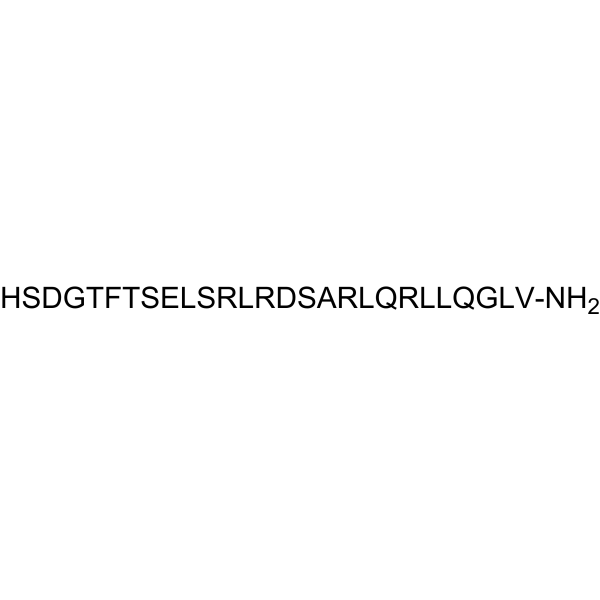
Physicochemical Properties
| Molecular Formula | C130H220N44O41.6[C4H7NO4] |
| Molecular Weight | 3854.02407999997 |
| Exact Mass | 3053.65 |
| CAS # | 17034-35-4 |
| Appearance | White to off-white solid powder |
| HS Tariff Code | 2934.99.9001 |
| Storage |
Powder-20°C 3 years 4°C 2 years In solvent -80°C 6 months -20°C 1 month |
| Shipping Condition | Room temperature (This product is stable at ambient temperature for a few days during ordinary shipping and time spent in Customs) |
Biological Activity
| ln Vitro | Secretin (porcine) (10−7M, 10−6M; 24 to 72 hours and 7 days) interacts with the secretin receptor (SR) to promote bile growth; cAMP-dependent signaling is downregulated to diminish bile proliferation by knocking down SR[2]. Large murine biliary cell lines and human HIBEpiC are more proliferative when exposed to secretin (10−7M, 10−6M; 24 to 72 hours and 7 days) [2][3][4]. The use of immunofluorescence |
| ln Vivo | Pig secretin (2.5 nM/kg, body weight/day, mini-osmotic pump, for 1 week) stimulates the expression of microRNA let7a and microRNA 125b in mice, which in turn promotes the proliferation of cholangiocytes [2]. |
| Cell Assay |
Immunofluorescence[2] Cell Types: Large mouse cholangiocyte cell line Tested Concentrations: 10−7M, 10−6 M Incubation Duration: 24 to 72 hrs (hours) and 7 days Experimental Results: Increased cholangiocyte proliferation. Cell proliferation assay[2] Cell Types: Human HIBEpiC and Large Murine Cholangiocarcinoma Cell Line Tested Concentrations: 10−7M, 10−6M Incubation Duration: 24 to 72 hrs (hours) and 7 days Experimental Results: Untransfected, vector-transfected, and secretin Increased proliferation of shRNA-containing bile duct cells and HiBEpiC compared with cell lines treated with BSA (basal). |
| Animal Protocol |
Animal/Disease Models: Sct+/- mice [2] Doses: 2.5 nM/kg Route of Administration: 2.5 nM/kg, body weight/day, mini-osmotic pump for 1 week Experimental Results: Post-BDL cholangiocyte and S cell supernatants and serum and levels in bile were increased in control mice. BDL Sct+/- mice have lower IBDM, diminished proliferation, and diminished vascular endothelial growth factor A (VEGFA) and nerve growth factor (NGF) production. Regulates the expression of VEGF and NGF and is negatively correlated with microRNA 125b and let7a levels in liver tissue [2]. |
| References |
[1]. Secretin as a Satiation Whisperer With the Potential to Turn into an Obesity-curbing Knight. Endocrinology. 2021 Sep 1;162(9):bqab113. [2]. Secretin stimulates biliary cell proliferation by regulating expression of microRNA 125b and microRNA let7a in mice. Gastroenterology. 2014 Jun;146(7):1795-808.e12. [3]. Morphological, molecular, and functional heterogeneity of cholangiocytes from normal rat liver. Gastroenterology. 1996 May;110(5):1636-43. [4]. Knockout of secretin receptor reduces large cholangiocyte hyperplasia in mice with extrahepatic cholestasis induced by bile duct ligation. Hepatology. 2010 Jul;52(1):204-14. |
Solubility Data
| Solubility (In Vitro) | May dissolve in DMSO (in most cases), if not, try other solvents such as H2O, Ethanol, or DMF with a minute amount of products to avoid loss of samples |
| Solubility (In Vivo) |
Note: Listed below are some common formulations that may be used to formulate products with low water solubility (e.g. < 1 mg/mL), you may test these formulations using a minute amount of products to avoid loss of samples. Injection Formulations (e.g. IP/IV/IM/SC) Injection Formulation 1: DMSO : Tween 80: Saline = 10 : 5 : 85 (i.e. 100 μL DMSO stock solution → 50 μL Tween 80 → 850 μL Saline) *Preparation of saline: Dissolve 0.9 g of sodium chloride in 100 mL ddH ₂ O to obtain a clear solution. Injection Formulation 2: DMSO : PEG300 :Tween 80 : Saline = 10 : 40 : 5 : 45 (i.e. 100 μL DMSO → 400 μLPEG300 → 50 μL Tween 80 → 450 μL Saline) Injection Formulation 3: DMSO : Corn oil = 10 : 90 (i.e. 100 μL DMSO → 900 μL Corn oil) Example: Take the Injection Formulation 3 (DMSO : Corn oil = 10 : 90) as an example, if 1 mL of 2.5 mg/mL working solution is to be prepared, you can take 100 μL 25 mg/mL DMSO stock solution and add to 900 μL corn oil, mix well to obtain a clear or suspension solution (2.5 mg/mL, ready for use in animals). Injection Formulation 4: DMSO : 20% SBE-β-CD in saline = 10 : 90 [i.e. 100 μL DMSO → 900 μL (20% SBE-β-CD in saline)] *Preparation of 20% SBE-β-CD in Saline (4°C,1 week): Dissolve 2 g SBE-β-CD in 10 mL saline to obtain a clear solution. Injection Formulation 5: 2-Hydroxypropyl-β-cyclodextrin : Saline = 50 : 50 (i.e. 500 μL 2-Hydroxypropyl-β-cyclodextrin → 500 μL Saline) Injection Formulation 6: DMSO : PEG300 : castor oil : Saline = 5 : 10 : 20 : 65 (i.e. 50 μL DMSO → 100 μLPEG300 → 200 μL castor oil → 650 μL Saline) Injection Formulation 7: Ethanol : Cremophor : Saline = 10: 10 : 80 (i.e. 100 μL Ethanol → 100 μL Cremophor → 800 μL Saline) Injection Formulation 8: Dissolve in Cremophor/Ethanol (50 : 50), then diluted by Saline Injection Formulation 9: EtOH : Corn oil = 10 : 90 (i.e. 100 μL EtOH → 900 μL Corn oil) Injection Formulation 10: EtOH : PEG300:Tween 80 : Saline = 10 : 40 : 5 : 45 (i.e. 100 μL EtOH → 400 μLPEG300 → 50 μL Tween 80 → 450 μL Saline) Oral Formulations Oral Formulation 1: Suspend in 0.5% CMC Na (carboxymethylcellulose sodium) Oral Formulation 2: Suspend in 0.5% Carboxymethyl cellulose Example: Take the Oral Formulation 1 (Suspend in 0.5% CMC Na) as an example, if 100 mL of 2.5 mg/mL working solution is to be prepared, you can first prepare 0.5% CMC Na solution by measuring 0.5 g CMC Na and dissolve it in 100 mL ddH2O to obtain a clear solution; then add 250 mg of the product to 100 mL 0.5% CMC Na solution, to make the suspension solution (2.5 mg/mL, ready for use in animals). Oral Formulation 3: Dissolved in PEG400 Oral Formulation 4: Suspend in 0.2% Carboxymethyl cellulose Oral Formulation 5: Dissolve in 0.25% Tween 80 and 0.5% Carboxymethyl cellulose Oral Formulation 6: Mixing with food powders Note: Please be aware that the above formulations are for reference only. InvivoChem strongly recommends customers to read literature methods/protocols carefully before determining which formulation you should use for in vivo studies, as different compounds have different solubility properties and have to be formulated differently. (Please use freshly prepared in vivo formulations for optimal results.) |
| Preparing Stock Solutions | 1 mg | 5 mg | 10 mg | |
| 1 mM | 0.2595 mL | 1.2973 mL | 2.5947 mL | |
| 5 mM | 0.0519 mL | 0.2595 mL | 0.5189 mL | |
| 10 mM | 0.0259 mL | 0.1297 mL | 0.2595 mL |