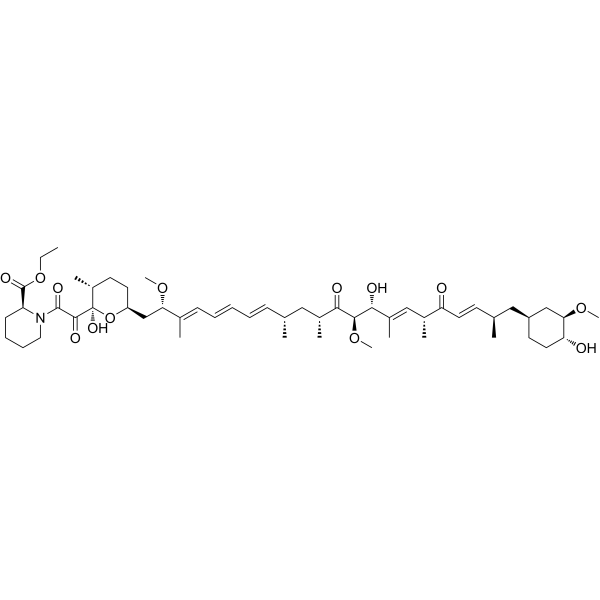
Physicochemical Properties
| Molecular Formula | C53H83NO13 |
| Molecular Weight | 942.2 |
| Exact Mass | 941.58644 |
| PubChem CID | 154573775 |
| Appearance | Light yellow to yellow ointment |
| LogP | 8.3 |
| Hydrogen Bond Donor Count | 3 |
| Hydrogen Bond Acceptor Count | 13 |
| Rotatable Bond Count | 26 |
| Heavy Atom Count | 67 |
| Complexity | 1790 |
| Defined Atom Stereocenter Count | 14 |
| SMILES | CCOC(=O)[C@@H]1CCCCN1C(=O)C(=O)[C@]2([C@@H](CC[C@H](O2)C[C@@H](/C(=C/C=C/C=C/[C@@H](C)C[C@@H](C)C(=O)[C@@H]([C@@H](/C(=C/[C@@H](C)C(=O)/C=C/[C@H](C)C[C@@H]3CC[C@H]([C@@H](C3)OC)O)/C)O)OC)/C)OC)C)O |
| InChi Key | AFZMAZIUJNBBML-CCDOOBSISA-N |
| InChi Code | InChI=1S/C53H83NO13/c1-12-66-52(61)42-20-16-17-27-54(42)51(60)50(59)53(62)39(8)22-24-41(67-53)32-45(63-9)35(4)19-15-13-14-18-33(2)28-37(6)47(57)49(65-11)48(58)38(7)30-36(5)43(55)25-21-34(3)29-40-23-26-44(56)46(31-40)64-10/h13-15,18-19,21,25,30,33-34,36-37,39-42,44-46,48-49,56,58,62H,12,16-17,20,22-24,26-29,31-32H2,1-11H3/b15-13+,18-14+,25-21+,35-19+,38-30+/t33-,34+,36-,37-,39-,40+,41+,42+,44-,45+,46-,48-,49+,53-/m1/s1 |
| Chemical Name | ethyl (2S)-1-[2-[(2R,3R,6S)-2-hydroxy-6-[(2S,3E,5E,7E,9S,11R,13R,14R,15E,17R,19E,21R)-14-hydroxy-22-[(1S,3R,4R)-4-hydroxy-3-methoxycyclohexyl]-2,13-dimethoxy-3,9,11,15,17,21-hexamethyl-12,18-dioxodocosa-3,5,7,15,19-pentaenyl]-3-methyloxan-2-yl]-2-oxoacetyl]piperidine-2-carboxylate |
| Synonyms | Seco Rapamycin ethyl ester; ethyl (2S)-1-[2-[(2R,3R,6S)-2-hydroxy-6-[(2S,3E,5E,7E,9S,11R,13R,14R,15E,17R,19E,21R)-14-hydroxy-22-[(1S,3R,4R)-4-hydroxy-3-methoxycyclohexyl]-2,13-dimethoxy-3,9,11,15,17,21-hexamethyl-12,18-dioxodocosa-3,5,7,15,19-pentaenyl]-3-methyloxan-2-yl]-2-oxoacetyl]piperidine-2-carboxylate |
| HS Tariff Code | 2934.99.9001 |
| Storage |
Powder-20°C 3 years 4°C 2 years In solvent -80°C 6 months -20°C 1 month Note: (1). This product requires protection from light (avoid light exposure) during transportation and storage.(2). Please store this product in a sealed and protected environment (e.g. under nitrogen), avoid exposure to moisture. |
| Shipping Condition | Room temperature (This product is stable at ambient temperature for a few days during ordinary shipping and time spent in Customs) |
Biological Activity
| Targets | Seco Rapamycin (Secorapamycin A) does not significantly affect mTOR function and no IC50, Ki, or EC50 values were reported in the literature [1]. |
| ln Vitro |
- Metabolic Conversion in Tissue Homogenates: In human liver, jejunal mucosal, and Caco-2 cell homogenates, Seco Rapamycin (Secorapamycin A) (20 μM) was converted to dihydro sirolimus (M2) in an NADPH-dependent manner. Ketoconazole (100 μM) did not inhibit M2 formation in these homogenates [1]. - Caco-2 Cell Monolayer Disposition: When Seco Rapamycin (Secorapamycin A) (20 μM) was applied to the apical compartment of Caco-2 cell monolayers, minimal drug was detected in the basolateral compartment after 4 hours, with limited M2 production. However, when applied basolaterally, both Seco Rapamycin (Secorapamycin A) and M2 were readily detected in the apical compartment. The P-glycoprotein inhibitor LY335679 reduced apical flux of Seco Rapamycin (Secorapamycin A) and increased M2 levels in both compartments [1]. Seco Rapamycin's Disposition in Caco-2 Cell Monolayers and Human Tissue Homogenates. Human liver, jejunal mucosal, and Caco-2 homogenates are treated with 20μM Seco Rapamycin to see if it can be converted to dihydro Sirolimus(M2). These homogenates all generated M2 in a way that was dependent on NADPH. Even at 100μM concentration, ketoconazole has no effect on M2 production in any of the homogenates tested. 20μM Seco Rapamycin is applied to Caco-2 cell monolayers to test if Seco Rapamycin may be converted to M2 in intact cells. After four hours, very little Seco Rapamycin is found in the cellular fraction and the basolateral compartment following application to the apical compartment. Furthermore, not much M2 is found. After an apical dosage, LY335979 has minimal effect on the distribution of Seco Rapamycin, even if M2 is now detectable in the apical compartment. LY335679 reduces the flux of Seco Rapamycin to the apical compartment and increases the amount of M2 in both the apical and basolateral compartments[1]. In contrast, when Seco Rapamycin is applied to the basolateral compartment, both Seco Rapamycin and M2 are easily detected in the apical compartment. |
| Enzyme Assay | Metabolic Activity in Tissue Homogenates: Human liver, jejunal mucosal, and Caco-2 cell homogenates were incubated with Seco Rapamycin (Secorapamycin A) (20 μM) in the presence of NADPH to assess M2 formation. Reactions were terminated after 30 minutes, and metabolites were analyzed by liquid chromatography. Ketoconazole (100 μM) was included in parallel experiments to evaluate cytochrome P450 inhibition [1]. |
| Cell Assay | - Caco-2 Cell Monolayer Permeability: Caco-2 cell monolayers grown on transwell inserts were treated with Seco Rapamycin (Secorapamycin A) (20 μM) apically or basolaterally for 4 hours. Samples from apical and basolateral compartments were collected and analyzed for Seco Rapamycin (Secorapamycin A) and M2 levels using LC-MS/MS. LY335979 (0.5 μM) was co-administered to investigate P-glycoprotein-mediated transport [1]. |
| ADME/Pharmacokinetics |
- Metabolic Pathway: Seco Rapamycin (Secorapamycin A) undergoes NADPH-dependent conversion to M2 in human intestinal and hepatic tissues, suggesting involvement of cytochrome P450 enzymes. However, specific pharmacokinetic parameters (e.g., half-life, bioavailability) were not reported [1]. - Tissue Distribution: In Caco-2 cell monolayers, Seco Rapamycin (Secorapamycin A) exhibited limited apical-to-basolateral transport but efficient basolateral-to-apical flux, indicating potential efflux mechanisms [1]. |
| References |
[1]. Identification of a novel route of extraction of sirolimus in human small intestine: roles ofmetabolism and secretion. J Pharmacol Exp Ther. 2002 Apr;301(1):174-86. |
| Additional Infomation |
- Metabolite Background: Seco Rapamycin (Secorapamycin A) is the open-ring metabolite of sirolimus (rapamycin), formed during intestinal and hepatic metabolism [1]. - Study Purpose: The literature primarily investigates the intestinal extraction and metabolism of sirolimus, with Seco Rapamycin (Secorapamycin A) serving as a model compound to characterize metabolic pathways and transporter interactions [1]. - Transporter Interaction: P-glycoprotein modulation affected Seco Rapamycin (Secorapamycin A) distribution in Caco-2 cells, highlighting its potential as a P-glycoprotein substrate [1]. |
Solubility Data
| Solubility (In Vitro) | DMSO :~100 mg/mL (~106.13 mM) |
| Solubility (In Vivo) |
Solubility in Formulation 1: 5 mg/mL (5.31 mM) in 10% DMSO + 40% PEG300 + 5% Tween80 + 45% Saline (add these co-solvents sequentially from left to right, and one by one), suspension solution; with sonication. For example, if 1 mL of working solution is to be prepared, you can add 100 μL of 50.0 mg/mL clear DMSO stock solution to 400 μL PEG300 and mix evenly; then add 50 μL Tween-80 to the above solution and mix evenly; then add 450 μL normal saline to adjust the volume to 1 mL. Preparation of saline: Dissolve 0.9 g of sodium chloride in 100 mL ddH₂ O to obtain a clear solution. Solubility in Formulation 2: 5 mg/mL (5.31 mM) in 10% DMSO + 90% (20% SBE-β-CD in Saline) (add these co-solvents sequentially from left to right, and one by one), suspension solution; with ultrasonication. For example, if 1 mL of working solution is to be prepared, you can add 100 μL of 50.0 mg/mL clear DMSO stock solution to 900 μL of 20% SBE-β-CD physiological saline solution and mix evenly. Preparation of 20% SBE-β-CD in Saline (4°C,1 week): Dissolve 2 g SBE-β-CD in 10 mL saline to obtain a clear solution. Solubility in Formulation 3: ≥ 5 mg/mL (5.31 mM) (saturation unknown) in 10% DMSO + 90% Corn Oil (add these co-solvents sequentially from left to right, and one by one), clear solution. For example, if 1 mL of working solution is to be prepared, you can add 100 μL of 50.0 mg/mL clear DMSO stock solution to 900 μL of corn oil and mix evenly. (Please use freshly prepared in vivo formulations for optimal results.) |
| Preparing Stock Solutions | 1 mg | 5 mg | 10 mg | |
| 1 mM | 1.0613 mL | 5.3067 mL | 10.6135 mL | |
| 5 mM | 0.2123 mL | 1.0613 mL | 2.1227 mL | |
| 10 mM | 0.1061 mL | 0.5307 mL | 1.0613 mL |