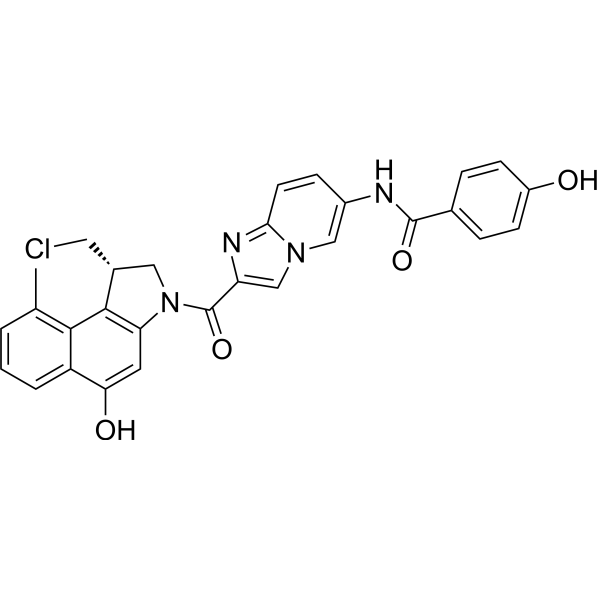
Physicochemical Properties
| Molecular Formula | C29H23CLN4O4 |
| Molecular Weight | 526.97 |
| Exact Mass | 526.14 |
| CAS # | 1227961-59-2 |
| Related CAS # | Seco-DUBA hydrochloride;1795733-93-5 |
| PubChem CID | 46240929 |
| Appearance | Light yellow to brown solid powder |
| LogP | 5.3 |
| Hydrogen Bond Donor Count | 3 |
| Hydrogen Bond Acceptor Count | 5 |
| Rotatable Bond Count | 4 |
| Heavy Atom Count | 38 |
| Complexity | 885 |
| Defined Atom Stereocenter Count | 1 |
| SMILES | C(NC1=CN2C=C(C(N3C4=C(C5=C(C)C=CC=C5C(O)=C4)[C@H](CCl)C3)=O)N=C2C=C1)(=O)C1=CC=C(O)C=C1 |
| InChi Key | VQAFBYLFRCCWNB-GOSISDBHSA-N |
| InChi Code | InChI=1S/C29H23ClN4O4/c1-16-3-2-4-21-24(36)11-23-27(26(16)21)18(12-30)13-34(23)29(38)22-15-33-14-19(7-10-25(33)32-22)31-28(37)17-5-8-20(35)9-6-17/h2-11,14-15,18,35-36H,12-13H2,1H3,(H,31,37)/t18-/m1/s1 |
| Chemical Name | N-[2-[(1S)-1-(chloromethyl)-5-hydroxy-9-methyl-1,2-dihydrobenzo[e]indole-3-carbonyl]imidazo[1,2-a]pyridin-6-yl]-4-hydroxybenzamide |
| HS Tariff Code | 2934.99.9001 |
| Storage |
Powder-20°C 3 years 4°C 2 years In solvent -80°C 6 months -20°C 1 month Note: Please store this product in a sealed and protected environment (e.g. under nitrogen), avoid exposure to moisture. |
| Shipping Condition | Room temperature (This product is stable at ambient temperature for a few days during ordinary shipping and time spent in Customs) |
Biological Activity
| ln Vitro | Seco-DUBA (SK-BR-3 cells; 0.0001 pM~0.01 nM; 144 hours) exhibits potency and efficacy comparable to DUBA, albeit at a dose-dependent reduction in cell viability[1]. SK-BR-3 (IC50=0.09), SK-OV-3 (IC50=0.43), and SW620 (IC50=0.09) cells exhibit great sensitivity when exposed to seco-DUBA[1]. |
| ln Vivo | Seco-DUBA (89 μg/kg; iv) is likely transformed to DUBA virtually instantaneously[1]. |
| Cell Assay |
Cell Cytotoxicity Assay[1] Cell Types: SK-BR-3 cells Tested Concentrations: 0.0001 pM~0.01 nM Incubation Duration: 144 hrs (hours) Experimental Results: Dose-dependent decreased cell viability. |
| Animal Protocol |
Animal/Disease Models: Wistar rats[1] Doses: 89 μg/kg (pharmacokinetic/PK Analysis) Route of Administration: Iv Experimental Results: Likely converted to DUBA almost instantaneously. |
| References |
[1]. Design, Synthesis, and Evaluation of Linker-Duocarmycin Payloads: Toward Selection of HER2-Targeting Antibody-Drug Conjugate SYD985. Mol Pharm. 2015;12(6):1813-1835. [2]. Platform Technologies in Drug Discovery and Validation. |
Solubility Data
| Solubility (In Vitro) | DMSO : 100 mg/mL (189.76 mM) |
| Solubility (In Vivo) |
Solubility in Formulation 1: 1 mg/mL (1.90 mM) in 10% DMSO + 40% PEG300 + 5% Tween80 + 45% Saline (add these co-solvents sequentially from left to right, and one by one), suspension solution; with sonication. For example, if 1 mL of working solution is to be prepared, you can add 100 μL of 10.0 mg/mL clear DMSO stock solution to 400 μL of PEG300 and mix evenly; then add 50 μL of Tween-80 to the above solution and mix evenly; then add 450 μL of normal saline to adjust the volume to 1 mL. Preparation of saline: Dissolve 0.9 g of sodium chloride in 100 mL ddH₂ O to obtain a clear solution. Solubility in Formulation 2: 1 mg/mL (1.90 mM) in 10% DMSO + 90% (20% SBE-β-CD in Saline) (add these co-solvents sequentially from left to right, and one by one), suspension solution; with ultrasonication. For example, if 1 mL of working solution is to be prepared, you can add 100 μL of 10.0 mg/mL clear DMSO stock solution to 900 μL of 20% SBE-β-CD physiological saline solution and mix evenly. Preparation of 20% SBE-β-CD in Saline (4°C,1 week): Dissolve 2 g SBE-β-CD in 10 mL saline to obtain a clear solution. (Please use freshly prepared in vivo formulations for optimal results.) |
| Preparing Stock Solutions | 1 mg | 5 mg | 10 mg | |
| 1 mM | 1.8976 mL | 9.4882 mL | 18.9764 mL | |
| 5 mM | 0.3795 mL | 1.8976 mL | 3.7953 mL | |
| 10 mM | 0.1898 mL | 0.9488 mL | 1.8976 mL |