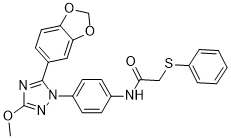
Physicochemical Properties
| Molecular Formula | C24H20N4O4S |
| Molecular Weight | 460.5 |
| Exact Mass | 460.12 |
| Elemental Analysis | C, 62.60; H, 4.38; N, 12.17; O, 13.90; S, 6.96 |
| CAS # | 853625-60-2 |
| Related CAS # | 853625-60-2 |
| PubChem CID | 1029232 |
| Appearance | White to off-white solid powder |
| Density | 1.4±0.1 g/cm3 |
| Index of Refraction | 1.687 |
| LogP | 4.94 |
| Hydrogen Bond Donor Count | 1 |
| Hydrogen Bond Acceptor Count | 7 |
| Rotatable Bond Count | 7 |
| Heavy Atom Count | 33 |
| Complexity | 644 |
| Defined Atom Stereocenter Count | 0 |
| SMILES | O=C(CSC1C=CC=CC=1)NC1C=CC(N2C(C3C=C4C(OCO4)=CC=3)=NC(OC)=N2)=CC=1 |
| InChi Key | QPGYAMIHXLCFTJ-UHFFFAOYSA-N |
| InChi Code | InChI=1S/C24H20N4O4S/c1-30-24-26-23(16-7-12-20-21(13-16)32-15-31-20)28(27-24)18-10-8-17(9-11-18)25-22(29)14-33-19-5-3-2-4-6-19/h2-13H,14-15H2,1H3,(H,25,29) |
| Chemical Name | N-[4-[5-(1,3-benzodioxol-5-yl)-3-methoxy-1,2,4-triazol-1-yl]phenyl]-2-phenylsulfanylacetamide |
| Synonyms | Secin H3; SecinH3; Secin-H3 |
| HS Tariff Code | 2934.99.9001 |
| Storage |
Powder-20°C 3 years 4°C 2 years In solvent -80°C 6 months -20°C 1 month |
| Shipping Condition | Room temperature (This product is stable at ambient temperature for a few days during ordinary shipping and time spent in Customs) |
Biological Activity
| Targets | hCyh1 (IC50 = 5.4 μM); hCyh2 (IC50 = 2.4 μM); mCyh3 (IC50 = 5.4 μM); hCyh3 (IC50 = 5.6 μM); drosophila steppke (IC50 = 5.6 μM); yGea2-S7 (IC50 = 65 μM) |
| ln Vitro | SecinH3 is a small GEF inhibitor that prefers the cytohesin family of small GEFs and is specific for the Sec7 family. IGFBP1 transcriptional repression caused by insulin is almost entirely blocked by SecinH3 with an IC50 of 2.2 M. Additionally, SecinH3 prevents insulin from stimulating ARF6 to move to the plasma membrane. It is discovered that, in a concentration-dependent manner, SecinH3 prevents the insulin-dependent phosphorylation of Akt and FoxO1A. SecinH3 entirely prevents the insulin-induced exclusion of FoxO1A from the nucleus. Additionally, SecinH3[1] inhibits IRS1's ability to bind to the insulin receptor. |
| ln Vivo | In mice treated with SecinH3, as opposed to mice fed the same diet without SecinH3, the expression levels of the insulin-repressed gluconeogenic genes are increased, while the expression levels of the insulin-induced glycolytic genes are decreased. Mice treated with SecinH3 also exhibit an inhibition of the Akt phosphorylation induced by insulin. Carnitine palmitoyltransferase 1a (Cpt1a) and hydroxyacyl-CoA dehydrogenase (Hadha), two essential mitochondrial -oxidation enzymes whose expression is suppressed by insulin, are expressed more frequently in the mice treated with SecinH3. In mice treated with SecinH3, serum insulin levels were found to be significantly higher and glucose levels to be slightly elevated. The serum of mice treated with SecinH3 consequently contains more 3-hydroxybutyrate[1]. |
| Enzyme Assay | A library of small molecules (10000 molecules) from Comgenex was screened in duplicate in 386 well plates using fluorescence polarization at 485 nm for excitation and 520 nm for read-out in a reaction volume of 50 μL at 37 °C. PBS, pH 7.5, 3 mM MgCl2, 100 nM fluorescein-labeled M69 aptamer, and 1 μM cytohesin-1 Sec7 at 100 μM compound concentrations make up the screening buffer. |
| Cell Assay | In 12 well plates with 105 HepG2 cells seeded inside, 10% FCS-containing EMEM is used for a 24-hour culture. After 24 hours of serum starvation in EMEM, cells are stimulated for 12 hours with 10 nM insulin in the presence of SecinH3, D5 (a negative control), or vehicle (0.2% final DMSO concentration). To prepare total mRNA, a kit is used, and 1 μg of RNA is used to produce cDNA for qPCR. Data are normalized to β2-microglobulin expression and qPCR is used to perform the analysis[1]. |
| References |
[1]. Inhibition of cytohesins by SecinH3 leads to hepatic insulin resistance. Nature. 2006 Dec 14;444(7121):941-4 |
| Additional Infomation | N-[4-[5-(1,3-benzodioxol-5-yl)-3-methoxy-1,2,4-triazol-1-yl]phenyl]-2-(phenylthio)acetamide is a member of triazoles. |
Solubility Data
| Solubility (In Vitro) |
DMSO: 92~130 mg/mL(199.8~282.3 mM) Ethanol (warmed with 50ºC water bath): ~1 mg/mL (~2.2 mM) |
| Solubility (In Vivo) |
Solubility in Formulation 1: ≥ 3.25 mg/mL (7.06 mM) (saturation unknown) in 10% DMSO + 90% Corn Oil (add these co-solvents sequentially from left to right, and one by one), clear solution. For example, if 1 mL of working solution is to be prepared, you can add 100 μL of 32.5 mg/mL clear DMSO stock solution to 900 μL of corn oil and mix evenly. (Please use freshly prepared in vivo formulations for optimal results.) |
| Preparing Stock Solutions | 1 mg | 5 mg | 10 mg | |
| 1 mM | 2.1716 mL | 10.8578 mL | 21.7155 mL | |
| 5 mM | 0.4343 mL | 2.1716 mL | 4.3431 mL | |
| 10 mM | 0.2172 mL | 1.0858 mL | 2.1716 mL |