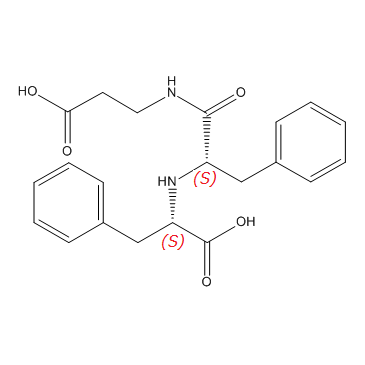
Sch-32615 (the S,S-diastereomer) is a novel and potent inhibitor of enkephalinase, an enzyme responsible for the degradation of endogenous enkephalins. The administration of SCH 32615 (3 mg/kg) decreased both D-1 and D-2 antagonist-induced catalepsy. In contrast, SCH 32615 (0.3 mg/kg) increased D-1 agonist-induced non-stereotyped grooming and D-2 agonist-induced stereotypies. SCH 32615 competitively antagonizes enkephalinase in vitro and produces analgesia in vivo.
Physicochemical Properties
| Molecular Formula | C21H24N2O5 |
| Molecular Weight | 384.43 |
| Exact Mass | 384.169 |
| Elemental Analysis | C, 65.61; H, 6.29; N, 7.29; O, 20.81 |
| CAS # | 83861-02-3 |
| Related CAS # | 83861-02-3 |
| PubChem CID | 5486715 |
| Appearance | Off-white to yellow solid powder |
| Density | 1.267g/cm3 |
| Boiling Point | 683ºC at 760 mmHg |
| Flash Point | 366.9ºC |
| Index of Refraction | 1.594 |
| LogP | 2.705 |
| Hydrogen Bond Donor Count | 4 |
| Hydrogen Bond Acceptor Count | 6 |
| Rotatable Bond Count | 11 |
| Heavy Atom Count | 28 |
| Complexity | 513 |
| Defined Atom Stereocenter Count | 2 |
| SMILES | [C@@H](C(=O)NCCC(=O)O)(CC1C=CC=CC=1)N[C@H](C(=O)O)CC1C=CC=CC=1 |
| InChi Key | WOVRTBFSWOVRST-ROUUACIJSA-N |
| InChi Code | InChI=1S/C21H24N2O5/c24-19(25)11-12-22-20(26)17(13-15-7-3-1-4-8-15)23-18(21(27)28)14-16-9-5-2-6-10-16/h1-10,17-18,23H,11-14H2,(H,22,26)(H,24,25)(H,27,28)/t17-,18-/m0/s1 |
| Chemical Name | ((S)-1-((2-carboxyethyl)amino)-1-oxo-3-phenylpropan-2-yl)-L-phenylalanine |
| Synonyms | Sch 32615; Sch32615; SCH 32,615; 83861-02-3; Sch-32,615; LT9YZC71VZ; beta-Alanine, N-(N-(1-carboxy-2-phenylethyl)-L-phenylalanyl)-, (S)-; DTXSID90232752; DTXCID20155243; (N-(1-Carboxy-2-phenyl)ethyl)phenylalanyl-B-alanine; Sch-32615. |
| HS Tariff Code | 2934.99.9001 |
| Storage |
Powder-20°C 3 years 4°C 2 years In solvent -80°C 6 months -20°C 1 month |
| Shipping Condition | Room temperature (This product is stable at ambient temperature for a few days during ordinary shipping and time spent in Customs) |
Biological Activity
| Targets |
Enkephalinase (neutral endopeptidase 24.11, NEP) [1][2][3] |
| ln Vitro |
- SCH 32615 (1-10 μM) potently inhibited enkephalinase activity in homogenates of rat brain cortex, with an IC50 of 0.3 μM, as measured by cleavage of the substrate [3H]enkephalin [3] - The compound showed no significant activity against angiotensin-converting enzyme (ACE) or other peptidases at concentrations up to 100 μM [3] SCH 32615 inhibits isolated enkephalinase, which has a Ki of 19.5 nM, from degrading Met5-enkephalin[3]. |
| ln Vivo |
- In mice undergoing surgical incision, SCH 32615 (1-10 mg/kg, intraperitoneal injection) significantly prolonged the latency to paw withdrawal in a hot plate test, indicating augmented analgesia. The effect was reversed by pretreatment with the opioid antagonist naloxone, suggesting dependence on endogenous enkephalin activity [1] - In pregnant mice, SCH 32615 (5 mg/kg, intraperitoneal) enhanced pregnancy-induced analgesia, as demonstrated by reduced response to mechanical stimulation. The effect was abolished by co-administration with a δ-opioid receptor antagonist [2] SCH 32615 (150 mg/kg; subcutaneous injection) increases surgically induced endogenous analgesia in mice [1]. |
| Enzyme Assay |
Enkephalinase inhibition assay: Rat brain cortex homogenates were incubated with SCH 32615 (0.1-100 μM) and [3H]enkephalin. The reaction was terminated by trichloroacetic acid, and radioactivity in the supernatant was measured to quantify substrate cleavage. IC50 was calculated using nonlinear regression [3] |
| Animal Protocol |
- Surgical analgesia model: Male mice received SCH 32615 (1-10 mg/kg, intraperitoneal) 30 minutes before paw incision. Paw withdrawal latency was assessed at 30, 60, and 90 minutes post-surgery using a hot plate (55°C) [1] - Pregnancy-induced analgesia model: Pregnant mice (day 15-18 of gestation) were treated with SCH 32615 (5 mg/kg, intraperitoneal). Mechanical allodynia was evaluated using von Frey filaments applied to the hind paw, with thresholds defined as the minimum force causing withdrawal [2] |
| ADME/Pharmacokinetics |
- Oral administration of SCH 32615 in rats resulted in rapid absorption, with peak plasma concentrations (Cmax) of 250 ng/mL at 0.5 hours. The compound had a plasma half-life of 1.2 hours and was primarily eliminated via renal excretion [3] - Plasma protein binding was approximately 85% in rat plasma [3] |
| Toxicity/Toxicokinetics |
- In acute toxicity studies, SCH 32615 administered intraperitoneally to mice had an LD50 of 120 mg/kg. Common adverse effects included sedation, respiratory depression, and tremors at higher doses [3] - No significant hepatic or renal toxicity was observed in rats treated with SCH 32615 (10 mg/kg/day) for 14 days [3] |
| References |
[1]. An enkephalinase inhibitor, SCH 32615, augments analgesia induced by surgery in mice. Anesthesiology. 1995 May;82(5):1283-7. [2]. SCH 32615, an enkephalinase inhibitor, enhances pregnancy-induced analgesia in mice. Anesth Analg. 1995 May;80(5):944-8. [3]. Pharmacology of SCH 34826, an orally active enkephalinase inhibitor analgesic. J Pharmacol Exp Ther. 1988 Jun;245(3):829-38. |
| Additional Infomation |
- SCH 32615 is a selective enkephalinase inhibitor designed to potentiate endogenous opioid-mediated analgesia. Its mechanism involves preventing enkephalin degradation, thereby enhancing opioid receptor activation [1][2][3] - The compound demonstrated efficacy in preclinical models of surgical and pregnancy-related pain, highlighting its potential as an adjunctive analgesic [1][2] |
Solubility Data
| Solubility (In Vitro) | DMSO : ~125 mg/mL (~325.16 mM) |
| Solubility (In Vivo) |
Solubility in Formulation 1: ≥ 2.08 mg/mL (5.41 mM) (saturation unknown) in 10% DMSO + 40% PEG300 + 5% Tween80 + 45% Saline (add these co-solvents sequentially from left to right, and one by one), clear solution. For example, if 1 mL of working solution is to be prepared, you can add 100 μL of 20.8 mg/mL clear DMSO stock solution to 400 μL PEG300 and mix evenly; then add 50 μL Tween-80 to the above solution and mix evenly; then add 450 μL normal saline to adjust the volume to 1 mL. Preparation of saline: Dissolve 0.9 g of sodium chloride in 100 mL ddH₂ O to obtain a clear solution. Solubility in Formulation 2: ≥ 2.08 mg/mL (5.41 mM) (saturation unknown) in 10% DMSO + 90% Corn Oil (add these co-solvents sequentially from left to right, and one by one), clear solution. For example, if 1 mL of working solution is to be prepared, you can add 100 μL of 20.8 mg/mL clear DMSO stock solution to 900 μL of corn oil and mix evenly. (Please use freshly prepared in vivo formulations for optimal results.) |
| Preparing Stock Solutions | 1 mg | 5 mg | 10 mg | |
| 1 mM | 2.6013 mL | 13.0063 mL | 26.0125 mL | |
| 5 mM | 0.5203 mL | 2.6013 mL | 5.2025 mL | |
| 10 mM | 0.2601 mL | 1.3006 mL | 2.6013 mL |