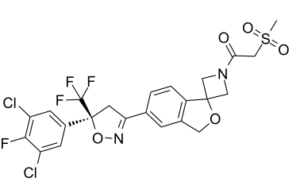
Sarolaner (also known as PF-6450567; PF6450567) is a novel, potent, orally bioactive and broad-spectrum ectoparasiticide (an antiparasitic agent for veterinary use). It has efficacy against fleas and ticks on dogs with LC80 of 0.3 μg/mL against C. felis and an LC100 of 0.003 μg/mL against O. turicata.
Physicochemical Properties
| Molecular Formula | C23H18CL2F4N2O5S |
| Molecular Weight | 581.364037036896 |
| Exact Mass | 580.025 |
| CAS # | 1398609-39-6 |
| PubChem CID | 73169092 |
| Appearance | White to off-white solid powder |
| LogP | 4.781 |
| Hydrogen Bond Donor Count | 0 |
| Hydrogen Bond Acceptor Count | 10 |
| Rotatable Bond Count | 4 |
| Heavy Atom Count | 37 |
| Complexity | 1050 |
| Defined Atom Stereocenter Count | 1 |
| SMILES | CS(=O)(=O)CC(=O)N1CC2(C1)C3=C(CO2)C=C(C=C3)C4=NO[C@@](C4)(C5=CC(=C(C(=C5)Cl)F)Cl)C(F)(F)F |
| InChi Key | FLEFKKUZMDEUIP-QFIPXVFZSA-N |
| InChi Code | InChI=1S/C23H18Cl2F4N2O5S/c1-37(33,34)9-19(32)31-10-21(11-31)15-3-2-12(4-13(15)8-35-21)18-7-22(36-30-18,23(27,28)29)14-5-16(24)20(26)17(25)6-14/h2-6H,7-11H2,1H3/t22-/m0/s1 |
| Chemical Name | (S)-1-(5'-(5-(3,5-dichloro-4-fluorophenyl)-5-(trifluoromethyl)-4,5-dihydroisoxazol-3-yl)-3'H-spiro[azetidine-3,1'-isobenzofuran]-1-yl)-2-(methylsulfonyl)ethan-1-one |
| Synonyms | PF6450567; PF 6450567; PF-6450567 |
| HS Tariff Code | 2934.99.9001 |
| Storage |
Powder-20°C 3 years 4°C 2 years In solvent -80°C 6 months -20°C 1 month Note: Please store this product in a sealed and protected environment, avoid exposure to moisture. |
| Shipping Condition | Room temperature (This product is stable at ambient temperature for a few days during ordinary shipping and time spent in Customs) |
Biological Activity
| Targets | Sarolaner (450 nM-1 mM; 5 minutes) suppresses currents produced by gamma-buffered butyric acid (GABA) on CfRDL-A285 and CfRDL-S285 receptors [1]. |
| ln Vitro |
Sarolaner (450 nM-1 mM; 5 minutes) suppresses currents produced by gamma-buffered butyric acid (GABA) on CfRDL-A285 and CfRDL-S285 receptors [1]. Sarolaner demonstrated potent activity against cat fleas (C. felis felis) in a blood feeding assay with an LC80 of 0.3 µg/mL. [1] Sarolaner demonstrated potent activity against soft ticks (Ornithodoros turicata) in a blood feeding assay with an LC100 of 0.003 µg/mL. [1] In a head-to-head comparative in vitro assay with afoxolaner and fluralaner, sarolaner demonstrated superior potency against fleas (LC80 = 0.1 µg/mL) and soft ticks (LC100 = 0.03 µg/mL). [1] Sarolaner potently blocked GABA-induced currents in recombinant CHO-K1 cells stably expressing cat flea RDL GABACl subunits. It showed no agonist activity. The IC50 for inhibition was 135 ± 33 nM for the susceptible CRDL-A285 channel and 136 ± 16 nM for the resistant CRDL-S285 channel. [1] In a side-by-side comparison using the same assay, sarolaner was significantly more potent (IC50 ~135-136 nM) than afoxolaner (IC50 ~412-539 nM) at inhibiting GABA-induced currents in both susceptible and resistant flea GABACls. [1] Sarolaner exhibited similar potency against both dieldrin-susceptible and dieldrin-resistant (A285S mutation) flea GABACl alleles, unlike dieldrin which showed significantly reduced potency against the resistant allele. [1] |
| ln Vivo |
Sarolaner shown 100% effectiveness against R at 2.5 mg/kg; main sidewall. sanguineus as well as D. reticuLatus [1]. Sarolaner, which acts against I, is efficacious at 1.25–5 mg/kg (primary sidewall). ricinus [1]. In dogs, a single oral dose of sarolaner at 2.5 mg/kg (solution) provided 100% efficacy against existing infestations of cat fleas (C. felis) and brown dog ticks (Rhipicephalus sanguineus) at 48 hours post-treatment. [1] The same dose (2.5 mg/kg) provided ≥99.9% efficacy against weekly re-infestations of cat fleas for 35 days. [1] Against R. sanguineus, the 2.5 mg/kg dose provided 100% efficacy for 35 days against weekly re-infestations. [1] Against Dermacentor reticulatus ticks, the 2.5 mg/kg dose provided ≥98.0% efficacy for 35 days against weekly re-infestations. [1] In a dose-finding study against Ixodes ricinus ticks, sarolaner administered as an oral suspension at 1.25, 2.5, and 5 mg/kg provided 100% efficacy against an existing infestation at 48 hours post-treatment. [1] Against subsequent re-infestations, the 1.25 mg/kg dose provided ≥99.3% efficacy for 35 days (efficacy was 80.1% on Day 57). The 2.5 and 5 mg/kg doses provided >99.3% efficacy through Day 57. [1] |
| Cell Assay |
Cell Viability Assay[1] Cell Types: CHO-K1 Cell Tested Concentrations: 450 nM-1 mM Incubation Duration: 5 minutes Experimental Results: Inhibition of GABA-elicited current of susceptible fleas (CfRDL-A285) and resistant fleas GABACl, EC50 is 135 respectively and 136 nM. Voltage-clamp electrophysiology studies were conducted using CHO-K1 cells stably expressing recombinant cat flea (C. felis) RDL GABA-gated chloride channel subunits (CRDL-A285 and CRDL-S285). [1] A cell suspension was prepared immediately prior to studies. Experiments were performed on an automated patch-clamp platform. The external solution was a HEPES-buffered saline. The internal solution contained a potassium-based salt and a perforating agent. All recordings were made at room temperature with cells held at -80 mV. [1] For agonist testing, GABA was diluted in external solution. An eight-point, 3-fold serial dilution series was prepared from a stock solution. Test compounds were added via an integrated pipettor. Recordings were sampled before and after compound addition. Peak inward current was determined. Concentration-response data were fit using non-linear regression to determine EC50. [1] For antagonist testing, an eight-point concentration series of the test compound was constructed. After test compound addition and recording, an approximate EC80 concentration of GABA was added to evaluate the inhibitory activity of the test compound. Recordings were sampled before and after agonist addition. Percent inhibition of GABA-induced current was calculated. Concentration-response curves were constructed and fit to determine IC50. [1] |
| Animal Protocol |
Animal/Disease Models: Dogs infected with R. sanguineus and D. reticulatus [1] Doses: 2.5 mg/kg Route of Administration: po (oral gavage); 2.5 mg/kg One time Experimental Results:100% efficacy against R. sanguineus 48 hrs (hrs (hours)) after treatment , also has 98.0% efficacy against D. d. Net pattern. Animal/Disease Models: Ricin-infected dogs [1] Doses: 1.25, 2.5 and 5 mg/kg Route of Administration: po (oral gavage); 1.25, 2.5 and 5 mg/kg Primary Experimental Results: Prior to 7 days, all doses were effective in ricin Both narcotics demonstrated 100% efficacy and diminished subsequent reinfections by more than 99.3% by 57 days at doses of 5.0 and 2.5 mg/kg. An exploratory margin of safety study in adult Beagle dogs: Sarolaner was formulated in capsules with excipients (microcrystalline cellulose, sodium starch glycolate, sodium lauryl sulfate, magnesium stearate) and administered orally at doses of 2, 6, or 10 mg/kg. Each treatment group was dosed three times at 28-day intervals. A full post-mortem examination was conducted one week after the third dose. [1] An exploratory tolerance study in 8-week-old Beagle dogs: Sarolaner was formulated similarly in capsules and administered orally at doses of 4, 12, or 20 mg/kg. Each dog was dosed twice at a 28-day interval, followed by a complete post-mortem examination one week after the second dose. [1] A parallel-design bioavailability study in Beagle dogs: Sarolaner was administered either as an intravenous solution at 2 mg/kg or as a compressed tablet for oral administration (20 mg/dog, dose range 2.17–3.79 mg/kg). Dogs were fasted overnight prior to dosing. Blood samples for pharmacokinetic analysis were collected through Day 56. [1] Efficacy Study 1 in dogs: Dogs were treated via oral gavage with either a placebo control or a sarolaner solution (5 mg/mL in a tetraglycol/solutol base) to provide a dose of 2.5 mg/kg. [1] Efficacy Study 2 in dogs: Dogs were treated via oral gavage with either a placebo control, or a sarolaner suspension formulated in a carboxymethylcellulose/Tween-80 base with water at concentrations to provide doses of 1.25, 2.5, or 5 mg/kg. [1] |
| ADME/Pharmacokinetics |
Following intravenous administration at 2 mg/kg to dogs, the volume of distribution at steady state (Vdss) was 2.81 L/kg and clearance (CL) was 0.12 mL/min/kg. [1] Sarolaner was rapidly and well absorbed following oral dosing. Time to maximum plasma concentration (Tmax) occurred within the first day post-dose. [1] The oral bioavailability of sarolaner in fasted dogs was calculated to be >85%. [1] The elimination half-life (T1/2) of sarolaner was calculated to be 11–12 days. [1] Sarolaner exhibited dose-proportional plasma concentrations over the oral dose range of 1.25 to 5 mg/kg in dogs. [1] Sarolaner is highly protein bound (>99.9%). [1] Following oral administration of 20 mg/dog (dose-normalized to 2 mg/kg), the least squares mean maximum plasma concentration (Cmax) was 1100 ng/mL. [1] |
| Toxicity/Toxicokinetics |
In a mouse symptomatology screening model, sarolaner did not cause any adverse reactions at oral doses up to 30 mg/kg. [1] In exploratory safety studies in dogs, oral administration of sarolaner at 2, 6, and 10 mg/kg three times at 28-day intervals to adult dogs, and at 4, 12, and 20 mg/kg twice at 28-day intervals to 8-week-old dogs, was well-tolerated at all dose levels with no adverse reactions observed. [1] Toxicokinetic evaluation indicated dose-proportional systemic exposure in both adult and young dogs. Test article-related changes in clinical pathology, gross pathology, organ weight, and histopathology were minimal and not considered adverse or clinically relevant. [1] |
| References |
[1]. Discovery of sarolaner: A novel, orally administered, broad-spectrum, isoxazoline ectoparasiticide for dogs. Vet Parasitol. 2016 May 30;222:3-11. |
| Additional Infomation |
See also: Moxidectin; Pyrantel Pamoate; Sarolaner (component of); Sarolaner; Selamectin (component of). Drug Indication For the treatment of tick infestations (Dermacentor reticulatus, Ixodes hexagonus, Ixodes ricinus and Rhipicephalus sanguineus). The veterinary medicinal product has immediate and persistent tick killing activity for at least 5 weeks. For the treatment of flea infestations (Ctenocephalides felis and Ctenocephalides canis). The veterinary medicinal product has immediate and persistent flea killing activity against new infestations for at least 5 weeks. The veterinary medicinal product can be used as part of a treatment strategy for the control of Flea Allergy Dermatitis (FAD). For the treatment of sarcoptic mange (Sarcoptes scabiei). For the treatment of ear mite infestations (Otodectes cynotis). For the treatment of demodicosis (Demodex canis). Fleas and ticks must attach to the host and commence feeding in order to be exposed to the active substance. For the treatment of tick infestations (Dermacentor reticulatus, Ixodes hexagonus,Ixodes ricinus and Rhipicephalus sanguineus). The veterinary medicinal product has immediate and persistent tick killing activity for at least 5 weeks. , , For the treatment of flea infestations (Ctenocephalides felis and Ctenocephalides canis). The veterinary medicinal product has immediate and persistent flea killing activity against new infestations for at least 5 weeks. The veterinary medicinal product can be used as part of a treatment strategy for the control of Flea Allergy Dermatitis (FAD). , , For the treatment of sarcoptic mange (Sarcoptes scabiei). , , For the treatment of ear mite infestations (Otodectes cynotis). , , For the treatment of demodicosis (Demodex canis). , , Fleas and ticks must attach to the host and commence feeding in order to be exposed to the active substance. , Sarolaner is a novel isoxazoline ectoparasiticide specifically discovered and developed for use in companion animals (dogs). [1] The molecule is a chirally pure S-enantiomer. The flea and tick activity resides entirely in this enantiomer; the R-enantiomer is inactive. [1] The chemical structure consists of four subunits: a substituted phenyl head group, the isoxazoline core, a spiroazetidinebenzofuran moiety, and a methylsulfonylethanone tail. [1] It was discovered from a lead optimization program where over 3000 isoxazoline compounds were prepared and tested. [1] The primary mechanism of action is the inhibition of invertebrate ligand-gated chloride channels (GABA-gated chloride channels). [1] It is intended as a monthly oral treatment for the control of fleas and ticks on dogs. [1] |
Solubility Data
| Solubility (In Vitro) | DMSO : ~300 mg/mL (~516.03 mM) |
| Solubility (In Vivo) |
Solubility in Formulation 1: ≥ 7.5 mg/mL (12.90 mM) (saturation unknown) in 10% DMSO + 40% PEG300 + 5% Tween80 + 45% Saline (add these co-solvents sequentially from left to right, and one by one), clear solution. For example, if 1 mL of working solution is to be prepared, you can add 100 μL of 75.0 mg/mL clear DMSO stock solution to 400 μL PEG300 and mix evenly; then add 50 μL Tween-80 to the above solution and mix evenly; then add 450 μL normal saline to adjust the volume to 1 mL. Preparation of saline: Dissolve 0.9 g of sodium chloride in 100 mL ddH₂ O to obtain a clear solution. Solubility in Formulation 2: ≥ 7.5 mg/mL (12.90 mM) (saturation unknown) in 10% DMSO + 90% Corn Oil (add these co-solvents sequentially from left to right, and one by one), clear solution. For example, if 1 mL of working solution is to be prepared, you can add 100 μL of 75.0 mg/mL clear DMSO stock solution to 900 μL of corn oil and mix evenly. (Please use freshly prepared in vivo formulations for optimal results.) |
| Preparing Stock Solutions | 1 mg | 5 mg | 10 mg | |
| 1 mM | 1.7201 mL | 8.6005 mL | 17.2010 mL | |
| 5 mM | 0.3440 mL | 1.7201 mL | 3.4402 mL | |
| 10 mM | 0.1720 mL | 0.8601 mL | 1.7201 mL |