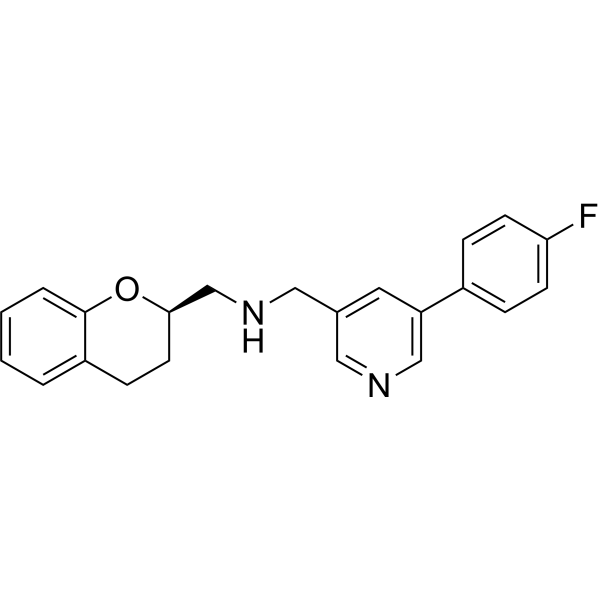
Physicochemical Properties
| Molecular Formula | C22H21FN2O |
| Molecular Weight | 348.413348913193 |
| Exact Mass | 350.179 |
| CAS # | 351862-32-3 |
| PubChem CID | 6918388 |
| Appearance | Colorless to light yellow viscous liquid |
| LogP | 4.658 |
| Hydrogen Bond Donor Count | 1 |
| Hydrogen Bond Acceptor Count | 4 |
| Rotatable Bond Count | 5 |
| Heavy Atom Count | 26 |
| Complexity | 426 |
| Defined Atom Stereocenter Count | 1 |
| SMILES | FC1C=CC(=CC=1)C1=CN=CC(=C1)CNCC1CCC2C=CC=CC=2O1 |
| InChi Key | HKFMQJUJWSFOLY-OAQYLSRUSA-N |
| InChi Code | InChI=1S/C22H21FN2O/c23-20-8-5-17(6-9-20)19-11-16(12-24-14-19)13-25-15-21-10-7-18-3-1-2-4-22(18)26-21/h1-6,8-9,11-12,14,21,25H,7,10,13,15H2/t21-/m1/s1 |
| Chemical Name | 1-[(2R)-3,4-dihydro-2H-chromen-2-yl]-N-[[5-(4-fluorophenyl)pyridin-3-yl]methyl]methanamine |
| HS Tariff Code | 2934.99.9001 |
| Storage |
Powder-20°C 3 years 4°C 2 years In solvent -80°C 6 months -20°C 1 month |
| Shipping Condition | Room temperature (This product is stable at ambient temperature for a few days during ordinary shipping and time spent in Customs) |
Biological Activity
| ln Vitro | In a concentration-dependent manner, sarizotan (IC50 = 150 nM; Emax = 40% at 1 mM) suppresses electrically generated contractions [1]. |
| ln Vivo | The striatum's 5-HT and the frontal cortex and hippocampus's 5-HIAA metabolite showed a small decrease in response to higher oral dosages of sarizotan (3, 10 mg/kg). The DA metabolites DOPAC and HVA in the striatum and frontal cortex are markedly elevated by sarizotan (10 mg/kg, orally) [1]. Sarizotan is a novel therapeutic option for the management of extrapyramidal motor problems, including Parkinson's disease-related dyskinesia brought on by levodopa [1]. In 6-OHDA-lesioned rats, sarizotan (10 ng and 1 μg) applied topically lessens levodopa-induced dyskinesia [2]. |
| Animal Protocol |
Animal/Disease Models: Male SD (SD (Sprague-Dawley)) rat, weighing 220-240 grams (showing strong rotation response) [2]. Doses: 1 ng, 10 ng, and 1 μg in 0.3 μL solution. Route of Administration: Administration was administered via an injection cannula inserted into the guide cannula through the STN (V -8.4 mm from the skull), connected to a 10 μL syringe and mounted on a microinfusion pump, for 22 days. Experimental Results: On day 23, subthalamic administration of higher test doses (10 ng and 1 μg) of salizotant Dramatically diminished levodopa-treated rats compared with rats treated with levodopa alone. Total dyskinesia score (p<0.05, p<0.01). |
| References |
[1]. Sarizotan, a Serotonin 5-HT1A Receptor Agonist and Dopamine Receptor Ligand. J Neural Transm (Vienna). 2004 Feb;111(2):113-26. [2]. Local Administration of Sarizotan Into the Subthalamic Nucleus Attenuates Levodopa-Induced Dyskinesias in 6-OHDA-lesioned Rats. Psychopharmacology (Berl). 2009 Jun;204(2):241-50. |
| Additional Infomation |
Drug Indication Investigated for use/treatment in schizophrenia and schizoaffective disorders and parkinson's disease. |
Solubility Data
| Solubility (In Vitro) | DMSO : ~100 mg/mL (~287.02 mM) |
| Solubility (In Vivo) |
Note: Listed below are some common formulations that may be used to formulate products with low water solubility (e.g. < 1 mg/mL), you may test these formulations using a minute amount of products to avoid loss of samples. Injection Formulations (e.g. IP/IV/IM/SC) Injection Formulation 1: DMSO : Tween 80: Saline = 10 : 5 : 85 (i.e. 100 μL DMSO stock solution → 50 μL Tween 80 → 850 μL Saline) *Preparation of saline: Dissolve 0.9 g of sodium chloride in 100 mL ddH ₂ O to obtain a clear solution. Injection Formulation 2: DMSO : PEG300 :Tween 80 : Saline = 10 : 40 : 5 : 45 (i.e. 100 μL DMSO → 400 μLPEG300 → 50 μL Tween 80 → 450 μL Saline) Injection Formulation 3: DMSO : Corn oil = 10 : 90 (i.e. 100 μL DMSO → 900 μL Corn oil) Example: Take the Injection Formulation 3 (DMSO : Corn oil = 10 : 90) as an example, if 1 mL of 2.5 mg/mL working solution is to be prepared, you can take 100 μL 25 mg/mL DMSO stock solution and add to 900 μL corn oil, mix well to obtain a clear or suspension solution (2.5 mg/mL, ready for use in animals). Injection Formulation 4: DMSO : 20% SBE-β-CD in saline = 10 : 90 [i.e. 100 μL DMSO → 900 μL (20% SBE-β-CD in saline)] *Preparation of 20% SBE-β-CD in Saline (4°C,1 week): Dissolve 2 g SBE-β-CD in 10 mL saline to obtain a clear solution. Injection Formulation 5: 2-Hydroxypropyl-β-cyclodextrin : Saline = 50 : 50 (i.e. 500 μL 2-Hydroxypropyl-β-cyclodextrin → 500 μL Saline) Injection Formulation 6: DMSO : PEG300 : castor oil : Saline = 5 : 10 : 20 : 65 (i.e. 50 μL DMSO → 100 μLPEG300 → 200 μL castor oil → 650 μL Saline) Injection Formulation 7: Ethanol : Cremophor : Saline = 10: 10 : 80 (i.e. 100 μL Ethanol → 100 μL Cremophor → 800 μL Saline) Injection Formulation 8: Dissolve in Cremophor/Ethanol (50 : 50), then diluted by Saline Injection Formulation 9: EtOH : Corn oil = 10 : 90 (i.e. 100 μL EtOH → 900 μL Corn oil) Injection Formulation 10: EtOH : PEG300:Tween 80 : Saline = 10 : 40 : 5 : 45 (i.e. 100 μL EtOH → 400 μLPEG300 → 50 μL Tween 80 → 450 μL Saline) Oral Formulations Oral Formulation 1: Suspend in 0.5% CMC Na (carboxymethylcellulose sodium) Oral Formulation 2: Suspend in 0.5% Carboxymethyl cellulose Example: Take the Oral Formulation 1 (Suspend in 0.5% CMC Na) as an example, if 100 mL of 2.5 mg/mL working solution is to be prepared, you can first prepare 0.5% CMC Na solution by measuring 0.5 g CMC Na and dissolve it in 100 mL ddH2O to obtain a clear solution; then add 250 mg of the product to 100 mL 0.5% CMC Na solution, to make the suspension solution (2.5 mg/mL, ready for use in animals). Oral Formulation 3: Dissolved in PEG400 Oral Formulation 4: Suspend in 0.2% Carboxymethyl cellulose Oral Formulation 5: Dissolve in 0.25% Tween 80 and 0.5% Carboxymethyl cellulose Oral Formulation 6: Mixing with food powders Note: Please be aware that the above formulations are for reference only. InvivoChem strongly recommends customers to read literature methods/protocols carefully before determining which formulation you should use for in vivo studies, as different compounds have different solubility properties and have to be formulated differently. (Please use freshly prepared in vivo formulations for optimal results.) |
| Preparing Stock Solutions | 1 mg | 5 mg | 10 mg | |
| 1 mM | 2.8702 mL | 14.3509 mL | 28.7018 mL | |
| 5 mM | 0.5740 mL | 2.8702 mL | 5.7404 mL | |
| 10 mM | 0.2870 mL | 1.4351 mL | 2.8702 mL |