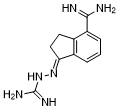
Description: Sardomozide (formerly SAM-486A; CGP-48664) is a novel and 2nd-generation polyamine synthesis inhibitor and S-adenosylmethionine decarboxylase (SAMDC) inhibitor with a broad spectrum antiproliferative and antitumor activity. SAM486 is more potent and specific than the first-generation SAMDC inhibitor methylglyoxal (bis) guanylhydrazone (MGBG). Preclinical testing confirmed promising antiproliferative activity. The in vitro tests showed that p53 wild-type NB cells were highly sensitive to SAM486A treatment. Most notably, SAM486A treatment resulted in the rapid accumulation of proapoptotic proteins p53 and Mdm2.
Physicochemical Properties
| Molecular Formula | C11H14N6 |
| Molecular Weight | 230.28 |
| Exact Mass | 230.128 |
| CAS # | 149400-88-4 |
| Related CAS # | Sardomozide dihydrochloride;138794-73-7 |
| PubChem CID | 9576789 |
| Appearance | Typically exists as solid at room temperature |
| Density | 1.54g/cm3 |
| Boiling Point | 490.6ºC at 760mmHg |
| Flash Point | 250.5ºC |
| Vapour Pressure | 0mmHg at 25°C |
| Index of Refraction | 1.768 |
| LogP | 2.095 |
| Hydrogen Bond Donor Count | 4 |
| Hydrogen Bond Acceptor Count | 3 |
| Rotatable Bond Count | 2 |
| Heavy Atom Count | 17 |
| Complexity | 368 |
| Defined Atom Stereocenter Count | 0 |
| SMILES | N=C(C1=CC=CC2=C1CC/C2=N\NC(N)=N)N |
| InChi Key | CYPGNVSXMAUSJY-CXUHLZMHSA-N |
| InChi Code | InChI=1S/C11H14N6/c12-10(13)8-3-1-2-7-6(8)4-5-9(7)16-17-11(14)15/h1-3H,4-5H2,(H3,12,13)(H4,14,15,17)/b16-9+ |
| Chemical Name | Hydrazinecarboximidamide, 2-(4-(aminoiminomethyl)-2,3-dihydro-1H-inden-1-ylidene)- |
| Synonyms | CGP 48664 SAM-486ACGP-48664 SAM486A CGP48664 SAM 486ASAM486A SAM-486A SAM 486A |
| HS Tariff Code | 2934.99.9001 |
| Storage |
Powder-20°C 3 years 4°C 2 years In solvent -80°C 6 months -20°C 1 month |
| Shipping Condition | Room temperature (This product is stable at ambient temperature for a few days during ordinary shipping and time spent in Customs) |
Biological Activity
| Targets |
|
|
| ln Vitro | An IC50 of 5 nM was observed in a cell experiment for the S-adenosylmethionine decarboxylase (SAMDC) inhibitor sardomozide. After being treated with 3 μM Sardomozide for 48 hours, intracellular SAMDC activity drops to 10% of the control level[1]. Vacuole production is not seen in CHO/664 cells grown in the presence of Sardomozide and treated with DENSPM; instead, the cells exhibit growth inhibition and DENSPM levels comparable to those of the original CHO cells[2]. | |
| Cell Assay |
|
|
| References |
[1]. CGP 48664, a new S-adenosylmethionine decarboxylase inhibitor with broad spectrum antiproliferative and antitumor activity. Cancer Res. 1994 Jun 15;54(12):3210-7. [2]. Lysosomal sequestration of polyamine analogues in Chinese hamster ovary cells resistant to the S-adenosylmethionine decarboxylase inhibitor, CGP-48664. Cancer Res. 1998 Sep 1;58(17):3883-90. |
|
| Additional Infomation | Sardomozide is a methylglyoxal-bis(guanylhydrazone) (MGBG) derivative with potential antineoplastic and antiviral properties. Sardomozide selectively binds to and inhibits S-adenosylmethionine decarboxylase (SAMDC), an enzyme essential for the biosynthesis of polyamines, such as spermine and spermidine that bind to DNA and play critical roles in cell division, cell differentiation and membrane function. By inhibiting SAMDC, sardomozide reduces the intracellular polyamine concentration, thereby interfering with cell growth and differentiation. In addition, this agent also exhibits anti-HIV effect via suppressing expression of eukaryotic translation initiation factor 5A (eIF-5A), which is essential for retroviral replication. |
Solubility Data
| Solubility (In Vitro) | May dissolve in DMSO (in most cases), if not, try other solvents such as H2O, Ethanol, or DMF with a minute amount of products to avoid loss of samples |
| Solubility (In Vivo) |
Note: Listed below are some common formulations that may be used to formulate products with low water solubility (e.g. < 1 mg/mL), you may test these formulations using a minute amount of products to avoid loss of samples. Injection Formulations (e.g. IP/IV/IM/SC) Injection Formulation 1: DMSO : Tween 80: Saline = 10 : 5 : 85 (i.e. 100 μL DMSO stock solution → 50 μL Tween 80 → 850 μL Saline) *Preparation of saline: Dissolve 0.9 g of sodium chloride in 100 mL ddH ₂ O to obtain a clear solution. Injection Formulation 2: DMSO : PEG300 :Tween 80 : Saline = 10 : 40 : 5 : 45 (i.e. 100 μL DMSO → 400 μLPEG300 → 50 μL Tween 80 → 450 μL Saline) Injection Formulation 3: DMSO : Corn oil = 10 : 90 (i.e. 100 μL DMSO → 900 μL Corn oil) Example: Take the Injection Formulation 3 (DMSO : Corn oil = 10 : 90) as an example, if 1 mL of 2.5 mg/mL working solution is to be prepared, you can take 100 μL 25 mg/mL DMSO stock solution and add to 900 μL corn oil, mix well to obtain a clear or suspension solution (2.5 mg/mL, ready for use in animals). Injection Formulation 4: DMSO : 20% SBE-β-CD in saline = 10 : 90 [i.e. 100 μL DMSO → 900 μL (20% SBE-β-CD in saline)] *Preparation of 20% SBE-β-CD in Saline (4°C,1 week): Dissolve 2 g SBE-β-CD in 10 mL saline to obtain a clear solution. Injection Formulation 5: 2-Hydroxypropyl-β-cyclodextrin : Saline = 50 : 50 (i.e. 500 μL 2-Hydroxypropyl-β-cyclodextrin → 500 μL Saline) Injection Formulation 6: DMSO : PEG300 : castor oil : Saline = 5 : 10 : 20 : 65 (i.e. 50 μL DMSO → 100 μLPEG300 → 200 μL castor oil → 650 μL Saline) Injection Formulation 7: Ethanol : Cremophor : Saline = 10: 10 : 80 (i.e. 100 μL Ethanol → 100 μL Cremophor → 800 μL Saline) Injection Formulation 8: Dissolve in Cremophor/Ethanol (50 : 50), then diluted by Saline Injection Formulation 9: EtOH : Corn oil = 10 : 90 (i.e. 100 μL EtOH → 900 μL Corn oil) Injection Formulation 10: EtOH : PEG300:Tween 80 : Saline = 10 : 40 : 5 : 45 (i.e. 100 μL EtOH → 400 μLPEG300 → 50 μL Tween 80 → 450 μL Saline) Oral Formulations Oral Formulation 1: Suspend in 0.5% CMC Na (carboxymethylcellulose sodium) Oral Formulation 2: Suspend in 0.5% Carboxymethyl cellulose Example: Take the Oral Formulation 1 (Suspend in 0.5% CMC Na) as an example, if 100 mL of 2.5 mg/mL working solution is to be prepared, you can first prepare 0.5% CMC Na solution by measuring 0.5 g CMC Na and dissolve it in 100 mL ddH2O to obtain a clear solution; then add 250 mg of the product to 100 mL 0.5% CMC Na solution, to make the suspension solution (2.5 mg/mL, ready for use in animals). Oral Formulation 3: Dissolved in PEG400 Oral Formulation 4: Suspend in 0.2% Carboxymethyl cellulose Oral Formulation 5: Dissolve in 0.25% Tween 80 and 0.5% Carboxymethyl cellulose Oral Formulation 6: Mixing with food powders Note: Please be aware that the above formulations are for reference only. InvivoChem strongly recommends customers to read literature methods/protocols carefully before determining which formulation you should use for in vivo studies, as different compounds have different solubility properties and have to be formulated differently. (Please use freshly prepared in vivo formulations for optimal results.) |
| Preparing Stock Solutions | 1 mg | 5 mg | 10 mg | |
| 1 mM | 4.3425 mL | 21.7127 mL | 43.4254 mL | |
| 5 mM | 0.8685 mL | 4.3425 mL | 8.6851 mL | |
| 10 mM | 0.4343 mL | 2.1713 mL | 4.3425 mL |