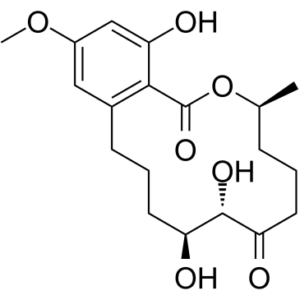
San78-130 is a novel, potent and selective ALK1 inhibitor with an IC50 of 62 nM. It also inhibits FLT4/VEGFR3, KDR/VEGFR2, MEK2, and FLT3 with IC50s of 114, 162, 186.7, and 188 nM, respectively.
Physicochemical Properties
| Molecular Formula | C19H26O7 |
| Molecular Weight | 366.41 |
| CAS # | 66018-45-9 |
| Appearance | Typically exists as solid at room temperature |
| Synonyms | San78-130; San 78 130; San 78-130 |
| HS Tariff Code | 2934.99.9001 |
| Storage |
Powder-20°C 3 years 4°C 2 years In solvent -80°C 6 months -20°C 1 month |
| Shipping Condition | Room temperature (This product is stable at ambient temperature for a few days during ordinary shipping and time spent in Customs) |
Biological Activity
| ln Vitro | San78-130, a reversible version of L-783277, as a selective and potent ALK1 inhibitor. Our study showed that San78-130 possesses great kinase selectivity against a panel of 342 kinases and more potent activity against ALK1 than L-783277. Among the six ALK isotypes (ALK1-6), ALK1 is most significantly inhibited by San78-130. San78-130 suppresses the BMP9-induced Smad1/5 pathway by mainly inhibiting ALK1 in C2C12 cells. Our molecular dynamics simulations suggest that H-bonding interaction between the C-4' hydroxyl group of San78-130 and Arg334 of ALK1 substantially contributes to the ALK1 inhibition. To the best of our knowledge, San78-130 is the first selective ALK1 inhibitor. Furthermore, San78-130 promoted angiogenesis in both endothelial tube formation and microfluidic chip based 3D angiogenesis assays, suggesting that San78-130 could be a lead compound for therapeutic angiogenesis agents. |
| Cell Assay |
To determine the ability to block agonist activation of TRPM8, AMG2850 was incubated with CHO cells expressing the TRP channel for 2 min before the addition of agonist and 45Ca2+ and cells were washed after a further incubation of 2 min to determine the 45Ca2+ uptake.[1] For treatment with TRPM8 inhibitors, the receptive field of each C fiber was isolated with a metal ring (4-mm diameter) sealed to the skin and incubated in vehicle (0.1 % DMSO or 0.003 % DMSO) or 10 μM AMG2850 for 10 min. AMG2850 was dissolved to the final concentration in 0.1 % DMSO. A baseline recording was taken during the final 2 min of compound incubation to measure any ongoing action potentials.[1] |
| References | J Med Chem. 2017 Feb 23;60(4):1495-1508. |
Solubility Data
| Solubility (In Vitro) | May dissolve in DMSO (in most cases), if not, try other solvents such as H2O, Ethanol, or DMF with a minute amount of products to avoid loss of samples |
| Solubility (In Vivo) |
Note: Listed below are some common formulations that may be used to formulate products with low water solubility (e.g. < 1 mg/mL), you may test these formulations using a minute amount of products to avoid loss of samples. Injection Formulations (e.g. IP/IV/IM/SC) Injection Formulation 1: DMSO : Tween 80: Saline = 10 : 5 : 85 (i.e. 100 μL DMSO stock solution → 50 μL Tween 80 → 850 μL Saline) *Preparation of saline: Dissolve 0.9 g of sodium chloride in 100 mL ddH ₂ O to obtain a clear solution. Injection Formulation 2: DMSO : PEG300 :Tween 80 : Saline = 10 : 40 : 5 : 45 (i.e. 100 μL DMSO → 400 μLPEG300 → 50 μL Tween 80 → 450 μL Saline) Injection Formulation 3: DMSO : Corn oil = 10 : 90 (i.e. 100 μL DMSO → 900 μL Corn oil) Example: Take the Injection Formulation 3 (DMSO : Corn oil = 10 : 90) as an example, if 1 mL of 2.5 mg/mL working solution is to be prepared, you can take 100 μL 25 mg/mL DMSO stock solution and add to 900 μL corn oil, mix well to obtain a clear or suspension solution (2.5 mg/mL, ready for use in animals). Injection Formulation 4: DMSO : 20% SBE-β-CD in saline = 10 : 90 [i.e. 100 μL DMSO → 900 μL (20% SBE-β-CD in saline)] *Preparation of 20% SBE-β-CD in Saline (4°C,1 week): Dissolve 2 g SBE-β-CD in 10 mL saline to obtain a clear solution. Injection Formulation 5: 2-Hydroxypropyl-β-cyclodextrin : Saline = 50 : 50 (i.e. 500 μL 2-Hydroxypropyl-β-cyclodextrin → 500 μL Saline) Injection Formulation 6: DMSO : PEG300 : castor oil : Saline = 5 : 10 : 20 : 65 (i.e. 50 μL DMSO → 100 μLPEG300 → 200 μL castor oil → 650 μL Saline) Injection Formulation 7: Ethanol : Cremophor : Saline = 10: 10 : 80 (i.e. 100 μL Ethanol → 100 μL Cremophor → 800 μL Saline) Injection Formulation 8: Dissolve in Cremophor/Ethanol (50 : 50), then diluted by Saline Injection Formulation 9: EtOH : Corn oil = 10 : 90 (i.e. 100 μL EtOH → 900 μL Corn oil) Injection Formulation 10: EtOH : PEG300:Tween 80 : Saline = 10 : 40 : 5 : 45 (i.e. 100 μL EtOH → 400 μLPEG300 → 50 μL Tween 80 → 450 μL Saline) Oral Formulations Oral Formulation 1: Suspend in 0.5% CMC Na (carboxymethylcellulose sodium) Oral Formulation 2: Suspend in 0.5% Carboxymethyl cellulose Example: Take the Oral Formulation 1 (Suspend in 0.5% CMC Na) as an example, if 100 mL of 2.5 mg/mL working solution is to be prepared, you can first prepare 0.5% CMC Na solution by measuring 0.5 g CMC Na and dissolve it in 100 mL ddH2O to obtain a clear solution; then add 250 mg of the product to 100 mL 0.5% CMC Na solution, to make the suspension solution (2.5 mg/mL, ready for use in animals). Oral Formulation 3: Dissolved in PEG400 Oral Formulation 4: Suspend in 0.2% Carboxymethyl cellulose Oral Formulation 5: Dissolve in 0.25% Tween 80 and 0.5% Carboxymethyl cellulose Oral Formulation 6: Mixing with food powders Note: Please be aware that the above formulations are for reference only. InvivoChem strongly recommends customers to read literature methods/protocols carefully before determining which formulation you should use for in vivo studies, as different compounds have different solubility properties and have to be formulated differently. (Please use freshly prepared in vivo formulations for optimal results.) |
| Preparing Stock Solutions | 1 mg | 5 mg | 10 mg | |
| 1 mM | 2.7292 mL | 13.6459 mL | 27.2918 mL | |
| 5 mM | 0.5458 mL | 2.7292 mL | 5.4584 mL | |
| 10 mM | 0.2729 mL | 1.3646 mL | 2.7292 mL |