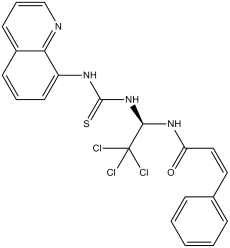
Salubrinal is a novel, potent, cell-permeable and selective inhibitor of eIF2 (eukaryotic translation initiation factor 2 subunit α) dephosphorylation that may have anticancer effects. With an EC50 of 15 μM in cell-free assays, it prevents ER stress-mediated apoptosis. In order to make proteins, the eukaryotic translation initiation factor 2 subunit α (eIF2α) is essential. Cells were largely shielded from apoptosis by eIF2α phosphorylation. The phosphatase complexes that dephosphorylate eIF-2α are selectively suppressed by salubrinal. By preventing the PP1/GADD34 complex from functioning, salubrinal prevents eIF2α dephosphorylation. By preventing eIF2α dephosphorylation, salubrinal blocks HSV replication with an IC50 of 3 μM.
Physicochemical Properties
| Molecular Formula | C21H17CL3N4OS | |
| Molecular Weight | 479.81 | |
| Exact Mass | 478.018 | |
| Elemental Analysis | C, 52.57; H, 3.57; Cl, 22.17; N, 11.68; O, 3.33; S, 6.68 | |
| CAS # | 405060-95-9 | |
| Related CAS # |
|
|
| PubChem CID | 5717801 | |
| Appearance | Light brown to gray solid powder | |
| Density | 1.5±0.1 g/cm3 | |
| Index of Refraction | 1.732 | |
| LogP | 6.21 | |
| Hydrogen Bond Donor Count | 3 | |
| Hydrogen Bond Acceptor Count | 3 | |
| Rotatable Bond Count | 5 | |
| Heavy Atom Count | 30 | |
| Complexity | 622 | |
| Defined Atom Stereocenter Count | 0 | |
| SMILES | ClC(C([H])(N([H])C(/C(/[H])=C(\[H])/C1C([H])=C([H])C([H])=C([H])C=1[H])=O)N([H])C(N([H])C1=C([H])C([H])=C([H])C2C([H])=C([H])C([H])=NC1=2)=S)(Cl)Cl |
|
| InChi Key | LCOIAYJMPKXARU-VAWYXSNFSA-N | |
| InChi Code | InChI=1S/C21H17Cl3N4OS/c22-21(23,24)19(27-17(29)12-11-14-6-2-1-3-7-14)28-20(30)26-16-10-4-8-15-9-5-13-25-18(15)16/h1-13,19H,(H,27,29)(H2,26,28,30)/b12-11+ | |
| Chemical Name | (E)-3-phenyl-N-[2,2,2-trichloro-1-(quinolin-8-ylcarbamothioylamino)ethyl]prop-2-enamide | |
| Synonyms | Salubrinal | |
| HS Tariff Code | 2934.99.9001 | |
| Storage |
Powder-20°C 3 years 4°C 2 years In solvent -80°C 6 months -20°C 1 month Note: This product requires protection from light (avoid light exposure) during transportation and storage. |
|
| Shipping Condition | Room temperature (This product is stable at ambient temperature for a few days during ordinary shipping and time spent in Customs) |
Biological Activity
| Targets | Dusp2; HSV-1 | ||
| ln Vitro | Salubrinal is a selective inhibitor of cellular complexes that dephosphorylate eukaryotic translation initiation factor 2 subunit α (eIF2α) phosphorylation. With a median effective concentration (EC50) of ~ 15 μM, salubrinal inhibited protein glycosylation inhibitor tunicamycin's (Tm) induction of ER stress-mediated apoptosis in a dose-dependent manner. The processing of caspase-7, a caspase activated by ER stress, was also inhibited by salubrinal, which also prevented Tm-induced DNA fragmentation. Salubrinal isn't a universal apoptosis inhibitor, though. In PC12 cells, salubrinal induced rapid and robust eIF2α phosphorylation as well as its downstream effects, which included the up-regulation of GADD34 and CHOP and the up-regulation of cyclin D1, two proteins whose expression is induced by eIF2α phosphorylation, and the down-regulation of cyclin D1. Salubrinal blocks the PP1/GADD34 complex, preventing eIF2 dephosphorylation. Salubrinal blocks eIF2α dephosphorylation, which prevents HSV replication with an IC50 of ~ 3μM. [1] NREM (non-rapid eye movement) sleep was improved by salubrinal. [2] | ||
| ln Vivo |
|
||
| Enzyme Assay | Immunoprecipitates of the phosphatases are used to measure phosphatase activities. Briefly, Salubrinal (20 µM), PSI (10 nM), the two drugs combined, or okadaic acid (100 nM) are applied to 2×10⁶ K562 cells for 18 hours. Following a PBS wash, the cells are either lysed for 15 minutes on ice in PP1LB (for determination of PP1γ-activity; 20 mM Tris-HCl, pH 7.5, 1% Triton X-100, 10% glycerol, 132 mM NaCl, Roche complete protease inhibitor ) or in RIPA (for PP2A), supplemented with Roche complete protease inhibitor). 500 µg (PP1γ) or 300 µg (PP2A) of protein-containing cell lysates are immunoprecipitated with 2-3 g of the corresponding antibodies overnight at 4°C, and then Protein A-Sepharose is added to the mixture. Immunoprecipitates are washed three times in lysis buffer, followed by resuspension in phosphatase assay buffer (PP2A: 20 mM Tris-HCl, pH7.5, 0.1 mM CaCl2; PP1γ: 50 mM Tris HCl pH 7.0, 0.2 mM MnCl2, 0.1 mM CaCl2, 125 µg/mL BSA, 0.05% Tween 20), supplemented with 100 µM 6,8-difluoro-4-methyl-umbelliferyl phosphate (DiFMUP). Precipitates are placed in an Eppendorf Thermoshaker and allowed to react with the substrate for 1 hour at 37°C. After centrifuging the mixture, the fluorescence of the DiFMU is measured using a BioTek Lambda Fluoro 320 microplate reader (360 nmex/460 nmem). Phosphatase activities are expressed as a percentage change from the control (DMSO-treated cells), in comparison. | ||
| Cell Assay | To induce ER stress, PC12 cells are plated in 384-well plates at a density of 5000 cells per well in a 40μL phenol red-free medium containing 3 g/ml Tm. By robotic pin transfer, 100 nL of the DiverSet E (5 mg/ml in DMSO) or the Structural Diversity set and Open Collections (10 mM in DMSO) (NCI) are added to the wells. After 48 hours, a luminescence-based ATP assay is used to determine the viability of the cells. On each plate, the wells that had been treated with DMSO or zVAD.fmk served as the rescue from ER stress-induced ATP loss's negative and positive controls, respectively. | ||
| Animal Protocol |
|
||
| References |
[1]. Science . 2005 Feb 11;307(5711):935-9. [2]. Am J Physiol Regul Integr Comp Physiol . 2009 Jan;296(1):R178-84. [3]. Neuroscience . 2012 May 3:209:108-18. |
||
| Additional Infomation | Salubrinal is a member of the class of quinolines that is a mixed aminal resulting from the formal condensation oftrichloroacetaldehyde with the amide nitrogen of trans-cinnamamide and the primary amino group of 1-quinolin-8-ylthiourea. It is a selective inhibitor of cellular complexes that dephosphorylate eukaryotic translation initiation factor 2 subunit alpha (eIF2alpha). It is a member of quinolines, a member of thioureas, an aminal, an organochlorine compound and a secondary carboxamide. It is functionally related to a trichloroacetaldehyde and a trans-cinnamamide. |
Solubility Data
| Solubility (In Vitro) |
|
|||
| Solubility (In Vivo) |
Solubility in Formulation 1: 10 mg/mL (20.84 mM) in 45% PEG300 +5% Tween-80 + 50% Saline (add these co-solvents sequentially from left to right, and one by one), suspension solution; with sonication. Preparation of saline: Dissolve 0.9 g of sodium chloride in 100 mL ddH₂ O to obtain a clear solution. (Please use freshly prepared in vivo formulations for optimal results.) |
| Preparing Stock Solutions | 1 mg | 5 mg | 10 mg | |
| 1 mM | 2.0842 mL | 10.4208 mL | 20.8416 mL | |
| 5 mM | 0.4168 mL | 2.0842 mL | 4.1683 mL | |
| 10 mM | 0.2084 mL | 1.0421 mL | 2.0842 mL |