|
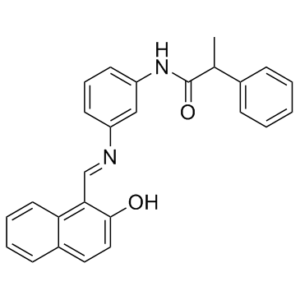
Salermide is a potent inhibitor of Sirt1/2 (Sirtuin 1/2) with a strong cancer-specific proapoptotic effect mediated by Sirt1. Class III histone deacetylases that are dependent on NAD+ (nicotinamide adenine dinucleotide-positive) include Sirt1 and Sirt2, which are involved in lifespan regulation. Since cancer is an age-related illness, focusing on sirtuins is becoming more and more popular as an antitumor tactic. Salermide is a reverse amide that significantly inhibits Sirt1 and Sirt2 in vitro. Salermide caused tumor-specific cell death in a variety of human cancer cell lines and was well tolerated by mice at concentrations up to 100 muM. Salermide's antitumor activity was mostly brought on by a significant induction of apoptosis. This suggested an in vivo mechanism of action via Sirt1 and was independent of global tubulin and K16H4 acetylation, ruling out a potential Sirt2-mediated apoptotic pathway. This is supported by the fact that cancer cells underwent apoptosis when Sirt1 but not Sirt2 was knocked down via RNA interference. Genetic p53 knockdowns demonstrated that Salermide's Sirt1-dependent proapoptotic effect is p53-independent, despite reports that p53 is a target of Sirt1. When combined, these findings point to the potential of salermide as an anticancer medication and provide light on the molecular pathway by which Sirt1 contributes to human carcinogenesis.
|
Physicochemical Properties
| Molecular Formula |
C26H22N2O2
|
| Molecular Weight |
394.47
|
| Exact Mass |
394.168
|
| Elemental Analysis |
C, 79.17; H, 5.62; N, 7.10; O, 8.11
|
| CAS # |
1105698-15-4
|
| Related CAS # |
|
| PubChem CID |
135659046
|
| Appearance |
White to off-white solid powder
|
| Density |
1.2±0.1 g/cm3
|
| Boiling Point |
666.7±50.0 °C at 760 mmHg
|
| Flash Point |
357.0±30.1 °C
|
| Vapour Pressure |
0.0±2.1 mmHg at 25°C
|
| Index of Refraction |
1.623
|
| LogP |
5.4
|
| Hydrogen Bond Donor Count |
2
|
| Hydrogen Bond Acceptor Count |
3
|
| Rotatable Bond Count |
5
|
| Heavy Atom Count |
30
|
| Complexity |
586
|
| Defined Atom Stereocenter Count |
0
|
| SMILES |
O=C(NC1=CC=CC(/N=C/C2=C3C=CC=CC3=CC=C2O)=C1)C(C)C4=CC=CC=C4
|
| InChi Key |
HQSSEGBEYORUBY-UHFFFAOYSA-N
|
| InChi Code |
InChI=1S/C26H22N2O2/c1-18(19-8-3-2-4-9-19)26(30)28-22-12-7-11-21(16-22)27-17-24-23-13-6-5-10-20(23)14-15-25(24)29/h2-18,29H,1H3,(H,28,30)
|
| Chemical Name |
N-[3-[(2-hydroxynaphthalen-1-yl)methylideneamino]phenyl]-2-phenylpropanamide
|
| Synonyms |
|
| HS Tariff Code |
2934.99.9001
|
| Storage |
Powder-20°C 3 years
4°C 2 years
In solvent -80°C 6 months
-20°C 1 month
|
| Shipping Condition |
Room temperature (This product is stable at ambient temperature for a few days during ordinary shipping and time spent in Customs)
|
|
Biological Activity
| Targets |
SIRT1; SIRT2
|
| ln Vitro |
In vitro activity: Salermide exhibits a dose-dependent inhibition against Sirt1 and Sirt2, which increases to 80% at 90 μM and 25 μM, respectively. In a variety of human cancer cell lines derived from leukemia (MOLT4, KG1A, K562), lymphoma (Raji), colon (SW480), and breast (MDA-MB-231), salermide can induce tumour-specific cell death. After being incubated at 100 μM Salermide alone, mitochondrial cytochrome was decreased and cytosolic activated caspase 3 was increased. Apoptosis can be induced by salermide alone via both intrinsic and extrinsic pathways. Compared to the previously reported class III HDAC inhibitors, salermide exhibited a number of antitumorigenic benefits. Firstly, it replicates the proapoptotic effect that the classical class I, II, and IV HDAC inhibitors showed on cancer samples, but it also has a cancer-specific proapoptotic effect[1]. |
|
| ln Vivo |
| Salermide is well tolerated by mice at 100 μM concentrations. Sirt1 specifically mediates the mechanism of action of salermide in vivo. Salermide administered intraperitoneally to naked mice does not appear to be toxic[1]. |
|
| Enzyme Assay |
The deacetylase activity of recombinant His-tagged human Sirt1 and Sirt2 was measured using the HDAC fluorescent activity assay (BIOMOL, Plymouth, PA, USA). The reactions lasted 60 minutes at 37 °C. The mean and standard deviation of four separate experiments are used to express the results.
|
| Cell Assay |
Cell lines (SW480, MDA-MB-231, MOLT4, KG1A, K562 and Raji) are used in the study. Cell viability is determined using the 3-(4,5-dimethylthiazol-2-yl)-2,5-diphenyltetrazolium bromide assay. IC50 index is calculated using four Salermide concentrations (25, 50, 75 and 100 μM) for 24 h. The percentage of apoptotic cells is determined with the FACSCalibur apparatus[1].
|
| Animal Protocol |
| Mice: To determine whether salermide might have any negative in vivo effects. This is accomplished by injecting 100 μL of 100 μM salermide intraperitoneally into ten nude mice over a 34-day period. Throughout the research, an eye is kept on diet consumption, body weight gain, and changes in posture and behavior[1]. | |
|
| References |
[1]. Salermide, a Sirtuin inhibitor with a strong cancer-specific proapoptotic effect. Oncogene. 2009 Feb 12;28(6):781-91.
|
| Additional Infomation |
N-[3-[(2-oxo-1-naphthalenylidene)methylamino]phenyl]-2-phenylpropanamide is a member of naphthalenes.
|
|
Solubility Data
| Solubility (In Vitro) |
| DMSO: ~10 mM | | Water: N/A | | Ethanol: N/A |
|
| Solubility (In Vivo) |
Solubility in Formulation 1: ≥ 2.5 mg/mL (6.34 mM) (saturation unknown) in 10% DMSO + 90% Corn Oil (add these co-solvents sequentially from left to right, and one by one), clear solution.
For example, if 1 mL of working solution is to be prepared, you can add 100 μL of 25.0 mg/mL clear DMSO stock solution to 900 μL of corn oil and mix evenly.
(Please use freshly prepared in vivo formulations for optimal results.)
|
| Preparing Stock Solutions |
|
1 mg |
5 mg |
10 mg |
| 1 mM |
2.5350 mL |
12.6752 mL |
25.3505 mL |
| 5 mM |
0.5070 mL |
2.5350 mL |
5.0701 mL |
| 10 mM |
0.2535 mL |
1.2675 mL |
2.5350 mL |
*Note: Please select an appropriate solvent for the preparation of stock solution based on your experiment needs. For most products, DMSO can be used for preparing stock solutions (e.g. 5 mM, 10 mM, or 20 mM concentration); some products with high aqueous solubility may be dissolved in water directly. Solubility information is available at the above Solubility Data section. Once the stock solution is prepared, aliquot it to routine usage volumes and store at -20°C or -80°C. Avoid repeated freeze and thaw cycles. |