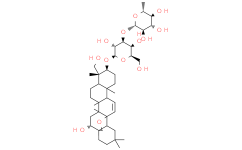
Physicochemical Properties
| Molecular Formula | C42H68O13 |
| Molecular Weight | 780.99 |
| Exact Mass | 780.466 |
| CAS # | 20736-09-8 |
| Related CAS # | 20736-09-8; |
| PubChem CID | 167928 |
| Appearance | White to off-white solid powder |
| Density | 1.4±0.1 g/cm3 |
| Boiling Point | 893.7±65.0 °C at 760 mmHg |
| Melting Point | 225 - 235ºC |
| Flash Point | 494.3±34.3 °C |
| Vapour Pressure | 0.0±0.6 mmHg at 25°C |
| Index of Refraction | 1.617 |
| LogP | 3.65 |
| Hydrogen Bond Donor Count | 8 |
| Hydrogen Bond Acceptor Count | 13 |
| Rotatable Bond Count | 6 |
| Heavy Atom Count | 55 |
| Complexity | 1490 |
| Defined Atom Stereocenter Count | 21 |
| SMILES | C[C@@H]1[C@@H]([C@@H]([C@H]([C@@H](O1)O[C@H]2CC[C@]3([C@H]([C@]2(C)CO)CC[C@@]4([C@@H]3C=C[C@@]56[C@]4(C[C@@H]([C@@]7([C@H]5CC(CC7)(C)C)CO6)O)C)C)C)O)O[C@H]8[C@@H]([C@H]([C@@H]([C@H](O8)CO)O)O)O)O |
| InChi Key | KYWSCMDFVARMPN-MSSMMRRTSA-N |
| InChi Code | InChI=1S/C42H68O13/c1-21-28(46)33(55-34-31(49)30(48)29(47)22(18-43)53-34)32(50)35(52-21)54-27-10-11-37(4)23(38(27,5)19-44)8-12-39(6)24(37)9-13-42-25-16-36(2,3)14-15-41(25,20-51-42)26(45)17-40(39,42)7/h9,13,21-35,43-50H,8,10-12,14-20H2,1-7H3/t21-,22-,23-,24-,25-,26+,27+,28+,29-,30+,31-,32-,33+,34+,35+,37+,38+,39-,40+,41-,42+/m1/s1 |
| Chemical Name | (2S,3R,4S,5S,6R)-2-[(2R,3R,4S,5S,6R)-3,5-dihydroxy-2-[[(1S,2S,4S,5R,8R,9R,10S,13S,14R,17S,18R)-2-hydroxy-9-(hydroxymethyl)-4,5,9,13,20,20-hexamethyl-24-oxahexacyclo[15.5.2.01,18.04,17.05,14.08,13]tetracos-15-en-10-yl]oxy]-6-methyloxan-4-yl]oxy-6-(hydroxymethyl)oxane-3,4,5-triol |
| HS Tariff Code | 2934.99.9001 |
| Storage |
Powder-20°C 3 years 4°C 2 years In solvent -80°C 6 months -20°C 1 month Note: This product requires protection from light (avoid light exposure) during transportation and storage. |
| Shipping Condition | Room temperature (This product is stable at ambient temperature for a few days during ordinary shipping and time spent in Customs) |
Biological Activity
| ln Vitro | Human osteoarthritis nurse cells have no effect on the viability of saikosaponin A (5–15 μM, 24 hours) [1]. Saikosaponin A (5-15 μM, 24 h) increases the expression of LXRα in a dose-dependent manner and suppresses the generation of NO, PGE2, and NF-κB produced by IL-1β [1]. |
| ln Vivo | Saikosaponin A (1-10 mg/kg, intraperitoneal injection, 7 days) can stop the morphological alterations brought on by 5-FU in the small intestine. [2]. Saikosaponin-A (1–10 mg/kg, intraperitoneal, 7 days) improves 5-FU-induced mucositis in 5 |
| Cell Assay |
Western Blot Analysis Cell Types: Human Osteoarthritis Chondrocytes Tested Concentrations: 5, 10, 15 μM Incubation Duration: 24. h Experimental Results: Inhibition of IL-1β-induced NF-κB p65 and IκBα phosphorylation levels. Upregulates the expression of LXRα in a dose-dependent manner. |
| Animal Protocol |
Animal/Disease Models: BALB/c mouse model [2] Doses: 1, 5, 10 mg /kg/day, 7 d Route of Administration: intraperitoneal (ip) injection Experimental Results: diminished villous blunting, crypt cell apoptosis and inflammatory cell infiltration. The concentrations of GSH, GST, catalase and SOD in intestinal tissue were diminished. |
| References |
[1]. Saikosaponin A inhibits IL-1β-induced inflammatory mediators in human osteoarthritis chondrocytes by activating LXRα. Oncotarget. 2017 Sep 30;8(51):88941-88950. [2]. Mucoprotective effects of Saikosaponin-A in 5-fluorouracil-induced intestinal mucositis in mice model. Life Sci. 2019. |
| Additional Infomation |
Saikosaponin A is a saikosaponin. Saikosaponin A has been reported in Bupleurum chinense, Scrophularia kakudensis, and other organisms with data available. |
Solubility Data
| Solubility (In Vitro) | DMSO : ~100 mg/mL (~128.04 mM) |
| Solubility (In Vivo) |
Solubility in Formulation 1: ≥ 2.5 mg/mL (3.20 mM) (saturation unknown) in 10% DMSO + 40% PEG300 + 5% Tween80 + 45% Saline (add these co-solvents sequentially from left to right, and one by one), clear solution. For example, if 1 mL of working solution is to be prepared, you can add 100 μL of 25.0 mg/mL clear DMSO stock solution to 400 μL PEG300 and mix evenly; then add 50 μL Tween-80 to the above solution and mix evenly; then add 450 μL normal saline to adjust the volume to 1 mL. Preparation of saline: Dissolve 0.9 g of sodium chloride in 100 mL ddH₂ O to obtain a clear solution. Solubility in Formulation 2: ≥ 2.5 mg/mL (3.20 mM) (saturation unknown) in 10% DMSO + 90% (20% SBE-β-CD in Saline) (add these co-solvents sequentially from left to right, and one by one), clear solution. For example, if 1 mL of working solution is to be prepared, you can add 100 μL of 25.0 mg/mL clear DMSO stock solution to 900 μL of 20% SBE-β-CD physiological saline solution and mix evenly. Preparation of 20% SBE-β-CD in Saline (4°C,1 week): Dissolve 2 g SBE-β-CD in 10 mL saline to obtain a clear solution. Solubility in Formulation 3: ≥ 2.5 mg/mL (3.20 mM) (saturation unknown) in 10% DMSO + 90% Corn Oil (add these co-solvents sequentially from left to right, and one by one), clear solution. For example, if 1 mL of working solution is to be prepared, you can add 100 μL of 25.0 mg/mL clear DMSO stock solution to 900 μL of corn oil and mix evenly. (Please use freshly prepared in vivo formulations for optimal results.) |
| Preparing Stock Solutions | 1 mg | 5 mg | 10 mg | |
| 1 mM | 1.2804 mL | 6.4021 mL | 12.8043 mL | |
| 5 mM | 0.2561 mL | 1.2804 mL | 2.5609 mL | |
| 10 mM | 0.1280 mL | 0.6402 mL | 1.2804 mL |