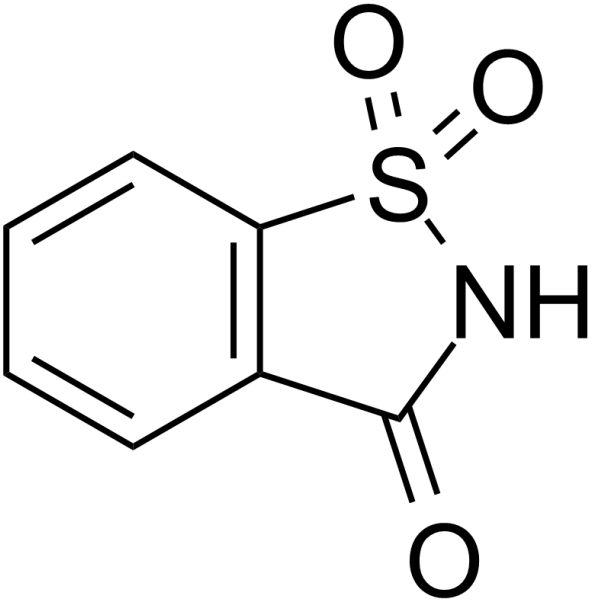
Physicochemical Properties
| Molecular Formula | C7H5NO3S |
| Molecular Weight | 183.1845 |
| Exact Mass | 182.999 |
| CAS # | 81-07-2 |
| Related CAS # | Saccharin sodium hydrate;82385-42-0;Saccharin-d4;1189466-17-8;Saccharin sodium;128-44-9 |
| PubChem CID | 5143 |
| Appearance |
Monoclinic crystals Needles from acetone; prisms from alcohol; leaflets from water White, crystalline powder White crystals |
| Density | 1.7±0.1 g/cm3 |
| Boiling Point | 438.9±28.0 °C at 760 mmHg |
| Melting Point | 226-229 °C(lit.) |
| Flash Point | 219.3±24.0 °C |
| Vapour Pressure | 0.0±1.1 mmHg at 25°C |
| Index of Refraction | 1.714 |
| LogP | 0.46 |
| Hydrogen Bond Donor Count | 1 |
| Hydrogen Bond Acceptor Count | 3 |
| Rotatable Bond Count | 0 |
| Heavy Atom Count | 12 |
| Complexity | 303 |
| Defined Atom Stereocenter Count | 0 |
| SMILES | O=C1C2C(=CC=CC=2)S(=O)(=O)N1 |
| InChi Key | CVHZOJJKTDOEJC-UHFFFAOYSA-N |
| InChi Code | InChI=1S/C7H5NO3S/c9-7-5-3-1-2-4-6(5)12(10,11)8-7/h1-4H,(H,8,9) |
| Chemical Name | 1,1-dioxo-1,2-benzothiazol-3-one |
| HS Tariff Code | 2934.99.9001 |
| Storage |
Powder-20°C 3 years 4°C 2 years In solvent -80°C 6 months -20°C 1 month |
| Shipping Condition | Room temperature (This product is stable at ambient temperature for a few days during ordinary shipping and time spent in Customs) |
Biological Activity
| ln Vitro | In a species-coupled manner, saccharin (0.5, 2.5, and 5 mM) externally inhibits cell growth [1]. |
| ln Vivo | Saccharin (respiratory; 5 mg/kg; twice daily) was found to lessen cough burden and change the composition of the lesion group in vivo [1]. However, there was no significant change in the vibrational barrier's interaction with the C57BL/6JRj wild type (wt). |
| ADME/Pharmacokinetics |
Absorption, Distribution and Excretion TRANSPLACENTAL TRANSFER OF ... (14)C-SACCHARIN ADMIN BY IV INFUSION TO RHESUS MONKEYS IN LATE PREGNANCY, WAS RAPID, BUT SLIGHT. (14)C WAS CLEARED MORE SLOWLY FROM FETAL THAN FROM MATERNAL BLOOD, & WAS DISTRIBUTED IN ALL FETAL TISSUES EXAMINED ... WAS ONLY BIOTRANSFORMED TO LIMITED EXTENT & WAS RAPIDLY EXCRETED ... . Three groups of five men were given sodium saccharin in single oral doses of 50, 150 or 333 mg/60 kg bw. Peak plasma concentrations occurred between 30 and 60 min after dosing, and 60 and 76% was excreted unchanged in urine at 6 and 24 h, respectively. /Sodium saccharin/ IN 3 VOLUNTEERS, 85-92% OF DOSES OF 1 G 3(14)C-SACCHARIN ADMIN ORALLY FOR 21 DAYS WAS EXCRETED UNCHANGED IN THE URINE WITHIN 24 HR; NO METABOLITES WERE FOUND. WITHIN 48 HR, 92.3% OF A DOSE OF 500 MG (14)C-SACCHARIN WAS EXCRETED IN THE URINE & 5.8% IN THE FECES. After administration of 1-g doses of soluble (sodium) saccharin [form not specified] to three men, saccharin was excreted in the urine quantitatively unchanged by two of the subjects within 48 hr. In a subsequent experiment involving six subjects, none excreted the dose quantitatively within 72 hr, but no metabolism of saccharin was detected. /Sodium saccharin/ For more Absorption, Distribution and Excretion (Complete) data for SACCHARIN (13 total), please visit the HSDB record page. Metabolism / Metabolites ... 3-(14)C-SACCHARIN WAS EXCRETED UNCHANGED, MAINLY IN THE URINE (85-92% IN 24 HR) BY ADULT HUMAN SUBJECTS, BOTH BEFORE & AFTER TAKING 1 G OF SACCHARIN DAILY FOR 21 DAYS; NO METABOLITE OF SACCHARIN WAS FOUND. THESE RESULTS WERE AMPLY CONFIRMED IN ANIMAL EXPERIMENTS, IN WHICH ORALLY ADMIN (14)C-SACCHARIN WAS EXCRETED ENTIRELY UNCHANGED BY RATS ON A NORMAL DIET & BY RATS ON A DIET CONTAINING 1% & 5% OF SACCHARIN FOR UP TO 12 MO. 80-90% OF THE DOSE WAS EXCRETED IN THE URINE, 10-20% IN THE FECES; NO (14)CO2 WAS FOUND IN THE EXHALED AIR, & NO (14)CO3(2-) OR 2-SULFAMOYLBENZOIC ACID IN THE URINE. YIELDS IN MONKEYS SULFAMOYLBENZOIC ACID & O-SULFOBENZOIC ACID. /FROM TABLE/ EXPOSURE OF MALE CHARLES RIVER CDI RATS TO 5% SACCHARIN DIET IN UTERO & THROUGHOUT WEANING, DID NOT INDUCE DETECTABLE METABOLISM. NO METABOLITES WERE DETECTED IN URINE OF NORMAL RATS GIVEN TRACER DOSE. PRETREATMENT WITH 3-METHYLCHOLANTHRENE DID NOT INDUCE SACCHARIN METABOLISM. One female and two male volunteers excreted 85-92% of a dose of 1g (3-14)C- saccharin unchanged in the urine within 24 hr, before or after taking 1 g saccharin daily for 21 days; no metabolites were found. Within 48 h, 92% of a dose of 500 mg [14C]saccharin taken by six male volunteers was excreted in the urine and 5.8% in the faeces. Analysis of urine and feces by highperformance liquid chromatography and thin-layer chromatography revealed only unmetabolized saccharin. Biological Half-Life In three adult men given an intravenous bolus of 10 mg/kg bw sodium saccharin, the plasma concentration-time curve fitted a two-compartment open model with a terminal half-life of 70 min. /Sodium saccharin/ Six women with an average oral daily intake of 100-300 mg saccharin (form not specified) had maximum plasma concentrations after 0.5-1 hr and an elimination half-life of 7.5 hr. |
| Toxicity/Toxicokinetics |
Effects During Pregnancy and Lactation ◉ Summary of Use during Lactation Because of the low levels of saccharin in breastmilk, amounts ingested by the infant after typical maternal intake are small and would not be expected to cause any adverse effects in breastfed infants and not likely to reach an intake greater than the acceptable daily intake. Ingestion of diet drinks containing low-calorie sweeteners might increase the risk of vomiting in breastfed infants. However, some authors suggest that women may wish to limit the consumption of nonnutritive sweeteners while breastfeeding because their effect on the nursing infants are unknown. ◉ Effects in Breastfed Infants A cross-sectional survey assessed the dietary history of US mothers nursing infants between 11 and 15 weeks of age. The survey was used to estimate the amount of diet soda and fruit drinks consumed by the women. There were no statistically significant differences in infants’ weight or z-scores based on low calorie sweetener exposure. However, infants exposed to low calorie sweetener in milk once or less per week had a statistically significantly higher risk of vomiting than those who were not exposed. Greater exposure was not associated with vomiting. It was not possible to assess the effects of specific sweeteners. ◉ Effects on Lactation and Breastmilk Relevant published information was not found as of the revision date. Interactions IT IS NOW WELL ESTABLISHED THAT THE INTERACTION OF MULTIPLE ENVIRONMENTAL FACTORS MAY INCR THE INCIDENCE OF SOME HUMAN CANCERS MORE THAN EXPOSURE TO A SINGLE CARCINOGEN. WITH AN IN VIVO EXPERIMENTAL RAT MODEL, SYNERGISTIC EFFECT IN BLADDER CARCINOGENESIS BETWEEN A SUBCARCINOGENIC DOSE OF THE STRONG BLADDER CARCINOGEN, N-METHYL-N-NITROSOUREA & SACCHARIN WAS DEMONSTRATED. Since both sodium L-ascorbate and sodium saccharin promote two-stage bladder carcinogenesis in rats, synergism of the two chemicals was investigated with special reference to the role of urinary pH and sodium+ concentration. Male F344 rats were given 0.05% N-butyl-N-(4-hydroxybutyl)nitrosamine in the drinking water for 4 wk and then treated with basal diet containing 5% sodium saccharin, 5% sodium L-ascorbate, 5% sodium saccharin plus 5% sodium L-ascorbate, 5% L-ascorbic acid, 5% sodium saccharin plus 5% L-ascorbic acid, or no added chemical for 32 wk. Treatment with sodium saccharin or sodium L-ascorbate alone significantly increased the induction of neoplastic and preneoplastic lesions of the bladder. Sodium saccharin plus sodium L-ascorbate also induced these bladder lesions significantly when compared with the controls, and the number of lesions was greater than the sum of the lesions in the group treated with sodium saccharin alone or sodium L-ascorbate alone. In contrast, the induction of carcinomas and papillomas in rats treated with sodium saccharin plus sodium L-ascorbate produced an elevation of urinary pH and sodium+ concentrations, although the increases were not different from those in rats fed sodium saccharin or sodium L-ascorbate alone. Sodium saccharin plus L-ascorbic acid, however, did not cause elevation of urinary pH, although it increased urinary sodium+ concentration. Thus, the bladder carcinogenesis promotion by sodium saccharin was synergized by sodium L-ascorbate and inhibited by L-ascorbic acid. This modulation was associated with changes of urinary pH and Na+ concentration. /Sodium saccharin/ CHRONIC RAT FEEDING STUDIES WERE CONDUCTED ON A 10:1 CYCLAMATE/SACCHARIN MIXT. THE TEST MIXT WAS FED AT DIETARY LEVELS DESIGNED TO FURNISH 500, 1120, & 2500 MG/KG TO GROUPS OF 35 MALE & 45 FEMALE RATS. THE ONLY POS FINDING WHICH PROVED TO HAVE CRUCIAL SIGNIFICANCE WAS THE OCCURRENCE OF PAPILLARY CARCINOMAS IN THE BLADDERS OF 12 OF THE 70 RATS FED THE MAX DIETARY LEVEL OF THE MIXT (EQUIV TO ABOUT 2500 MG/KG) FOR PERIODS RANGING FROM 78 TO 105 WK. N-METHYL-N-NITROSOUREA WAS USED AS INITIATING CARCINOGEN AND GREATLY INCR YIELD OF BLADDER CANCERS IN SACCHARIN TREATED RATS. SACCHARIN IS A WEAK INITIATOR BUT A POWERFUL PROMOTER OF CARCINOGENESIS IN THE RAT BLADDER. For more Interactions (Complete) data for SACCHARIN (15 total), please visit the HSDB record page. Non-Human Toxicity Values LD50 Rat ip 7100 mg/kg /Sodium saccharin/ LD50 Rat oral 14,200 mg/kg /Sodium saccharin/ LD50 Mouse oral 17,500 mg/kg /Sodium saccharin/ |
| References | [1]. Sünderhauf A, et al. Saccharin Supplementation Inhibits Bacterial Growth and Reduces Experimental Colitis in Mice. Nutrients. 2020 Apr 17;12(4). pii: E1122. |
| Additional Infomation |
Saccharin (manufacturing) appears as white crystals. Odorless or faintly aromatic odor. Sweet taste. (NTP, 1992) Saccharin, sodium salt appears as odorless white crystals or crystalline powder. Aqueous solution is neutral or alkaline to litmus, but not alkaline to phenolphthalein. Effloresces in dry air. Intensely sweet taste. (NTP, 1992) Saccharin is a 1,2-benzisothiazole having a keto-group at the 3-position and two oxo substituents at the 1-position. It is used as an artificial sweetening agent. It has a role as a sweetening agent, a xenobiotic and an environmental contaminant. It is a 1,2-benzisothiazole and a N-sulfonylcarboxamide. Saccharin has been investigated for the treatment of Hypertension and Hyperglycemia. Flavoring agent and non-nutritive sweetener. See also: Aspartame; saccharin; sodium cyclamate; sucralose (component of) ... View More ... Mechanism of Action ...it has been shown that the activation of particular T2R bitter taste receptors is partially involved with the bitter aftertaste sensation of saccharin and acesulfame-K. ... /This study/ addressed the question of whether /they/ could stimulate transient receptor potential vanilloid-1 (TRPV1) receptors, as these receptors are activated by a large range of structurally different chemicals. Moreover, TRPV1 receptors and/or their variants are found in taste receptor cells and in nerve terminals throughout the oral cavity. Hence, TRPV1 activation could be involved in the ... aftertaste or even contribute to the poorly understood metallic taste sensation. Using Ca(2+) imaging on TRPV1 receptors heterologously expressed in the human embryonic kidney (HEK) 293 cells and on dissociated primary sensory neurons,... /it was found/ that in both systems, .../sweeteners/ activate TRPV1 receptors, and, moreover, they sensitize these channels to acid and heat. ... /it was/also found that TRPV1 receptors were activated by CuSO(4), ZnSO(4), and FeSO(4), three salts known to produce a metallic taste sensation. In summary, .../the/ results identify a novel group of compounds that activate TRPV1 and, consequently, provide a molecular mechanism that may account for off tastes of sweeteners and metallic tasting salts. |
Solubility Data
| Solubility (In Vitro) |
DMSO : ~100 mg/mL (~545.91 mM) H2O : ~2.63 mg/mL (~14.36 mM) |
| Solubility (In Vivo) |
Solubility in Formulation 1: ≥ 2.5 mg/mL (13.65 mM) (saturation unknown) in 10% DMSO + 40% PEG300 + 5% Tween80 + 45% Saline (add these co-solvents sequentially from left to right, and one by one), clear solution. For example, if 1 mL of working solution is to be prepared, you can add 100 μL of 25.0 mg/mL clear DMSO stock solution to 400 μL PEG300 and mix evenly; then add 50 μL Tween-80 to the above solution and mix evenly; then add 450 μL normal saline to adjust the volume to 1 mL. Preparation of saline: Dissolve 0.9 g of sodium chloride in 100 mL ddH₂ O to obtain a clear solution. Solubility in Formulation 2: ≥ 2.5 mg/mL (13.65 mM) (saturation unknown) in 10% DMSO + 90% (20% SBE-β-CD in Saline) (add these co-solvents sequentially from left to right, and one by one), clear solution. For example, if 1 mL of working solution is to be prepared, you can add 100 μL of 25.0 mg/mL clear DMSO stock solution to 900 μL of 20% SBE-β-CD physiological saline solution and mix evenly. Preparation of 20% SBE-β-CD in Saline (4°C,1 week): Dissolve 2 g SBE-β-CD in 10 mL saline to obtain a clear solution. Solubility in Formulation 3: ≥ 2.5 mg/mL (13.65 mM) (saturation unknown) in 10% DMSO + 90% Corn Oil (add these co-solvents sequentially from left to right, and one by one), clear solution. For example, if 1 mL of working solution is to be prepared, you can add 100 μL of 25.0 mg/mL clear DMSO stock solution to 900 μL of corn oil and mix evenly. (Please use freshly prepared in vivo formulations for optimal results.) |
| Preparing Stock Solutions | 1 mg | 5 mg | 10 mg | |
| 1 mM | 5.4591 mL | 27.2956 mL | 54.5911 mL | |
| 5 mM | 1.0918 mL | 5.4591 mL | 10.9182 mL | |
| 10 mM | 0.5459 mL | 2.7296 mL | 5.4591 mL |