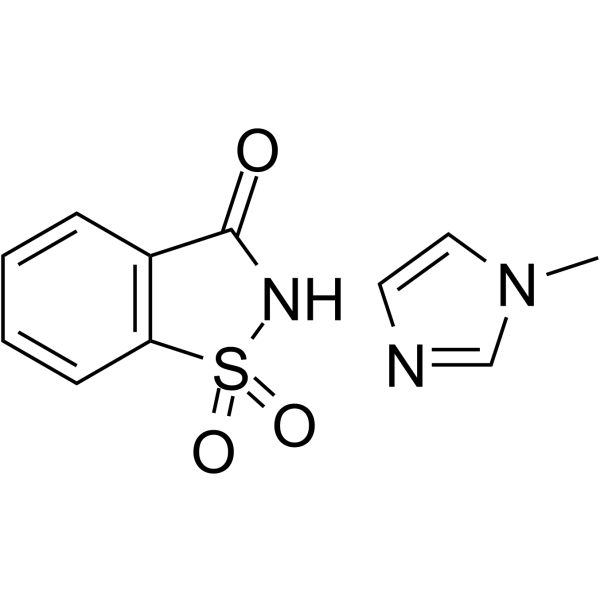
Physicochemical Properties
| Molecular Formula | C11H11N3O3S |
| Molecular Weight | 265.29 |
| Exact Mass | 265.052 |
| CAS # | 482333-74-4 |
| PubChem CID | 9813926 |
| Appearance | Light yellow to orange solid powder |
| LogP | 0.887 |
| Hydrogen Bond Donor Count | 1 |
| Hydrogen Bond Acceptor Count | 4 |
| Rotatable Bond Count | 0 |
| Heavy Atom Count | 18 |
| Complexity | 348 |
| Defined Atom Stereocenter Count | 0 |
| SMILES | O=S1(NC(=O)C2C=CC=CC1=2)=O.CN1C=NC=C1 |
| InChi Key | DMSNKRPEUQVMNF-UHFFFAOYSA-N |
| InChi Code | InChI=1S/C7H5NO3S.C4H6N2/c9-7-5-3-1-2-4-6(5)12(10,11)8-7;1-6-3-2-5-4-6/h1-4H,(H,8,9);2-4H,1H3 |
| Chemical Name | 1,1-dioxo-1,2-benzothiazol-3-one;1-methylimidazole |
| HS Tariff Code | 2934.99.9001 |
| Storage |
Powder-20°C 3 years 4°C 2 years In solvent -80°C 6 months -20°C 1 month |
| Shipping Condition | Room temperature (This product is stable at ambient temperature for a few days during ordinary shipping and time spent in Customs) |
Biological Activity
| ln Vitro | Calcium-deficient T51B cells are stimulated to initiate DNA synthesis rapidly, efficiently, or almost efficiently upon exposure to concentrations of the disparate promoters phenobarbital and the calcium and sodium salts of saccharin (22, 23, 25, 29, 38). This results in an increase in the extracellular calcium concentration to 1.25 mM[1]. |
| References | [1]. Boynton AL, et al. Stimulation of DNA synthesis in calcium-deprived T51B liver cells by the tumor promoters phenobarbital, saccharin, and 12-O-tetradecanoylphorbol-13-acetate. Cancer Res. 1980 Dec;40(12):4541-5. |
Solubility Data
| Solubility (In Vitro) |
DMSO : ~100 mg/mL (~376.95 mM) H2O : ≥ 100 mg/mL (~376.95 mM) |
| Solubility (In Vivo) |
Solubility in Formulation 1: ≥ 2.5 mg/mL (9.42 mM) (saturation unknown) in 10% DMSO + 40% PEG300 + 5% Tween80 + 45% Saline (add these co-solvents sequentially from left to right, and one by one), clear solution. For example, if 1 mL of working solution is to be prepared, you can add 100 μL of 25.0 mg/mL clear DMSO stock solution to 400 μL PEG300 and mix evenly; then add 50 μL Tween-80 to the above solution and mix evenly; then add 450 μL normal saline to adjust the volume to 1 mL. Preparation of saline: Dissolve 0.9 g of sodium chloride in 100 mL ddH₂ O to obtain a clear solution. Solubility in Formulation 2: ≥ 2.5 mg/mL (9.42 mM) (saturation unknown) in 10% DMSO + 90% (20% SBE-β-CD in Saline) (add these co-solvents sequentially from left to right, and one by one), clear solution. For example, if 1 mL of working solution is to be prepared, you can add 100 μL of 25.0 mg/mL clear DMSO stock solution to 900 μL of 20% SBE-β-CD physiological saline solution and mix evenly. Preparation of 20% SBE-β-CD in Saline (4°C,1 week): Dissolve 2 g SBE-β-CD in 10 mL saline to obtain a clear solution. Solubility in Formulation 3: ≥ 2.5 mg/mL (9.42 mM) (saturation unknown) in 10% DMSO + 90% Corn Oil (add these co-solvents sequentially from left to right, and one by one), clear solution. For example, if 1 mL of working solution is to be prepared, you can add 100 μL of 25.0 mg/mL clear DMSO stock solution to 900 μL of corn oil and mix evenly. (Please use freshly prepared in vivo formulations for optimal results.) |
| Preparing Stock Solutions | 1 mg | 5 mg | 10 mg | |
| 1 mM | 3.7695 mL | 18.8473 mL | 37.6946 mL | |
| 5 mM | 0.7539 mL | 3.7695 mL | 7.5389 mL | |
| 10 mM | 0.3769 mL | 1.8847 mL | 3.7695 mL |