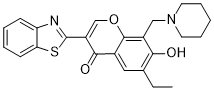
SZL P1-41 is a Skp2 inhibitor that phenocopies the effects observed upon genetic Skp2 deficiency, such as suppressing survival, Akt-mediated glycolysis as well as triggering p53-independent cellular senescence.The reference concentration is 5 uM. SZL P1-41 restricts cancer cell survival through triggering p53-independent cellular senescence and inhibiting aerobic glycolysis. SZL P1-41 exhibits potent anti-tumor activities in multiple animal models and cooperates with chemotherapeutic agents to reduce cancer cell survival.
Physicochemical Properties
| Molecular Formula | C24H24N2O3S | |
| Molecular Weight | 420.52 | |
| Exact Mass | 420.15 | |
| Elemental Analysis | C, 68.55; H, 5.75; N, 6.66; O, 11.41; S, 7.62 | |
| CAS # | 222716-34-9 | |
| Related CAS # |
|
|
| PubChem CID | 1286902 | |
| Appearance | Off-white to pink solid powder | |
| Density | 1.3±0.1 g/cm3 | |
| Boiling Point | 610.0±65.0 °C at 760 mmHg | |
| Flash Point | 322.7±34.3 °C | |
| Vapour Pressure | 0.0±1.8 mmHg at 25°C | |
| Index of Refraction | 1.687 | |
| LogP | 4.85 | |
| Hydrogen Bond Donor Count | 1 | |
| Hydrogen Bond Acceptor Count | 6 | |
| Rotatable Bond Count | 4 | |
| Heavy Atom Count | 30 | |
| Complexity | 665 | |
| Defined Atom Stereocenter Count | 0 | |
| SMILES | S1C2=C([H])C([H])=C([H])C([H])=C2N=C1C1=C([H])OC2=C(C1=O)C([H])=C(C([H])([H])C([H])([H])[H])C(=C2C([H])([H])N1C([H])([H])C([H])([H])C([H])([H])C([H])([H])C1([H])[H])O[H] |
|
| InChi Key | JKIXLEKBXHMXTN-UHFFFAOYSA-N | |
| InChi Code | InChI=1S/C24H24N2O3S/c1-2-15-12-16-22(28)18(24-25-19-8-4-5-9-20(19)30-24)14-29-23(16)17(21(15)27)13-26-10-6-3-7-11-26/h4-5,8-9,12,14,27H,2-3,6-7,10-11,13H2,1H3 | |
| Chemical Name | 3-(2-Benzothiazolyl)-6-ethyl-7-hydroxy-8-(1-piperidinylmethyl)-4H-1-benzopyran-4-one | |
| Synonyms | SZL-P1-41; SZL P1 41; SZLP141; SKP2 E3 Ligase Inhibitor III; SZLP-141; SZLP 141; | |
| HS Tariff Code | 2934.99.9001 | |
| Storage |
Powder-20°C 3 years 4°C 2 years In solvent -80°C 6 months -20°C 1 month |
|
| Shipping Condition | Room temperature (This product is stable at ambient temperature for a few days during ordinary shipping and time spent in Customs) |
Biological Activity
| Targets |
Skp2
The literature refers to "compound #25" (corresponding to SZL P1-41) as a specific inhibitor of Skp2 SCF ubiquitin ligase, which selectively targets the Skp2-Skp1 interaction interface to inhibit Skp2 E3 ligase activity; [1] SZL P1-41 (compound #25) targets Skp2 E3 ligase, upregulates the tumor suppressor p27 and inactivates the oncoprotein Akt,[2] |
| ln Vitro |
In PC3 cells, SZL P1-41 (5–20μM; 24 hours) stimulates the expression of p21, another Skp2 substrate, as well as endogenous p27 protein[1]. 1. SZL P1-41 (compound #25) selectively inhibits Skp2 E3 ligase activity but has no inhibitory effect on the activity of other SCF complexes. In in vitro Skp2-Skp1 binding assays, the compound blocks the interaction between Skp2 and Skp1; in in vivo binding assays in PC3 cells, it also disrupts the Skp2-Skp1 complex formation [1] 2. In 293T cells transfected with p27, His-Ub and Xp-Skp2, SZL P1-41 inhibits p27 ubiquitination in vivo; in in vitro Skp2-mediated p27 ubiquitination assays, the compound reduces p27 ubiquitination levels in the presence of Flag-Skp2-SCF [1] 3. SZL P1-41 inhibits Akt ubiquitination both in vivo (293T cell transfection assay) and in vitro (Skp2-mediated Akt ubiquitination assay with GST-Akt as substrate) [1] 4. After PC3 cells were treated with SZL P1-41 at different doses for 24 hours, immunoblotting results showed changes in the expression/modification levels of related proteins ; serum-starved LNCaP cells were treated with the compound for 24 hours, and after EGF stimulation, immunoblotting showed altered Akt activation [1] 5. SZL P1-41 reduces the survival rate of prostate cancer cells (PC3, LNCaP) and lung cancer cells (A549) in a dose-dependent manner, but has little effect on normal epithelial cells (PNT1A) and normal fibroblasts (IMR90) [1] 6. Treatment of PC3 cells with SZL P1-41 for 4 days induces p53-independent cellular senescence; the compound reduces lactate production in PC3 and LNCaP cells (similar to the effect of LY294002), indicating inhibition of Akt-mediated glycolysis; it also increases the apoptosis rate of PC3 cells [1] 7. PC3 cells with Skp2 knockdown or stable expression of Skp2 WT, W97A or D98A mutants were treated with SZL P1-41 at different doses: Skp2 knockdown enhances the sensitivity of PC3 cells to the compound, while Skp2 W97A/D98A mutants (which lose the binding site for the compound) reduce the inhibitory effect of the compound on cell survival (quantitative data presented as mean ± S.D., p<0.05, p<0.01) [1] 8. SZL P1-41 reduces the proportion of ALDH⁺ cancer stem cells in PC3 and LNCaP cells (similar to the effect of LY294002 and Skp2 knockdown); it also inhibits the sphere-forming ability of PC3 and LNCaP cells (prostate sphere-formation assay, mean ± S.D., p<0.01) [1] 9. Structure-activity relationship (SAR) studies of SZL P1-41 derivatives: in vitro Skp2-Skp1 binding assays and in vivo p27 ubiquitination assays showed that different derivatives have varying inhibitory activities against Skp2; cell survival assays confirmed that derivative activity is correlated with Skp2 inhibition efficacy [1] |
| ln Vivo |
SZL P1-41 (40–80 mg/kg; i.p.) has a strong antitumor growth-inhibiting effect on prostate and lung tumors in nude mice with xenografts of A549 and PC3 [1]. 1. SZL P1-41 (compound #25) enhances the sensitivity of PC3 cells to chemotherapeutic drugs Dox (doxorubicin) and CPA (cyclophosphamide) in vitro; in nude mouse xenograft models bearing A549 (lung cancer) or PC3 (prostate cancer) tumors, intraperitoneal (IP) injection of the compound significantly inhibits tumor growth (n=6 mice per group, mean tumor volumes ± s.d., p<0.05, p<0.01, ) [1] 2. Histological analysis of PC3 tumor xenografts in nude mice: SZL P1-41 (low dose: 40 mg/kg, high dose: 80 mg/kg, IP injection) upregulates the expression of p27 and p21, and downregulates the levels of pAkt and Glut1 in tumor tissues (quantification results presented as mean ± S.D., p<0.05, p<0.01; representative histological images with a scale bar of 100 µm) [1] 3. SZL P1-41 (compound #25) phenocopies the effects of Skp2 deficiency, targeting tumorigenesis by upregulating p27 and inactivating Akt; it may also have potential applications in obesity prevention [2] |
| Enzyme Assay |
1. In vitro Skp2-Skp1 binding assay: The interaction between Skp2 and Skp1 was detected under conditions with or without SZL P1-41 (compound #25); the assay was used to verify the inhibitory effect of the compound on the Skp2-Skp1 interaction, and was also applied to evaluate the activity of SZL P1-41 derivatives [1] 2. In vitro Skp2-mediated p27 ubiquitination assay: Flag-Skp2-SCF complex and p27 were used as substrates, and the ubiquitination level of p27 was detected in the presence of DMSO or SZL P1-41; the assay was designed to confirm the inhibitory effect of the compound on Skp2 E3 ligase activity [1] 3. In vitro Skp2-mediated Akt ubiquitination assay: Flag-Skp2-SCF complex and GST-Akt were used as substrates, and Akt ubiquitination levels were measured in the presence of DMSO or SZL P1-41 to assess the effect of the compound on Skp2-mediated Akt ubiquitination [1] |
| Cell Assay |
1. Cell survival assay: Prostate cancer cells (PC3, LNCaP), lung cancer cells (A549), normal epithelial cells (PNT1A) and normal fibroblasts (IMR90) were treated with SZL P1-41 (compound #25) at different doses for a specific duration (unspecified), and cell survival rate was detected ; PC3 cells with Skp2 knockdown or stable expression of Skp2 mutants (WT, W97A, D98A) were treated with the compound at various doses, and survival rate was normalized to the DMSO group (results presented as mean ± S.D., p<0.05, p<0.01) [1] 2. Senescence assay: PC3 cells were treated with or without SZL P1-41 for 4 days, and cellular senescence was evaluated [1] 3. Lactate production assay: PC3 and LNCaP cells were treated with DMSO, LY294002 or SZL P1-41, and lactate levels in the cell culture medium were measured to assess glycolysis activity [1] 4. Apoptosis assay: PC3 cells were treated with DMSO or SZL P1-41, and apoptosis rate was determined [1] 5. FACS analysis for ALDH⁺ cells: PC3 and LNCaP cells were treated with DMSO, LY294002, SZL P1-41 or subjected to Skp2 knockdown; ALDH⁺ cell populations (cancer stem cells) were quantified by flow cytometry [1] 6. Prostate sphere-formation assay: PC3 and LNCaP cells were treated with DMSO, LY294002 or SZL P1-41, and cultured under sphere-forming conditions; the number/size of spheres was counted to evaluate cancer stem cell self-renewal ability (results presented as mean ± S.D., p<0.01, ) [1] 7. Immunoblotting (IB) assay: PC3 cells treated with SZL P1-41 at different doses for 24 hours, or serum-starved LNCaP cells treated with the compound for 24 hours (with/without EGF stimulation) were harvested; whole cell extracts (WCE) were prepared, and protein expression/phosphorylation levels (e.g., pAkt, p27) were detected by western blot [1] 8. In vivo ubiquitination assay (cell-based): 293T cells were transfected with p27/His-Ub/Xp-Skp2 or Akt-related constructs, treated with DMSO or SZL P1-41 (and MG132 for 6 hours in some assays), and ubiquitination levels of p27/Akt were detected [1] |
| Animal Protocol |
1. Xenograft tumor model in nude mice: A549 (lung cancer) or PC3 (prostate cancer) cells were implanted into nude mice to establish tumor xenografts; SZL P1-41 (compound #25) was administered to the mice via intraperitoneal (IP) injection at doses of 40 mg/kg (low) and 80 mg/kg (high) . Tumor volumes were measured regularly, and data were presented as mean tumor volumes ± s.d. (n=6 mice per group). After the experiment, tumor tissues were collected for histological analysis [1] |
| References |
[1]. Pharmacological inactivation of Skp2 SCF ubiquitin ligase restricts cancer stem cell traits and cancer progression. Cell. 2013 Aug 1;154(3):556-68. [2]. Skp2: a dream target in the coming age of cancer therapy. Cell Cycle. 2014;13(5):679-80. |
| Additional Infomation |
SZL-P1-41 is a chromone that is 3-(1,3-benzothiazol-2-yl)-8-(1-piperidinylmethyl)chromen-4-one bearing additional ethyl and hydroxy substituents at positions 6 and 7 respectively. It has a role as an antineoplastic agent and an EC 6.3.2.19 (ubiquitin--protein ligase) inhibitor. It is a member of benzothiazoles, a member of chromones, a member of piperidines and a member of phenols. 1. SZL P1-41 (compound #25) was identified through high-throughput in silico screening of large and diverse chemical libraries, targeting the Skp2-Skp1 interaction interface (binding to Trp97 and Asp98 residues of Skp2, forming hydrogen bonds/hydrophobic/aromatic stacking interactions with Skp2) [1] 2. The chemical structure of SZL P1-41 is 3-(1,3-benzothiazol-2-yl)-6-ethyl-7-hydroxy-8-(1-piperidinylmethyl)-4H-chromen-4-one; molecular docking showed that the compound binds to predicted pocket 1 of Skp2 [1] 3. SZL P1-41 phenocopies the effects of genetic Skp2 deficiency, including suppressing cancer cell survival, inhibiting Akt-mediated glycolysis, inducing p53-independent cellular senescence, reducing cancer stem cell populations and self-renewal ability [1] 4. SZL P1-41 exhibits potent antitumor activity in multiple animal models and synergizes with chemotherapeutic agents (Dox, CPA) to reduce cancer cell survival [1] 5. SZL P1-41 (compound #25) may have potential applications in obesity prevention (Skp2 loss reduces adipocyte number possibly via p27 accumulation), in addition to its antitumor effects [2] 6. Skp2 is overexpressed in numerous human cancers and plays a critical role in cell-cycle progression, senescence, metabolism, cancer progression and metastasis; SZL P1-41 provides pharmacological evidence that Skp2 is a promising target for cancer therapy [1,2] |
Solubility Data
| Solubility (In Vitro) | DMSO : 2.5~5 mg/mL ( 5.95~11.89 mM ) |
| Solubility (In Vivo) |
Solubility in Formulation 1: 5 mg/mL (11.89 mM) in Corn Oil (add these co-solvents sequentially from left to right, and one by one), suspension solution; with sonication. (Please use freshly prepared in vivo formulations for optimal results.) |
| Preparing Stock Solutions | 1 mg | 5 mg | 10 mg | |
| 1 mM | 2.3780 mL | 11.8900 mL | 23.7801 mL | |
| 5 mM | 0.4756 mL | 2.3780 mL | 4.7560 mL | |
| 10 mM | 0.2378 mL | 1.1890 mL | 2.3780 mL |