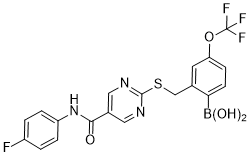
SX-682 (SX682) is a novel boronic acid-containing and selective CXCR2 chemokine receptor antagonist with potential anticancer and immunomodulatory activities. The proliferation and progression of tumor cells are facilitated by the upregulation of the CXC chemokine receptor CXCR2 in a range of distinct tumor cell types. Reduced tumorigenesis and metastasis were the results of CXCR2 inhibition. SX-682 is a CXCR2 antagonist that may be used to treat melanoma and prostate cancer that is resistant to castration. Syntrix Biosystems, Inc. has initiated a phase I clinical trial combining SX-682 and pembrolizumab for the treatment of metastatic melanoma.
Physicochemical Properties
| Molecular Formula | C19H14BF4N3O4S | |
| Molecular Weight | 467.20 | |
| Exact Mass | 467.07 | |
| Elemental Analysis | C, 48.85; H, 3.02; B, 2.31; F, 16.27; N, 8.99; O, 13.70; S, 6.86 | |
| CAS # | 1648843-04-2 | |
| Related CAS # |
|
|
| PubChem CID | 90467234 | |
| Appearance | Off-white to light yellow solid powder | |
| Density | 1.53±0.1 g/cm3(Predicted) | |
| Hydrogen Bond Donor Count | 3 | |
| Hydrogen Bond Acceptor Count | 11 | |
| Rotatable Bond Count | 7 | |
| Heavy Atom Count | 32 | |
| Complexity | 606 | |
| Defined Atom Stereocenter Count | 0 | |
| SMILES | S(C1N=CC(=CN=1)C(NC1C=CC(=CC=1)F)=O)CC1C=C(C=CC=1B(O)O)OC(F)(F)F |
|
| InChi Key | SDUDZBCEHIZMFZ-UHFFFAOYSA-N | |
| InChi Code | InChI=1S/C19H14BF4N3O4S/c21-13-1-3-14(4-2-13)27-17(28)12-8-25-18(26-9-12)32-10-11-7-15(31-19(22,23)24)5-6-16(11)20(29)30/h1-9,29-30H,10H2,(H,27,28) | |
| Chemical Name | [2-[[5-[(4-fluorophenyl)carbamoyl]pyrimidin-2-yl]sulfanylmethyl]-4-(trifluoromethoxy)phenyl]boronic acid | |
| Synonyms |
|
|
| HS Tariff Code | 2934.99.9001 | |
| Storage |
Powder-20°C 3 years 4°C 2 years In solvent -80°C 6 months -20°C 1 month |
|
| Shipping Condition | Room temperature (This product is stable at ambient temperature for a few days during ordinary shipping and time spent in Customs) |
Biological Activity
| Targets | CXCR2; CXCR1 | |
| ln Vitro |
|
|
| ln Vivo |
|
|
| Animal Protocol |
|
|
| References |
[1]. Nature . 2017 Mar 30;543(7647):728-732. [2]. JCI Insight . 2019 Apr 4;4(7):e126853. [3]. Clin Cancer Res . 2020 Mar 15;26(6):1420-1431. |
|
| Additional Infomation | CXCR1/2 Inhibitor SX-682 is an orally bioavailable, selective and reversible antagonist of C-X-C motif chemokine receptors 1 (CXCR1) and 2 (CXCR2), with potential anti-inflammatory and antineoplastic activities. Upon administration CXCR1/2 inhibitor SX-682 selectively and allosterically binds to CXCR 1 and 2 and inhibits their activation by tumor-secreted chemokines. This inhibits CXCR1/2-mediated signaling, reduces both recruitment and migration of immunosuppressive myeloid-derived suppressor cells (MDSCs) and neutrophils in the tumor microenvironment (TME), inhibits inflammatory processes and abrogates the immunosuppressive-induced nature of the TME. This allows effector cells, such as natural killer (NK) cells and cytotoxic T-lymphocytes (CTLs), to kill and eliminate cancer cells. This inhibits tumor cell migration, metastasis, angiogenesis and tumor cell proliferation. CXCR1 and 2, G protein-coupled receptor proteins located on myeloid cells and certain tumor cells, play key roles in the immunosuppressive nature of the TME, tumor metastasis, therapy-resistance and myeloid cell suppression. They play a key role in inflammation and their expression is elevated in several inflammatory-driven diseases. |
Solubility Data
| Solubility (In Vitro) |
|
|||
| Solubility (In Vivo) |
Solubility in Formulation 1: 11.76 mg/mL (25.17 mM) in 15% Cremophor EL + 85% Saline (add these co-solvents sequentially from left to right, and one by one), suspension solution; with sonication (<60°C). Preparation of saline: Dissolve 0.9 g of sodium chloride in 100 mL ddH₂ O to obtain a clear solution. Solubility in Formulation 2: ≥ 2.08 mg/mL (4.45 mM) (saturation unknown) in 10% DMSO + 90% Corn Oil (add these co-solvents sequentially from left to right, and one by one), clear solution. For example, if 1 mL of working solution is to be prepared, you can add 100 μL of 20.8 mg/mL clear DMSO stock solution to 900 μL of corn oil and mix evenly. (Please use freshly prepared in vivo formulations for optimal results.) |
| Preparing Stock Solutions | 1 mg | 5 mg | 10 mg | |
| 1 mM | 2.1404 mL | 10.7021 mL | 21.4041 mL | |
| 5 mM | 0.4281 mL | 2.1404 mL | 4.2808 mL | |
| 10 mM | 0.2140 mL | 1.0702 mL | 2.1404 mL |