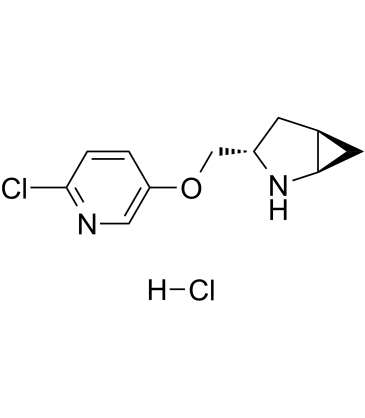
SUVN-911 is a novel, potent, selective, brain penetrated and orally bioavailable neuronal nicotinic acetylcholine α4β2 receptor antagonist, with a Ki of 1.5 nM. SUVN-911 has antidepressant activity.
Physicochemical Properties
| Molecular Formula | C11H14CL2N2O |
| Molecular Weight | 261.1477 |
| Exact Mass | 260.048 |
| CAS # | 2414674-71-6 |
| Related CAS # | Ropanicant;2414674-70-5 |
| PubChem CID | 146026958 |
| Appearance | Off-white to light yellow solid powder |
| Hydrogen Bond Donor Count | 2 |
| Hydrogen Bond Acceptor Count | 3 |
| Rotatable Bond Count | 3 |
| Heavy Atom Count | 16 |
| Complexity | 239 |
| Defined Atom Stereocenter Count | 3 |
| SMILES | ClC1C([H])=C([H])C(=C([H])N=1)OC([H])([H])[C@]1([H])C([H])([H])[C@@]2([H])C([H])([H])[C@@]2([H])N1[H].Cl[H] |
| InChi Key | VZIQKVIAFWXNFL-ANYFZDTESA-N |
| InChi Code | InChI=1S/C11H13ClN2O.ClH/c12-11-2-1-9(5-13-11)15-6-8-3-7-4-10(7)14-8;/h1-2,5,7-8,10,14H,3-4,6H2;1H/t7-,8-,10+;/m0./s1 |
| Chemical Name | (1R,3S,5R)-3-[(6-chloropyridin-3-yl)oxymethyl]-2-azabicyclo[3.1.0]hexane;hydrochloride |
| HS Tariff Code | 2934.99.9001 |
| Storage |
Powder-20°C 3 years 4°C 2 years In solvent -80°C 6 months -20°C 1 month Note: Please store this product in a sealed and protected environment, avoid exposure to moisture. |
| Shipping Condition | Room temperature (This product is stable at ambient temperature for a few days during ordinary shipping and time spent in Customs) |
Biological Activity
| Targets |
SUVN-911 targets the neuronal nicotinic acetylcholine α4β2 receptor (α4β2 nAChR), acting as a selective antagonist with a Ki value of 0.8 nM for human α4β2 nAChR [1] It exhibits >1000-fold selectivity over other nAChR subtypes (α7, α3β4, α6β2) with Ki > 1 μM, and no significant binding to muscarinic acetylcholine receptors (M1-M5) or other neurotransmitter receptors (e.g., 5-HT1A, D2) at 10 μM [1] |
| ln Vitro |
SUVN-911 is more α4β2 selective than α3β4 nAChR[1]. SUVN-911 demonstrates strong selectivity for over 70 receptors, encompassing GPCRs, ion channels, hormones, peptides, enzymes, growth factors, and prostaglandins [1]. In HEK293 cells stably expressing human α4β2 nAChR, SUVN-911 (0.1-100 nM) dose-dependently inhibited ACh-induced inward currents (patch-clamp assay) with an IC50 of 1.2 nM; it did not affect ACh-induced currents in α7 or α3β4 nAChR-expressing cells at concentrations up to 1 μM [1] - The compound (1 nM-10 μM) did not inhibit cell proliferation or induce cytotoxicity in SH-SY5Y neuroblastoma cells or primary rat cortical neurons (MTT assay) [1] - In rat brain synaptosomal preparations, SUVN-911 displaced [³H]epibatidine (α4β2 nAChR ligand) with a Ki of 0.9 nM, confirming high-affinity binding to native α4β2 nAChR [1] - It did not alter basal or ACh-induced intracellular calcium levels in α7 nAChR-expressing cells, further confirming subtype selectivity [1] |
| ln Vivo |
Cardiovascular and gastrointestinal side effects are absent from SUVN-911 [1]. Significant antidepressant effects are demonstrated by SUVN-911 (1.0–10.0 mg/kg; oral; daily; for 3 days) [1]. Rats with SUVN-911 show signs of metabolic stability [1]. In Wistar rats, SUVN-911 (3 mg/kg; oral) showed a high oral exposure, a longer half-life, and sufficient brain penetration [1]. In the mouse forced swim test (FST, depression model), oral administration of SUVN-911 (3 mg/kg, 10 mg/kg, 30 mg/kg) 1 hour before testing dose-dependently reduced immobility time by 28%, 45%, and 58%, respectively, compared to vehicle control [1] - In the rat tail suspension test (TST, depression model), oral SUVN-911 (5 mg/kg, 15 mg/kg, 45 mg/kg) significantly reduced immobility time by 32%, 48%, and 62% at 2 hours post-dosing; the effect lasted for up to 6 hours at the 45 mg/kg dose [1] - In the chronic unpredictable mild stress (CUMS) model of depression in rats, oral SUVN-911 (15 mg/kg, once daily for 21 days) reversed CUMS-induced anhedonia (increased sucrose preference from ~40% to ~75%) and reduced latency to feed in the novelty-suppressed feeding test (from ~120 s to ~55 s) [1] - The compound did not induce locomotor activity changes in mice at doses up to 30 mg/kg, ruling out behavioral stimulation as a confounding factor [1] |
| Enzyme Assay |
α4β2 nAChR binding assay: Human α4β2 nAChR-expressing HEK293 cell membranes were incubated with [³H]epibatidine (0.5 nM) and serial dilutions of SUVN-911 at 25°C for 120 minutes. Unbound ligand was removed by rapid filtration, and membrane-bound radioactivity was measured. Ki values were calculated using the Cheng-Prusoff equation [1] - nAChR functional assay (patch-clamp): HEK293 cells expressing human α4β2, α7, or α3β4 nAChR were voltage-clamped at -60 mV. SUVN-911 was pre-incubated with cells for 10 minutes, followed by application of ACh (EC80 concentration). Peak inward currents were recorded, and IC50 values for current inhibition were derived [1] |
| Cell Assay |
Cytotoxicity assay: SH-SY5Y cells or primary rat cortical neurons were seeded in 96-well plates and treated with SUVN-911 (0.1 nM-10 μM) for 24 hours. Cell viability was assessed using the MTT assay, with absorbance measured at 570 nm [1] - Calcium influx assay: α4β2 or α7 nAChR-expressing HEK293 cells were loaded with Fluo-4 AM dye. After pre-treatment with SUVN-911 for 10 minutes, cells were stimulated with ACh. Intracellular calcium levels were measured by a fluorescence plate reader, and inhibition of calcium influx was quantified [1] - Synaptosomal binding assay: Rat brain synaptosomes were prepared and incubated with [³H]epibatidine and SUVN-911 for 2 hours at 4°C. Bound ligand was separated by centrifugation, and radioactivity was counted to determine displacement efficiency [1] |
| Animal Protocol |
Animal/Disease Models: Male Wistar rat (180-230 g) [1] Doses: 1 mg/kg, 3 mg/kg, 10.0 mg/kg Route of Administration: Orally, one time/day for 3 days Experimental Results: Shown Antidepressant-like activity, no evidence of tachyphylaxis. Animal/Disease Models: Male Wistar rat (225±25g) [1] Doses: 3mg/kg (pharmacokinetic/PK/PK analysis) Route of Administration: Oral. Experimental Results: AUC=3507ngh/mL, T1/2=3.34 hrs (hrs (hours)). Mouse forced swim test (FST): Male Swiss albino mice (20-25 g) were acclimated to the test apparatus for 15 minutes 24 hours before testing. SUVN-911 was formulated in 0.5% carboxymethylcellulose sodium (CMC-Na) and administered orally at 3, 10, 30 mg/kg 1 hour before the test. Mice were placed in water-filled cylinders (25°C), and immobility time was recorded for 6 minutes [1] - Rat tail suspension test (TST): Male Wistar rats (200-220 g) were acclimated for 5 days. SUVN-911 (5, 15, 45 mg/kg, oral) was administered 2 hours before testing. Rats were suspended by the tail for 6 minutes, and immobility time was recorded [1] - Rat CUMS depression model: Male Sprague-Dawley rats (180-200 g) were subjected to CUMS (e.g., food/water deprivation, cage tilting, cold stress) for 21 days. SUVN-911 (15 mg/kg, oral) was administered once daily during the last 7 days of CUMS. Sucrose preference test and novelty-suppressed feeding test were performed to assess depressive-like behaviors [1] |
| ADME/Pharmacokinetics |
In rats, oral administration of SUVN-911 (15 mg/kg) resulted in a maximum plasma concentration (Cmax) of 2.3 μg/mL, area under the plasma concentration-time curve (AUC0-24h) of 18.7 μg·h/mL, and oral bioavailability of 72% [1] - The terminal half-life (t1/2) of the compound was 8.5 hours in rats and 10.2 hours in dogs after oral dosing [1] - Plasma protein binding of SUVN-911 was 91% in human plasma, 89% in rat plasma, and 90% in dog plasma [1] - In vitro metabolic stability studies using human liver microsomes showed a half-life of 145 minutes, with no major metabolites formed [1] - The apparent volume of distribution (Vdss) in rats was 3.2 L/kg, indicating good tissue penetration [1] |
| Toxicity/Toxicokinetics |
In a 28-day repeated oral toxicity study in rats (doses up to 100 mg/kg/day), SUVN-911 caused no significant body weight loss, mortality, or histopathological abnormalities in major organs (brain, liver, kidney, heart) [1] - No significant changes in hematological parameters (WBC, RBC, platelets) or biochemical markers of liver/kidney function (ALT, AST, creatinine, urea nitrogen) were observed [1] - The compound did not inhibit or induce major cytochrome P450 isoforms (CYP1A2, CYP2C9, CYP2C19, CYP2D6, CYP3A4) at therapeutic concentrations [1] - Acute oral toxicity (LD50) in mice was >2000 mg/kg [1] |
| References |
[1]. Discovery and Development of 3-(6-Chloropyridine-3-yloxymethyl)-2-azabicyclo[3.1.0]hexane Hydrochloride (SUVN-911): A Novel, Potent, Selective, and Orally Active Neuronal Nicotinic Acetylcholine α4β2 Receptor Antagonist for the Treatment of Depression. J Med Chem. 2020 Mar 26;63(6):2833-2853. |
| Additional Infomation |
SUVN-911 is a novel, potent, selective, and orally active α4β2 nAChR antagonist developed for the treatment of depression [1] - Its mechanism of action involves selective blocking of α4β2 nAChR, which modulates neurotransmitter release (e.g., increased serotonin and norepinephrine levels in the prefrontal cortex) and reverses depressive-like behaviors in animal models [1] - Unlike traditional antidepressants (e.g., SSRIs), SUVN-911 exhibits rapid onset of action (therapeutic effects observed within 1 hour post-dosing in FST/TST) and lacks side effects such as weight gain or sexual dysfunction [1] - Its high selectivity for α4β2 nAChR minimizes off-target effects, and favorable pharmacokinetic properties (high oral bioavailability, long half-life, good tissue penetration) support its potential as a clinical candidate for depression [1] |
Solubility Data
| Solubility (In Vitro) | DMSO : ~125 mg/mL (~478.65 mM) |
| Solubility (In Vivo) |
Note: Listed below are some common formulations that may be used to formulate products with low water solubility (e.g. < 1 mg/mL), you may test these formulations using a minute amount of products to avoid loss of samples. Injection Formulations (e.g. IP/IV/IM/SC) Injection Formulation 1: DMSO : Tween 80: Saline = 10 : 5 : 85 (i.e. 100 μL DMSO stock solution → 50 μL Tween 80 → 850 μL Saline) *Preparation of saline: Dissolve 0.9 g of sodium chloride in 100 mL ddH ₂ O to obtain a clear solution. Injection Formulation 2: DMSO : PEG300 :Tween 80 : Saline = 10 : 40 : 5 : 45 (i.e. 100 μL DMSO → 400 μLPEG300 → 50 μL Tween 80 → 450 μL Saline) Injection Formulation 3: DMSO : Corn oil = 10 : 90 (i.e. 100 μL DMSO → 900 μL Corn oil) Example: Take the Injection Formulation 3 (DMSO : Corn oil = 10 : 90) as an example, if 1 mL of 2.5 mg/mL working solution is to be prepared, you can take 100 μL 25 mg/mL DMSO stock solution and add to 900 μL corn oil, mix well to obtain a clear or suspension solution (2.5 mg/mL, ready for use in animals). Injection Formulation 4: DMSO : 20% SBE-β-CD in saline = 10 : 90 [i.e. 100 μL DMSO → 900 μL (20% SBE-β-CD in saline)] *Preparation of 20% SBE-β-CD in Saline (4°C,1 week): Dissolve 2 g SBE-β-CD in 10 mL saline to obtain a clear solution. Injection Formulation 5: 2-Hydroxypropyl-β-cyclodextrin : Saline = 50 : 50 (i.e. 500 μL 2-Hydroxypropyl-β-cyclodextrin → 500 μL Saline) Injection Formulation 6: DMSO : PEG300 : castor oil : Saline = 5 : 10 : 20 : 65 (i.e. 50 μL DMSO → 100 μLPEG300 → 200 μL castor oil → 650 μL Saline) Injection Formulation 7: Ethanol : Cremophor : Saline = 10: 10 : 80 (i.e. 100 μL Ethanol → 100 μL Cremophor → 800 μL Saline) Injection Formulation 8: Dissolve in Cremophor/Ethanol (50 : 50), then diluted by Saline Injection Formulation 9: EtOH : Corn oil = 10 : 90 (i.e. 100 μL EtOH → 900 μL Corn oil) Injection Formulation 10: EtOH : PEG300:Tween 80 : Saline = 10 : 40 : 5 : 45 (i.e. 100 μL EtOH → 400 μLPEG300 → 50 μL Tween 80 → 450 μL Saline) Oral Formulations Oral Formulation 1: Suspend in 0.5% CMC Na (carboxymethylcellulose sodium) Oral Formulation 2: Suspend in 0.5% Carboxymethyl cellulose Example: Take the Oral Formulation 1 (Suspend in 0.5% CMC Na) as an example, if 100 mL of 2.5 mg/mL working solution is to be prepared, you can first prepare 0.5% CMC Na solution by measuring 0.5 g CMC Na and dissolve it in 100 mL ddH2O to obtain a clear solution; then add 250 mg of the product to 100 mL 0.5% CMC Na solution, to make the suspension solution (2.5 mg/mL, ready for use in animals). Oral Formulation 3: Dissolved in PEG400 Oral Formulation 4: Suspend in 0.2% Carboxymethyl cellulose Oral Formulation 5: Dissolve in 0.25% Tween 80 and 0.5% Carboxymethyl cellulose Oral Formulation 6: Mixing with food powders Note: Please be aware that the above formulations are for reference only. InvivoChem strongly recommends customers to read literature methods/protocols carefully before determining which formulation you should use for in vivo studies, as different compounds have different solubility properties and have to be formulated differently. (Please use freshly prepared in vivo formulations for optimal results.) |
| Preparing Stock Solutions | 1 mg | 5 mg | 10 mg | |
| 1 mM | 3.8292 mL | 19.1461 mL | 38.2922 mL | |
| 5 mM | 0.7658 mL | 3.8292 mL | 7.6584 mL | |
| 10 mM | 0.3829 mL | 1.9146 mL | 3.8292 mL |