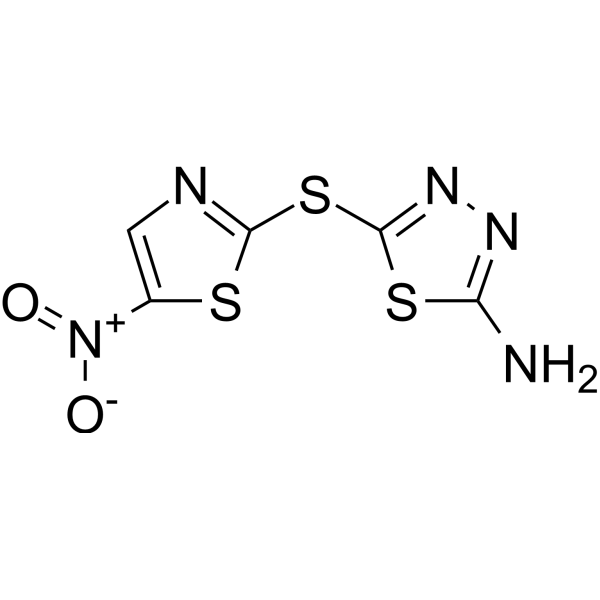
SU3327 (SU-3327; Halicin) is a novel and potent JNK inhibitor with IC50 of 0.7 μM. Also inhibits protein-protein interactions between JNK and JNK Interacting Protein (JIP) with an IC50 of 239 nM.
Physicochemical Properties
| Molecular Formula | C₅H₃N₅O₂S₃ |
| Molecular Weight | 261.30 |
| Exact Mass | 260.945 |
| CAS # | 40045-50-9 |
| PubChem CID | 11837140 |
| Appearance | Light yellow to yellow solid powder |
| Density | 1.888g/cm3 |
| Boiling Point | 549.841ºC at 760 mmHg |
| Melting Point | 160 °C(dec.) |
| Flash Point | 286.334ºC |
| Index of Refraction | 1.793 |
| LogP | 2.089 |
| Hydrogen Bond Donor Count | 1 |
| Hydrogen Bond Acceptor Count | 9 |
| Rotatable Bond Count | 2 |
| Heavy Atom Count | 15 |
| Complexity | 251 |
| Defined Atom Stereocenter Count | 0 |
| InChi Key | NQQBNZBOOHHVQP-UHFFFAOYSA-N |
| InChi Code | InChI=1S/C5H3N5O2S3/c6-3-8-9-5(14-3)15-4-7-1-2(13-4)10(11)12/h1H,(H2,6,8) |
| Chemical Name | 5-[(5-nitro-1,3-thiazol-2-yl)sulfanyl]-1,3,4-thiadiazol-2-amine |
| Synonyms | SU-3327 SU 3327 |
| HS Tariff Code | 2934.99.9001 |
| Storage |
Powder-20°C 3 years 4°C 2 years In solvent -80°C 6 months -20°C 1 month |
| Shipping Condition | Room temperature (This product is stable at ambient temperature for a few days during ordinary shipping and time spent in Customs) |
Biological Activity
| ln Vitro | In HeLa cells (EC50=6.23 μM), SU3327 (Compound 9) can prevent TNF-α-stimulated c-Jun phosphorylation[1]. Polymorphonuclear leukocyte (PMN) rolling and attachment to human brain microvascular endothelial cells (hCMEC/D3) is efficiently reduced by SU3327 (25 nM). It also inhibits AP-1 activation and drastically lowers VCAM-1 expression[3]. |
| ln Vivo | In diabetic electrode models, SU3327 (Compound 9; 25 mg/kg; intraperitoneal injection; cosmetic BKS.Cg-+Leprdb/+Leprdb/+Leprdb/OlaHsd db/db electrode) can recuperate the insulin electrodes' processing capacity [1]. |
| Animal Protocol |
Animal/Disease Models: Male BKS.Cg-+Leprdb/+Leprdb/OlaHsd db/db mice (11 weeks old) were injected with insulin [1]. ] Doses: 25 mg/kg Route of Administration: intraperitoneal (ip) injection Experimental Results: Resulted in a statistically significant reduction in blood glucose levels. |
| References |
[1]. Design, synthesis, and structure-activity relationship of substrate competitive, selective, and in vivo active triazole and thiadiazole inhibitors of the c-Jun N-terminal kinase. J Med Chem. 2009 Apr 9;52(7):1943-52. [2]. Traumatic injury elicits JNK-mediated human astrocyte retraction in vitro. Neuroscience. 2014 Aug 22;274:1-10. [3]. Pretreatment of human cerebrovascular endothelial cells with CO-releasing molecule-3 interferes with JNK/AP-1 signaling and suppresses LPS-induced proadhesive phenotype. Microcirculation. 2015 Jan;22(1):28-36. |
| Additional Infomation | Halicin is a member of the class of thiadiazoles that is 1,3,4-thiadiazol-2-amine which is substituted by a (5-nitro-1,3-thiazol-2-yl)sulfanediyl group at position 5. It is a c-Jun N-terminal kinase inhibitor (IC50 = 0.7uM) and exhibits antibacterial properties. It has a role as a c-Jun N-terminal kinase inhibitor and an antibacterial agent. It is a member of thiadiazoles, a member of 1,3-thiazoles, a primary amino compound, a C-nitro compound and an organic sulfide. |
Solubility Data
| Solubility (In Vitro) | DMSO : ~62.5 mg/mL (~239.19 mM) |
| Solubility (In Vivo) |
Solubility in Formulation 1: ≥ 2.08 mg/mL (7.96 mM) (saturation unknown) in 10% DMSO + 40% PEG300 + 5% Tween80 + 45% Saline (add these co-solvents sequentially from left to right, and one by one), clear solution. For example, if 1 mL of working solution is to be prepared, you can add 100 μL of 20.8 mg/mL clear DMSO stock solution to 400 μL PEG300 and mix evenly; then add 50 μL Tween-80 to the above solution and mix evenly; then add 450 μL normal saline to adjust the volume to 1 mL. Preparation of saline: Dissolve 0.9 g of sodium chloride in 100 mL ddH₂ O to obtain a clear solution. Solubility in Formulation 2: ≥ 2.08 mg/mL (7.96 mM) (saturation unknown) in 10% DMSO + 90% (20% SBE-β-CD in Saline) (add these co-solvents sequentially from left to right, and one by one), clear solution. For example, if 1 mL of working solution is to be prepared, you can add 100 μL of 20.8 mg/mL clear DMSO stock solution to 900 μL of 20% SBE-β-CD physiological saline solution and mix evenly. Preparation of 20% SBE-β-CD in Saline (4°C,1 week): Dissolve 2 g SBE-β-CD in 10 mL saline to obtain a clear solution. (Please use freshly prepared in vivo formulations for optimal results.) |
| Preparing Stock Solutions | 1 mg | 5 mg | 10 mg | |
| 1 mM | 3.8270 mL | 19.1351 mL | 38.2702 mL | |
| 5 mM | 0.7654 mL | 3.8270 mL | 7.6540 mL | |
| 10 mM | 0.3827 mL | 1.9135 mL | 3.8270 mL |