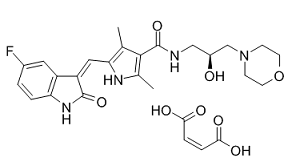
SU14813 maleate is a novel, orally bioavailable, multi-targeted tyrosine kinase inhibitor (TKI) with IC50s of 50, 2, 4, 15 nM for VEGFR2, VEGFR1, PDGFRβ and KIT, respectively. In order to exhibit optimal pharmacokinetic (PK) and tolerability profiles, SU14813 was created as a next-generation TKI agent, succeeding sunitinib (SU11248). Similar to sunitinib, SU14813 exhibited broad and strong antitumor activity, leading to tumor regression, growth arrest, growth delay, and extended survival in established xenograft cancer models in mice.
Physicochemical Properties
| Molecular Formula | C27H31FN4O8 |
| Molecular Weight | 558.55544 |
| Exact Mass | 558.213 |
| CAS # | 849643-15-8 |
| Related CAS # | SU14813;627908-92-3 |
| PubChem CID | 11353475 |
| Appearance | Yellow to orange solid |
| LogP | 1.995 |
| Hydrogen Bond Donor Count | 6 |
| Hydrogen Bond Acceptor Count | 10 |
| Rotatable Bond Count | 8 |
| Heavy Atom Count | 40 |
| Complexity | 848 |
| Defined Atom Stereocenter Count | 1 |
| SMILES | C(/C(=O)O)=C/C(=O)O.C(/C1NC(C)=C(C(=O)NC[C@H](O)CN2CCOCC2)C=1C)=C1/C(=O)NC2C=CC(=CC/1=2)F |
| InChi Key | PQPBIMIFGPFTNF-FYOMJGPWSA-N |
| InChi Code | InChI=1S/C23H27FN4O4.C4H4O4/c1-13-20(10-18-17-9-15(24)3-4-19(17)27-22(18)30)26-14(2)21(13)23(31)25-11-16(29)12-28-5-7-32-8-6-28;5-3(6)1-2-4(7)8/h3-4,9-10,16,26,29H,5-8,11-12H2,1-2H3,(H,25,31)(H,27,30);1-2H,(H,5,6)(H,7,8)/b18-10-;2-1-/t16-;/m0./s1 |
| Chemical Name | (Z)-but-2-enedioic acid;5-[(Z)-(5-fluoro-2-oxo-1H-indol-3-ylidene)methyl]-N-[(2S)-2-hydroxy-3-morpholin-4-ylpropyl]-2,4-dimethyl-1H-pyrrole-3-carboxamide |
| Synonyms | SU14813 maleate |
| HS Tariff Code | 2934.99.9001 |
| Storage |
Powder-20°C 3 years 4°C 2 years In solvent -80°C 6 months -20°C 1 month Note: Please store this product in a sealed and protected environment, avoid exposure to moisture. |
| Shipping Condition | Room temperature (This product is stable at ambient temperature for a few days during ordinary shipping and time spent in Customs) |
Biological Activity
| Targets | VEGFR2 (IC50 = 50 nM); VEGFR1 (IC50 = 2 nM); PDGFRβ (IC50 = 4 nM); KIT (IC50 = 15 nM) |
| ln Vitro | SU14813 suppresses the growth, migration, and survival of endothelial cells and/or tumor cells that express these targets both in ligand-dependent and ligand-independent ways. When it comes to transfected NIH 3T3 cells, FLT3-internal tandem duplication (FLT3-ITD; MV4;11 cells), KIT (Mo7e cells), PDGFR-β (transfected NIH 3T3 cells), and FMS/CSF1R (transfected NIH 3T3 cells), SU14813 inhibits their cellular ligand-dependent phosphorylation. In pig aorta endothelial cells overexpressing VEGFR-2, PDGFR-β, and KIT phosphorylation, SU14813 inhibits these processes with cellular IC50 values of 5.2, 9.9, and 11.2 nM, respectively. U-118MG's growth is inhibited by SU14813, with an IC50 of 50–100 nM[1]. |
| ln Vivo | SU14813 exhibits dose- and time-dependent inhibition of VEGFR-2, PDGFR-β, and FLT3 phosphorylation in xenograft tumors. An estimated 100–200 ng/mL of plasma is needed for in vivo target inhibition. When used as monotherapy, SU14813 demonstrates extensive and strong antitumor activity, causing a variety of established xenografts made from rat or human tumor cell lines to regress, grow to a stop, or grow much less. When treatment is combined with docetaxel, compared to when either drug is administered alone, both the inhibition of primary tumor growth and the survival of the tumor-bearing mice are significantly increased[1]. |
| Cell Assay | The impact of SU14813 on the survival of endothelial cells is assessed. Human umbilical vein endothelial cells in passages 4 through 5 are cultured to subconfluency in EGM2 medium with 10% FBS, endothelial cell growth supplement, and 10 μg/mL sodium heparin. Ten thousand cells per well of F12K medium containing 10% FBS are seeded in 96-well plates. After starving the cells in F12K+1% FBS for eighteen hours the following day, SU14813 is added to the cells at different concentrations. After forty-five minutes, the assay is reconstituted with 20 ng/mL of growth factor (VEGF or basic fibroblast growth factor, bFGF). The 3-(4,5-dimethylthiazol-2-yl)-2,5-diphenyltetrazolium bromide assay is used to calculate cell counts three days later[1]. |
| Animal Protocol | Mouse: In a murine LLC model resistant to docetaxel, SU14813's effectiveness and synergism with the microtubule inhibitor docetaxel are assessed. On day five following tumor implantation, SU14813 is given p.o. twice daily (BID) at doses of 10, 40, 80, or 120 mg/kg. Commencing on day 5 following tumor implantation, docetaxel 40 mg/kg (the maximum tolerated dose in mice) is injected intravenously three times a week[1]. |
| References |
[1]. SU14813: a novel multiple receptor tyrosine kinase inhibitor with potent antiangiogenic and antitumor activity. Mol Cancer Ther. 2006 Jul;5(7):1774-82. |
Solubility Data
| Solubility (In Vitro) | DMSO: ~66.7 mg/mL (~119.4 mM) |
| Solubility (In Vivo) |
Solubility in Formulation 1: ≥ 2.5 mg/mL (4.48 mM) (saturation unknown) in 10% DMSO + 40% PEG300 + 5% Tween80 + 45% Saline (add these co-solvents sequentially from left to right, and one by one), clear solution. For example, if 1 mL of working solution is to be prepared, you can add 100 μL of 25.0 mg/mL clear DMSO stock solution to 400 μL PEG300 and mix evenly; then add 50 μL Tween-80 to the above solution and mix evenly; then add 450 μL normal saline to adjust the volume to 1 mL. Preparation of saline: Dissolve 0.9 g of sodium chloride in 100 mL ddH₂ O to obtain a clear solution. Solubility in Formulation 2: ≥ 2.5 mg/mL (4.48 mM) (saturation unknown) in 10% DMSO + 90% (20% SBE-β-CD in Saline) (add these co-solvents sequentially from left to right, and one by one), clear solution. For example, if 1 mL of working solution is to be prepared, you can add 100 μL of 25.0 mg/mL clear DMSO stock solution to 900 μL of 20% SBE-β-CD physiological saline solution and mix evenly. Preparation of 20% SBE-β-CD in Saline (4°C,1 week): Dissolve 2 g SBE-β-CD in 10 mL saline to obtain a clear solution. (Please use freshly prepared in vivo formulations for optimal results.) |
| Preparing Stock Solutions | 1 mg | 5 mg | 10 mg | |
| 1 mM | 1.7903 mL | 8.9516 mL | 17.9032 mL | |
| 5 mM | 0.3581 mL | 1.7903 mL | 3.5806 mL | |
| 10 mM | 0.1790 mL | 0.8952 mL | 1.7903 mL |