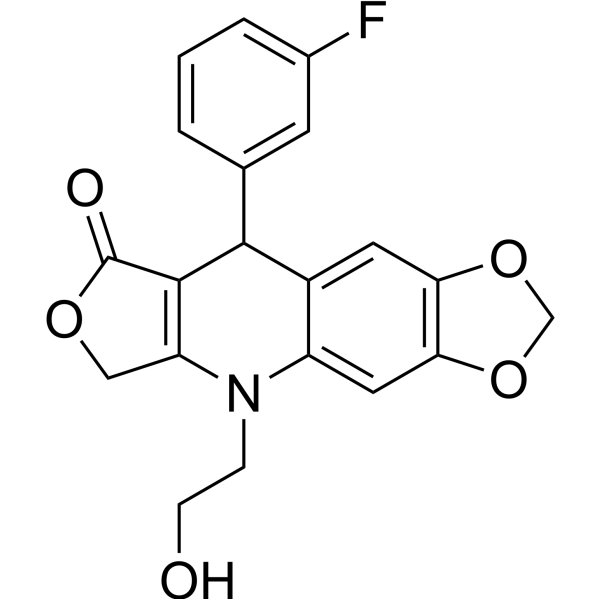
Physicochemical Properties
| Molecular Formula | C20H16FNO5 |
| Molecular Weight | 369.343149185181 |
| Exact Mass | 369.101 |
| CAS # | 2376580-08-2 |
| PubChem CID | 155351586 |
| Appearance | White to off-white solid powder |
| LogP | 2.3 |
| Hydrogen Bond Donor Count | 1 |
| Hydrogen Bond Acceptor Count | 7 |
| Rotatable Bond Count | 3 |
| Heavy Atom Count | 27 |
| Complexity | 640 |
| Defined Atom Stereocenter Count | 0 |
| SMILES | N1(CCO)C2C(=CC3OCOC=3C=2)C(C2=CC=CC(F)=C2)C2C(=O)OCC1=2 |
| InChi Key | WVJVLSHRAJOEEW-UHFFFAOYSA-N |
| InChi Code | InChI=1S/C20H16FNO5/c21-12-3-1-2-11(6-12)18-13-7-16-17(27-10-26-16)8-14(13)22(4-5-23)15-9-25-20(24)19(15)18/h1-3,6-8,18,23H,4-5,9-10H2 |
| Chemical Name | 8-(3-fluorophenyl)-2-(2-hydroxyethyl)-5,12,14-trioxa-2-azatetracyclo[7.7.0.03,7.011,15]hexadeca-1(16),3(7),9,11(15)-tetraen-6-one |
| HS Tariff Code | 2934.99.9001 |
| Storage |
Powder-20°C 3 years 4°C 2 years In solvent -80°C 6 months -20°C 1 month |
| Shipping Condition | Room temperature (This product is stable at ambient temperature for a few days during ordinary shipping and time spent in Customs) |
Biological Activity
| Targets | YB-1[1] |
| ln Vitro | SU056 (between 0 and 10 μM, for 48 hours) stops OVCAR3/4/5/8, SKOV3, and ID8 cells from growing [1]. OVCAR-8 and ID8 cell colony formation is dose-dependently inhibited by SU056 (1 μM, 5-8 days) [1]. OVCAR8, SKOV3, and ID8 cells are arrested in sub-G1 and G1 phases by SU056 (1–5 μM, 6 hours) [1]. OVCAR8, SKOV3, and ID8 cell migration is inhibited by SU056 (0-1 μM, 12 hours) [1]. OVCAR8, SKOV3, and ID8 cells undergo apoptosis in response to SU056 (0–5 μM, 24 h) [1]. In OVCAR8 cells, SU056 (1–5 μM, 12 h) suppresses the production of PMSB2, SUMO2, YB-1, and TMSB10 proteins [1]. Paclitaxel (HY-B0015) (0.1, 0.5, and 1 nM) had its cytotoxic effects enhanced by SU056 (0.1, 0.5, and 1 μM, 48 hours)[1]. |
| ln Vivo | In mice implanted with ID8 cells, SU056 (20 mg/kg, i.p.) reduces the formation of tumors [1]. In immunodeficient mice implanted with ovarian cancer cells (OVCAR8), SU056 (10 mg/kg, intraperitoneal injection, daily) in combination with Paclitaxel (Paclitaxel.html" target="_blank" xstyle="color: #6a4b92; font-weight:bold;">HY-B0015) (5 mg/kg, intraperitoneal injection, weekly) inhibits tumor growth, and the effect is more evident than administration alone [1]. |
| Cell Assay |
Cell Viability Assay[1] Cell Types: OVCAR3/4/5/8, SKOV3 and ID8 cells Tested Concentrations: 0-10 μM approximately Incubation Duration: 48 h Experimental Results: Inhibited cell growth with IC50 values of 1.27, 6.8, 4.33, 3.18, 1.73, 3.75 μM. Cell Migration Assay [1] Cell Types: OVCAR8, SKOV3, and ID8 cells Tested Concentrations: 0, 0.5, 1 μM Incubation Duration: 12 h Experimental Results: Dose-dependently inhibited cell migration. Western Blot Analysis[1] Cell Types: OVCAR8 cell Tested Concentrations: 1-5 μM Incubation Duration: 12 h Experimental Results: Dose- dependently inhibited the YB-1, TMSB10, SUMO2, and PMSB2 proteins. |
| Animal Protocol |
Animal/Disease Models: C57BL/6 mice implanted (sc) with luciferase-expressing ID8 cells[1] Doses: 20 mg/kg Route of Administration: intraperitoneal (ip)injection Experimental Results: diminished the tumor weight by 2-fold, and is well-tolerated. diminished the lung metastases. Inhibited YB-1 expression and downstream MDR1 (IHC assay of tumor sample). |
| References |
[1]. Y box binding protein 1 inhibition as a targeted therapy for ovarian cancer. Cell Chem Biol. 2021 Aug 19;28(8):1206-1220.e6. |
Solubility Data
| Solubility (In Vitro) | DMSO : 50 mg/mL (135.38 mM) |
| Solubility (In Vivo) |
Solubility in Formulation 1: 2.5 mg/mL (6.77 mM) in 10% DMSO + 40% PEG300 + 5% Tween80 + 45% Saline (add these co-solvents sequentially from left to right, and one by one), suspension solution; with sonication. For example, if 1 mL of working solution is to be prepared, you can add 100 μL of 25.0 mg/mL clear DMSO stock solution to 400 μL PEG300 and mix evenly; then add 50 μL Tween-80 to the above solution and mix evenly; then add 450 μL normal saline to adjust the volume to 1 mL. Preparation of saline: Dissolve 0.9 g of sodium chloride in 100 mL ddH₂ O to obtain a clear solution. Solubility in Formulation 2: ≥ 2.5 mg/mL (6.77 mM) (saturation unknown) in 10% DMSO + 90% (20% SBE-β-CD in Saline) (add these co-solvents sequentially from left to right, and one by one), clear solution. For example, if 1 mL of working solution is to be prepared, you can add 100 μL of 25.0 mg/mL clear DMSO stock solution to 900 μL of 20% SBE-β-CD physiological saline solution and mix evenly. Preparation of 20% SBE-β-CD in Saline (4°C,1 week): Dissolve 2 g SBE-β-CD in 10 mL saline to obtain a clear solution. Solubility in Formulation 3: 5 mg/mL (13.54 mM) in 50% PEG300 50% Saline (add these co-solvents sequentially from left to right, and one by one), suspension solution; with ultrasonication. Preparation of saline: Dissolve 0.9 g of sodium chloride in 100 mL ddH₂ O to obtain a clear solution. (Please use freshly prepared in vivo formulations for optimal results.) |
| Preparing Stock Solutions | 1 mg | 5 mg | 10 mg | |
| 1 mM | 2.7075 mL | 13.5377 mL | 27.0753 mL | |
| 5 mM | 0.5415 mL | 2.7075 mL | 5.4151 mL | |
| 10 mM | 0.2708 mL | 1.3538 mL | 2.7075 mL |