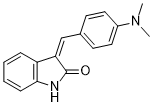
SU-4312, formerly known as DMBI, is a potent and selective inhibitor of VEGFR and PDGFR tyrosine kinases (IC50 are 0.8 and 19.4 μM respectively). SU4312 selectively and directly inhibits neuronal NOS, providing an unexpected defense against MPP(+)-induced neurotoxicity.
Physicochemical Properties
| Molecular Formula | C17H16N2O |
| Molecular Weight | 264.328 |
| Exact Mass | 264.126 |
| Elemental Analysis | C, 77.25; H, 6.10; N, 10.60; O, 6.05 |
| CAS # | 5812-07-7 |
| Related CAS # | 5812-07-7 |
| PubChem CID | 6450842 |
| Appearance | Yellow solid powder |
| Density | 1.219g/cm3 |
| Boiling Point | 497.1ºC at 760 mmHg |
| Flash Point | 254.5ºC |
| Index of Refraction | 1.683 |
| LogP | 3.383 |
| Hydrogen Bond Donor Count | 1 |
| Hydrogen Bond Acceptor Count | 2 |
| Rotatable Bond Count | 2 |
| Heavy Atom Count | 20 |
| Complexity | 394 |
| Defined Atom Stereocenter Count | 0 |
| SMILES | CN(C)C1=CC=C(C=C1)C=C2C3=CC=CC=C3NC2=O |
| InChi Key | UAKWLVYMKBWHMX-PTNGSMBKSA-N |
| InChi Code | InChI=1S/C17H16N2O/c1-19(2)13-9-7-12(8-10-13)11-15-14-5-3-4-6-16(14)18-17(15)20/h3-11H,1-2H3,(H,18,20)/b15-11- |
| Chemical Name | (3Z)-3-[[4-(dimethylamino)phenyl]methylidene]-1H-indol-2-one |
| Synonyms | NSC 86429; NSC-86429; NSC86429; SU4312; DMBI; SU-4312; SU 4312 |
| HS Tariff Code | 2934.99.9001 |
| Storage |
Powder-20°C 3 years 4°C 2 years In solvent -80°C 6 months -20°C 1 month Note: This product is not stable in solution, please use freshly prepared working solution for optimal results. |
| Shipping Condition | Room temperature (This product is stable at ambient temperature for a few days during ordinary shipping and time spent in Customs) |
Biological Activity
| Targets | PDGFR; Flk-1 |
| ln Vitro | It has been demonstrated that receptor tyrosine kinases (RTKs) are crucial mediators of cellular signal transduction in cells. It has been demonstrated that numerous RTKs are oncogene products, indicating their involvement in the transformation process linked to malignancies in humans[1]. |
| References |
[1]. Synthesis and biological evaluations of 3-substituted indolin-2-ones: a novel class of tyrosine kinase inhibitors that exhibit selectivity toward particular receptor tyrosine kinases. J Med Chem. 1998 Jul 2;41(14):2588-603. |
| Additional Infomation | See also: 3-(4-Dimethylamino-benzylidenyl)-2-indolinone (annotation moved to). |
Solubility Data
| Solubility (In Vitro) | DMSO: ~50 mg/mL (~189.2 mM) |
| Solubility (In Vivo) |
Solubility in Formulation 1: 2.08 mg/mL (7.87 mM) in 10% DMSO + 40% PEG300 +5% Tween-80 + 45% Saline (add these co-solvents sequentially from left to right, and one by one), suspension solution; with sonication. For example, if 1 mL of working solution is to be prepared, you can add 100 μL of 20.8 mg/mL clear DMSO stock solution to 400 μL PEG300 and mix evenly; then add 50 μL Tween-80 + to the above solution and mix evenly; then add 450 μL normal saline to adjust the volume to 1 mL. Preparation of saline: Dissolve 0.9 g of sodium chloride in 100 mL ddH₂ O to obtain a clear solution. (Please use freshly prepared in vivo formulations for optimal results.) |
| Preparing Stock Solutions | 1 mg | 5 mg | 10 mg | |
| 1 mM | 3.7831 mL | 18.9157 mL | 37.8315 mL | |
| 5 mM | 0.7566 mL | 3.7831 mL | 7.5663 mL | |
| 10 mM | 0.3783 mL | 1.8916 mL | 3.7831 mL |